




























Views
Downloads

Essential Consonant Blends Practice | Preschool ELA Ready

Paste this activity's link or code into your existing LMS (Google Classroom, Canvas, Teams, Schoology, Moodle, etc.).
Students can open and work on the activity right away, with no student login required.
You'll still be able to track student progress and results from your teacher account.
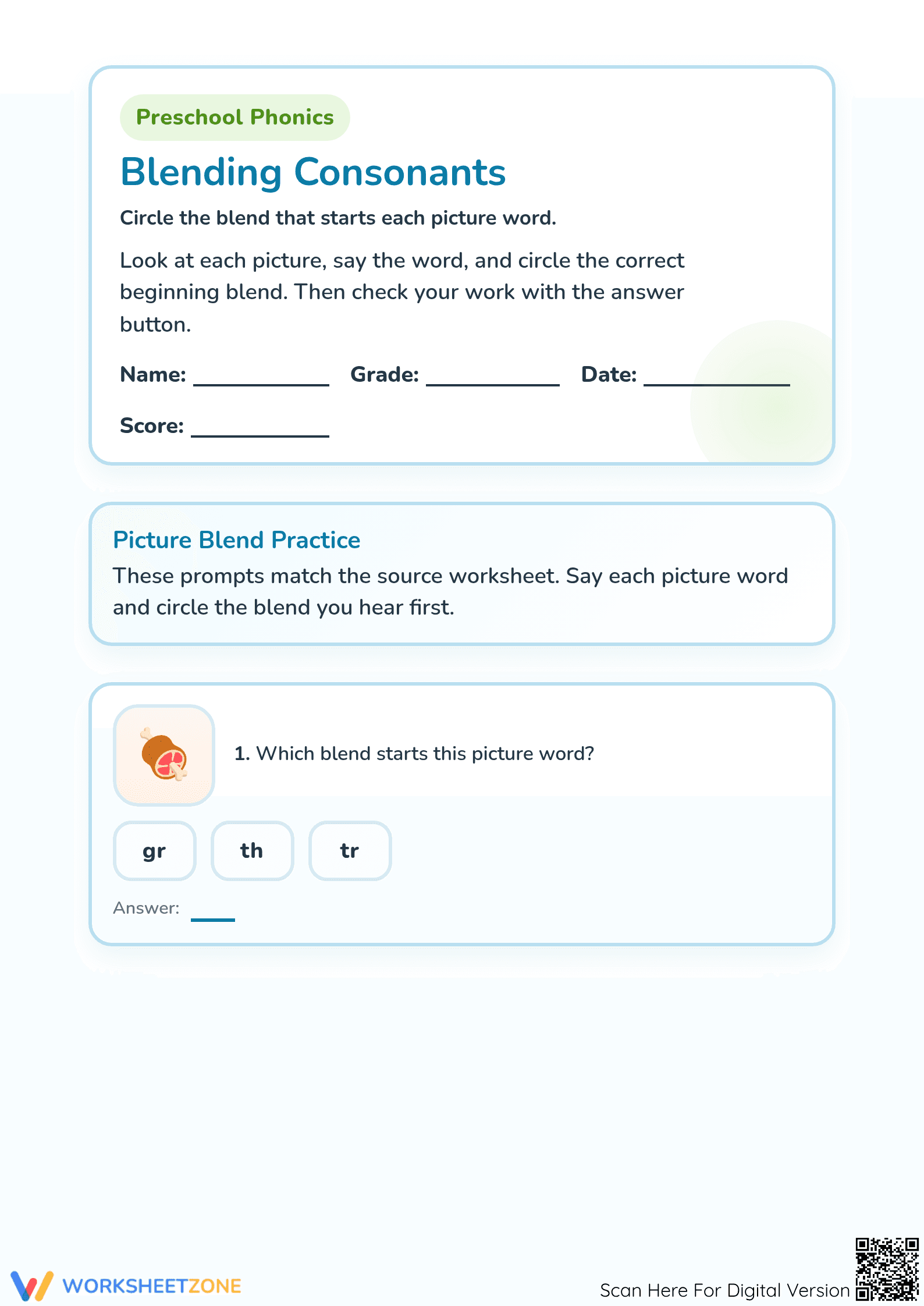
Master the foundations of phonemic awareness with this focused beginning consonant blends worksheet designed specifically for preschool learners. This resource helps students identify and isolate distinct consonant sounds at the start of familiar words, building the essential decoding skills needed for early reading success and confident oral language development.
At a Glance
- Grade: Preschool · Subject: English Language Arts
- Standard:
CCSS.ELA-LITERACY.RF.K.2— Demonstrate understanding of spoken words, syllables, and sounds (phonemes)- Skill Focus: Beginning Consonant Blends Recognition
- Format: 3 pages · 6 problems · Answer key included · PDF
- Best For: Early phonics practice and phonemic awareness
- Time: 10–15 minutes
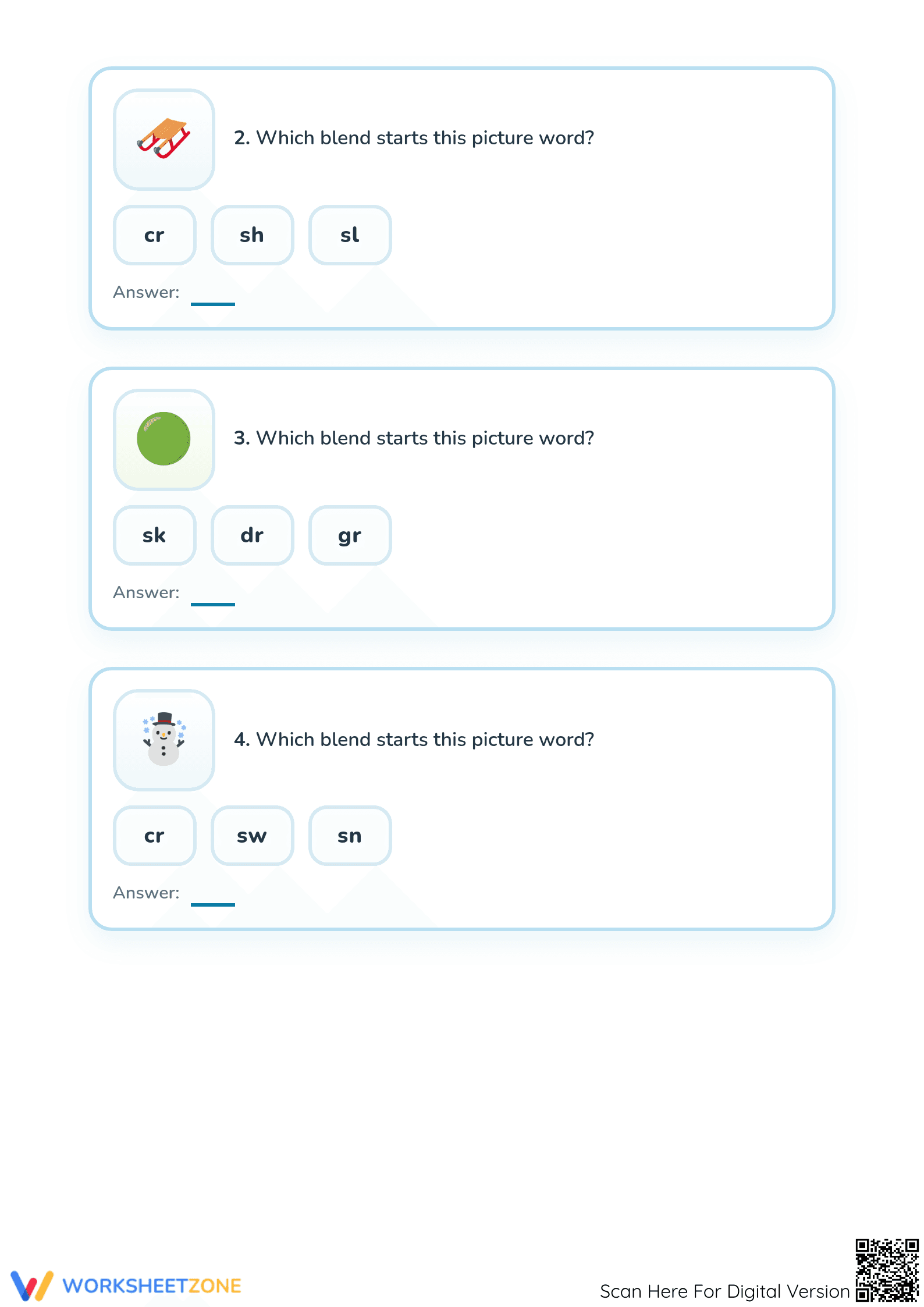
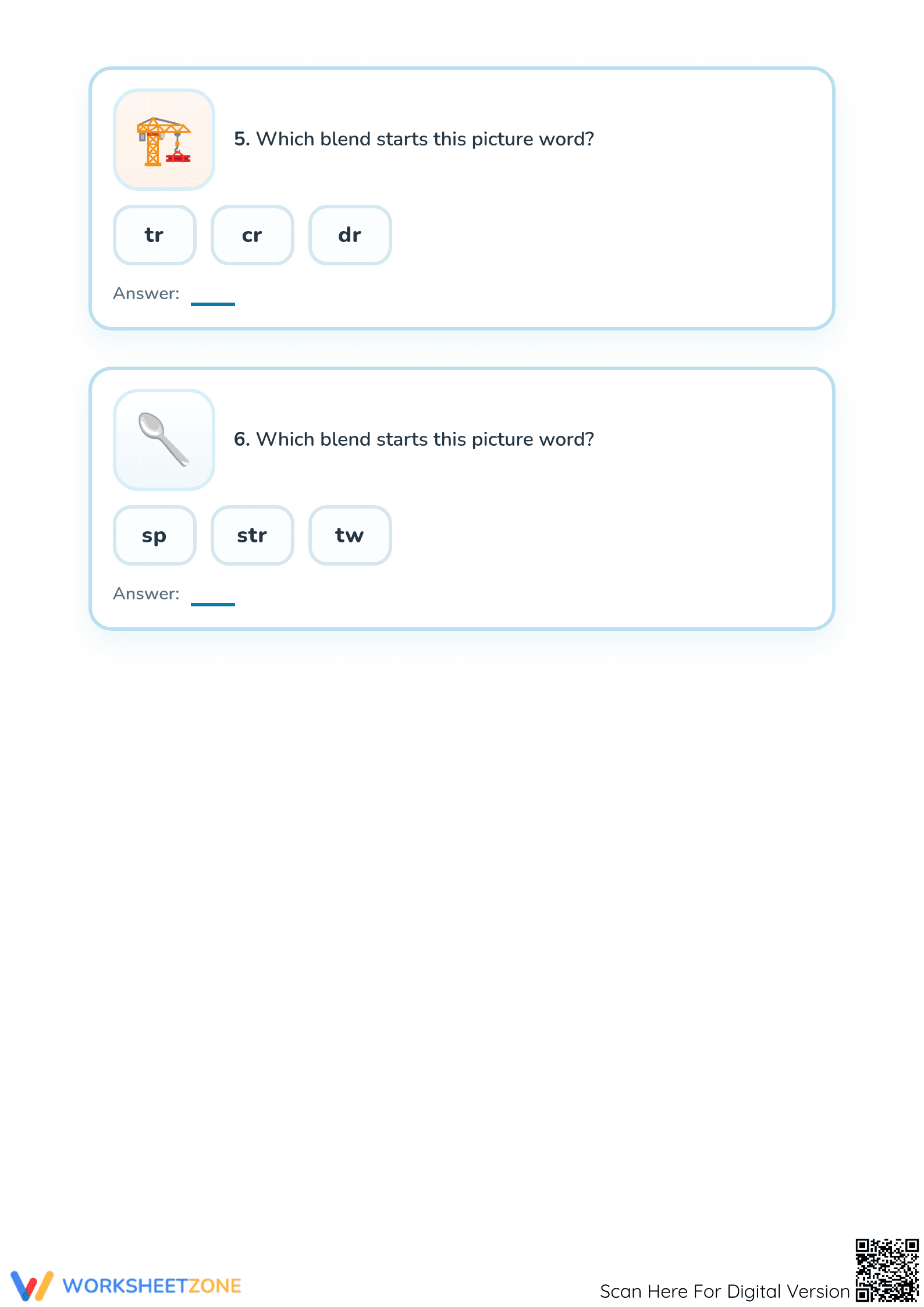
This comprehensive three-page PDF features six distinct picture-based tasks. Each item presents a high-quality illustration representing a common word starting with a consonant blend, such as a sled or a spoon. Students are prompted to look at the picture, say the word aloud, and circle the corresponding blend from three possible choices. A full answer key is included for quick self-correction or teacher review.
Zero-Prep Workflow
This resource is designed for immediate classroom implementation with zero teacher preparation. Step 1: Print the three pages and the answer key in under thirty seconds. Step 2: Distribute the worksheets to your students during centers or small group time. Step 3: Review the completed work using the provided answer button cues. The total setup time is less than two minutes, making it an ideal choice for busy mornings or emergency sub plans.
Standards Alignment
The primary focus is CCSS.ELA-LITERACY.RF.K.2, which requires students to demonstrate an understanding of spoken words and phonemes. By isolating the beginning blend, students engage in the specific task of blending and segmenting syllables in spoken words. This standard code can be copied directly into lesson plans, IEP goals, or district curriculum mapping tools to ensure instructional compliance.
How to Use It
Use this worksheet as a "Quick Check" after a direct instruction lesson on common blends like 'sl', 'sn', or 'sp'. Teachers can observe students as they say the words to identify any pronunciation errors or confusion between similar-sounding blends. It also serves as an excellent quiet activity for students who finish early or as part of a literacy rotation focused on phonemic sounds.
Who It's For
This resource is tailored for preschool and early kindergarten students who are just beginning to explore word structures. It provides visual scaffolding for learners who benefit from concrete imagery. It pairs naturally with a set of alphabet blocks or a "word wall" focused on beginning sounds to reinforce the auditory-visual connection required for reading.
Early childhood literacy research consistently emphasizes the critical role of phonemic awareness in long-term reading proficiency. According to the RAND AIRS 2024 report on foundational skills, early exposure to consonant blending significantly reduces later reading difficulties by establishing a strong phonological core. This Preschool ELA worksheet directly supports CCSS.ELA-LITERACY.RF.K.2 by requiring students to recognize and isolate beginning consonant blends through a combination of visual cues and oral production. By engaging with these six structured tasks, students build the necessary cognitive bridges between spoken sounds and written symbols. This systematic approach to phonics instruction ensures that young learners develop the accuracy and speed required for the eventual decoding of more complex multisyllabic words. This resource provides a reliable, data-informed tool for educators to track student progress in one of the most vital early literacy milestones, ensuring that no child falls behind in the development of basic reading mechanics.


