


























Views
Downloads


Beginning Blends Printable Worksheet | Grade 2 ELA
Paste this activity's link or code into your existing LMS (Google Classroom, Canvas, Teams, Schoology, Moodle, etc.).
Students can open and work on the activity right away, with no student login required.
You'll still be able to track student progress and results from your teacher account.
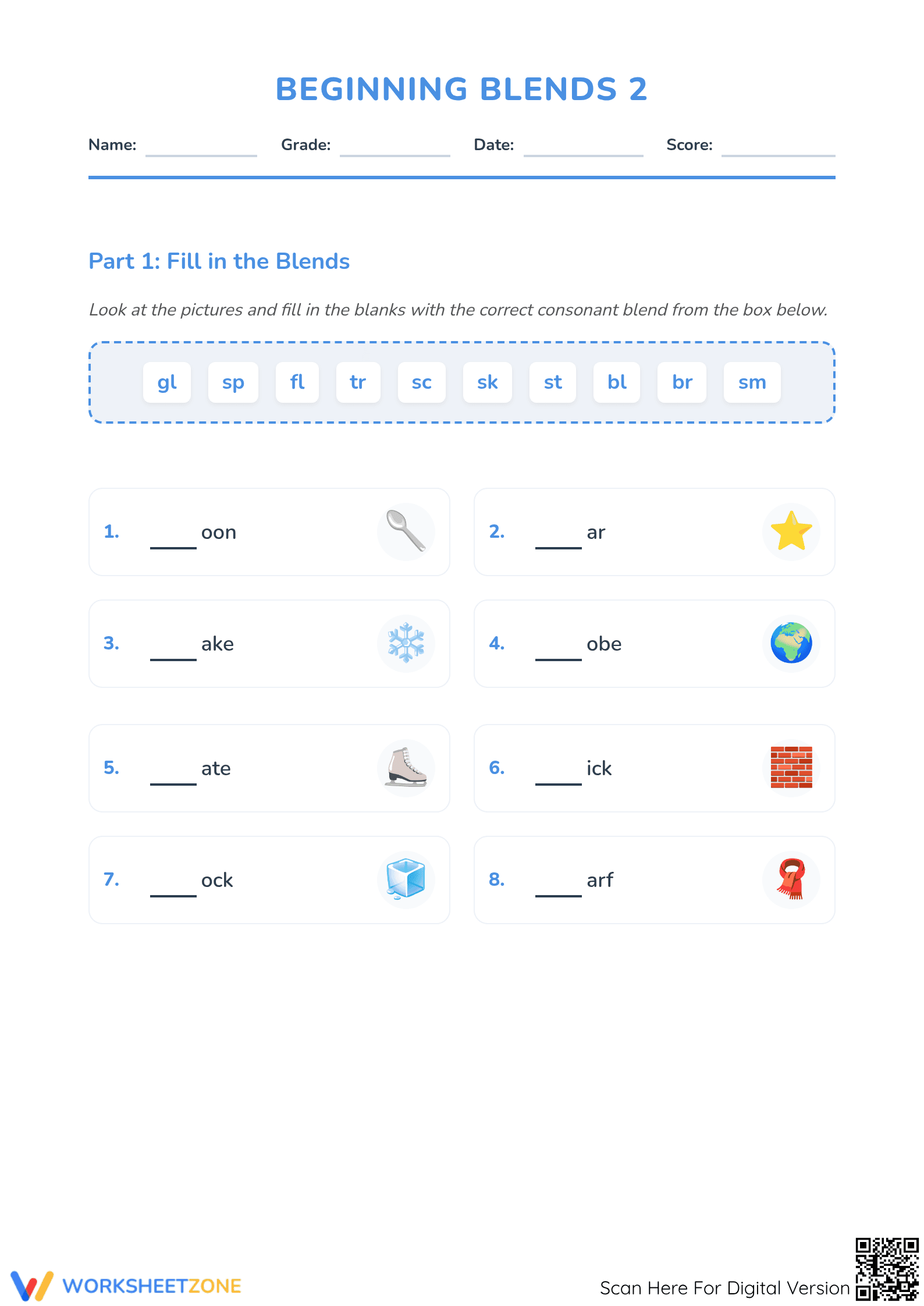
This beginning blends worksheet provides targeted practice for early readers mastering consonant clusters. By connecting visual cues to spelling patterns, students build essential decoding and vocabulary skills. The structured activities guide learners from simple letter-sound recognition to applying these phonics concepts in complete sentences.
At a Glance
- Grade: 2 · Subject: ELA
- Standard:
CCSS.ELA-LITERACY.RF.2.3— Know and apply grade-level phonics and word analysis skills.- Skill Focus: Consonant Blends
- Format: 3 pages · 17 problems · Answer key included · PDF
- Best For: Independent practice and literacy centers
- Time: 15–20 minutes
This three-page resource features a clear, student-friendly layout designed to reinforce phonics mastery. The first section includes 13 picture-supported fill-in-the-blank problems where students select the correct consonant blend from a provided word bank. The second section challenges learners to write three original sentences using the newly formed words. Finally, a bonus challenge encourages higher-order thinking by asking students to brainstorm an additional word using a specific blend. A complete answer key is provided for quick grading.
- Guided practice: Students begin by matching 13 visual prompts to the correct beginning blend using a supportive word bank.
- Supported practice: Learners transition to writing three complete sentences, applying their decoded words in context.
- Independent practice: A bonus challenge requires students to independently generate a new word starting with the "tr" blend without visual aids.
This gradual-release approach ensures students build confidence before moving to more complex application tasks.
This activity is aligned to CCSS.ELA-LITERACY.RF.2.3, requiring students to know and apply grade-level phonics and word analysis skills in decoding words. It also supports foundational writing standards by asking students to construct complete sentences. Both standard codes can be copied directly into lesson plans, IEP goals, or district curriculum mapping tools.
Deploy this worksheet during morning work or as a focused literacy center activity after direct instruction on consonant blends. It serves as an excellent independent practice tool while the teacher conducts small group reading sessions. As a formative assessment tip, observe which blends students struggle to identify; confusion between "sl" and "sm" or "tr" and "dr" can indicate a need for targeted phonemic awareness review. Students typically complete the entire activity in 15 to 20 minutes.
This resource is ideal for second-grade students developing their reading fluency and spelling accuracy. It also serves as an effective intervention tool for third graders needing additional phonics support. For differentiated instruction, pair this worksheet with a visual anchor chart displaying common consonant blends or a decodable reading passage that features the targeted spelling patterns.
Mastering consonant blends is a critical milestone in early literacy development. According to a 2024 report by EdReports, explicit and systematic phonics instruction significantly improves students' ability to decode unfamiliar words, directly impacting reading comprehension and overall academic success. This worksheet aligns with CCSS.ELA-LITERACY.RF.2.3, ensuring students know and apply grade-level phonics and word analysis skills. By requiring learners to transition from isolated word completion to sentence generation, the activity reinforces the cognitive links between spelling, reading, and writing. Research consistently demonstrates that integrating writing tasks into phonics practice solidifies letter-sound correspondences more effectively than isolated drills alone. Educators can utilize this evidence-based resource to provide meaningful, standards-aligned practice that bridges the gap between foundational decoding and fluent reading, supporting long-term literacy goals.


