




























Views
Downloads

Preschool Consonant Blends — Printable No-Prep Worksheet

Paste this activity's link or code into your existing LMS (Google Classroom, Canvas, Teams, Schoology, Moodle, etc.).
Students can open and work on the activity right away, with no student login required.
You'll still be able to track student progress and results from your teacher account.
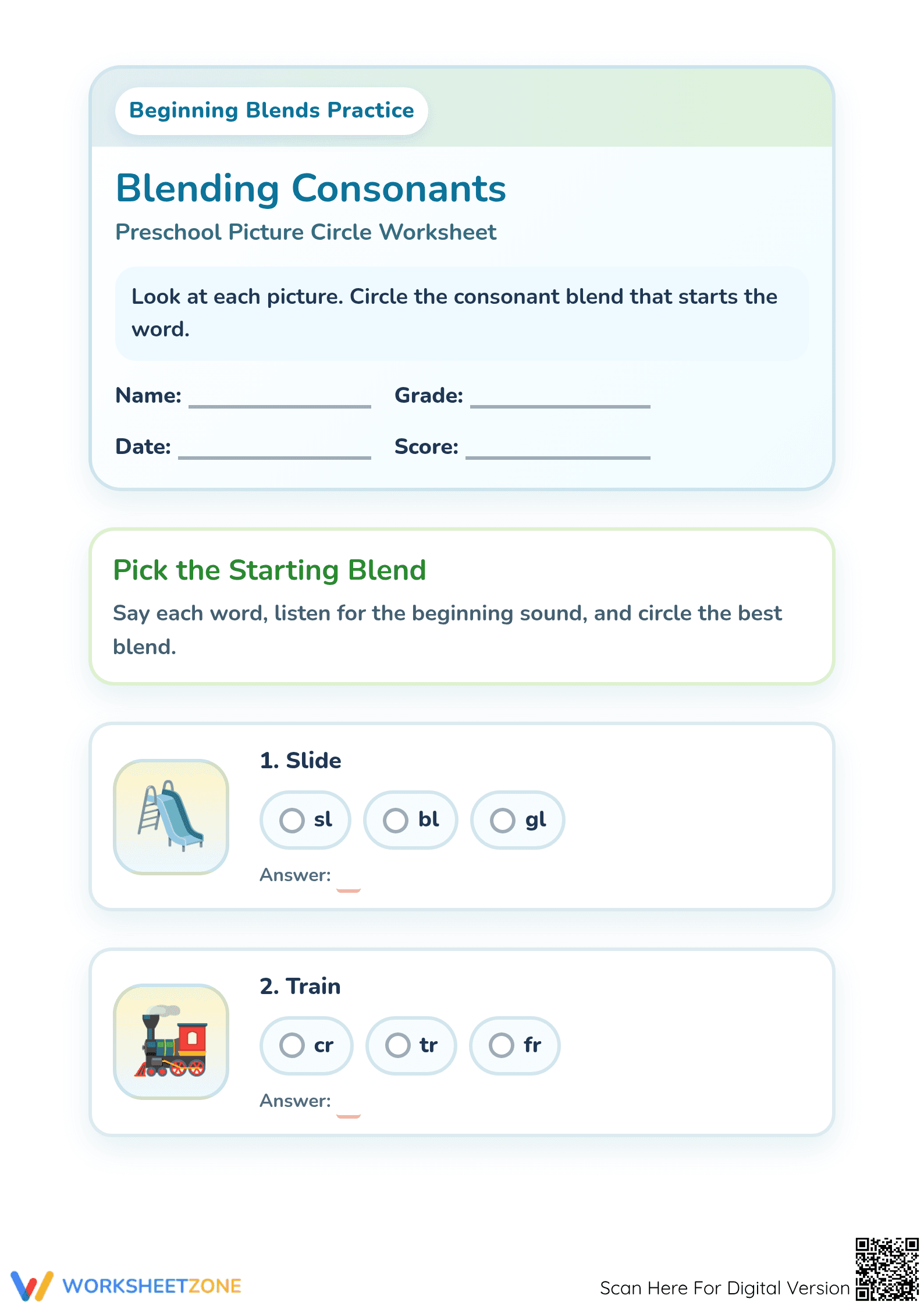
This Preschool consonant blends worksheet provides essential phonics practice by challenging students to identify the correct starting sounds for familiar objects. By connecting visual images to phonetic blends, learners strengthen their phonological awareness and early reading skills through a simple, interactive circling task that ensures immediate engagement and cognitive development in young readers.
At a Glance
- Grade: Preschool · Subject: ELA
- Standard:
CCSS.ELA-LITERACY.RF.PK.3.A— Produce the primary sound for each consonant and common beginning blends- Skill Focus: Beginning consonant blends (sl, tr, pl, fr, str, cr)
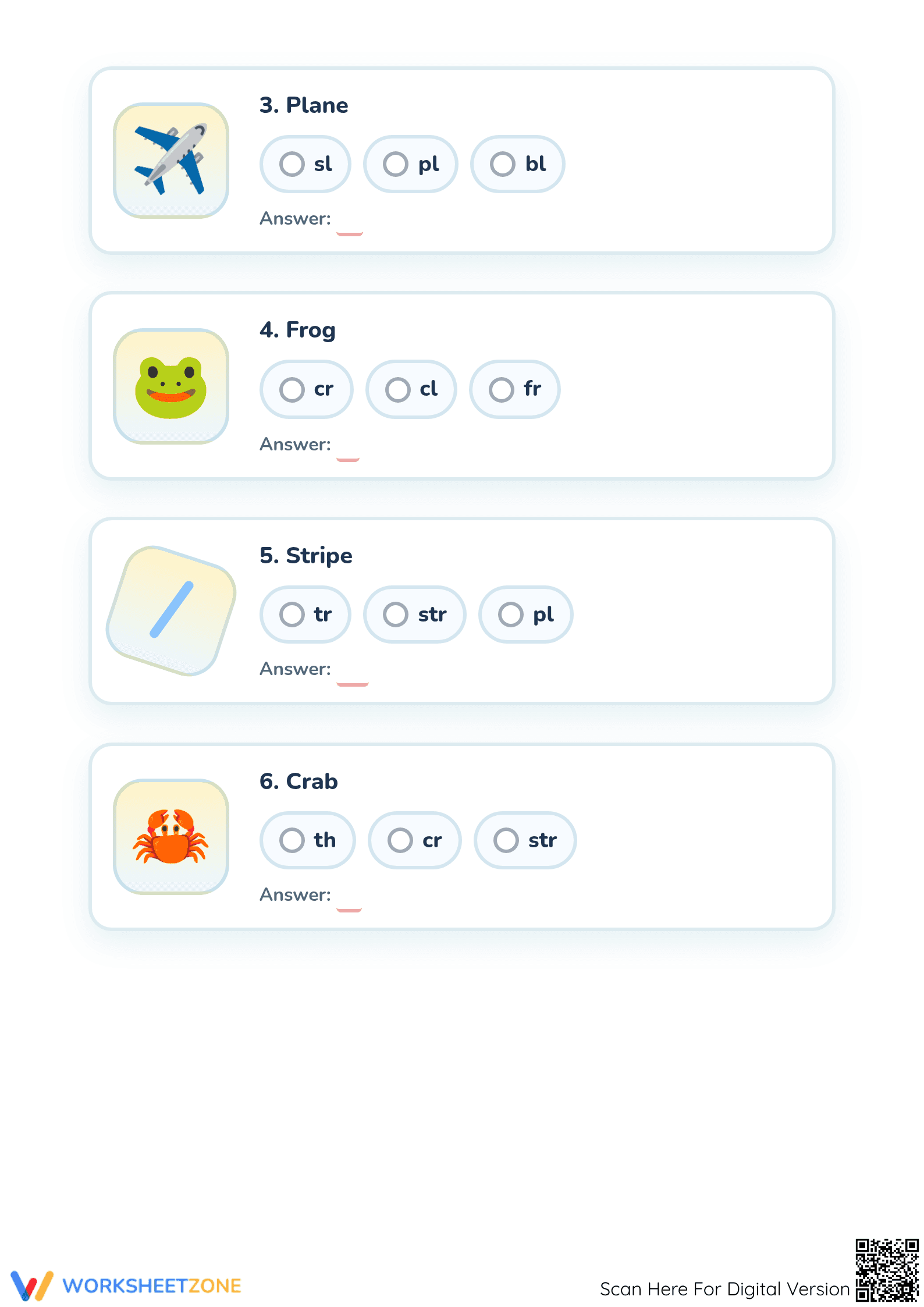
- Format: 2 pages · 6 problems · Answer key included · PDF
- Best For: Preschool phonics stations or independent practice
- Time: 10–15 minutes
What's Inside
This high-quality PDF resource contains two pages of focused phonics activities. Students encounter six distinct vocabulary words—Slide, Train, Plane, Frog, Stripe, and Crab—each accompanied by a vibrant illustration. For every item, three potential consonant blends are provided as multiple-choice options. A full answer key is included to facilitate quick grading or self-correction, and the layout features clear labels for student names, dates, and scores.
Zero-Prep Workflow
Teachers can implement this resource in under two minutes. First, print the two-page document (30 seconds). Second, distribute the sheets and explain the "Say, Listen, Circle" instructions (60 seconds). Finally, review the completed work using the provided answer key (30 seconds). This streamlined workflow makes it an ideal choice for emergency sub plans or transition periods between lessons.
Standards Alignment
The primary standard addressed is CCSS.ELA-LITERACY.RF.PK.3.A, which requires students to demonstrate basic knowledge of letter-sound correspondences by producing the primary sound for consonants. This worksheet extends that skill into common blends, bridging the gap between single-letter sounds and complex phonetic structures. Both standard codes can be copied directly into lesson plans, IEP goals, or district curriculum mapping tools.
How to Use It
This resource is best utilized during the "You Do" phase of a lesson. Another effective use case is as a formative assessment at a literacy center; teachers can observe if students are correctly subvocalizing the words before choosing a blend. Expect preschool learners to complete the six tasks in approximately twelve minutes, making it a perfect fit for a small group rotation or morning work session.
Who It's For
This worksheet is designed for preschool students beginning their journey into phonics, though it serves as an excellent intervention tool for kindergarteners needing remedial support. The large, clear images provide strong scaffolding for English Language Learners (ELLs). It pairs naturally with a beginning sounds anchor chart or a "blend of the day" direct instruction lesson to reinforce auditory discrimination.
Research indicates that early mastery of consonant blends is a critical predictor of later reading fluency and decoding accuracy. This resource aligns with CCSS.ELA-LITERACY.RF.PK.3.A by providing structured practice in identifying phonetic clusters at the onset of words, a task that requires sophisticated phonological processing. According to the ScienceDirect TpT Analysis, high-utility printable phonics worksheets with clear visual scaffolds significantly reduce cognitive load for preschool learners, allowing them to focus entirely on the auditory-to-graphemic mapping process. By incorporating six distinct tasks that move from simple two-letter blends like "sl" to more complex three-letter clusters like "str" in "stripe," this worksheet ensures a rigorous yet accessible introduction to phonetic structures. The inclusion of an answer key and standardized tracking fields makes this a professional-grade tool for any educational setting seeking to improve literacy outcomes through evidence-based practice.


