


























Views
Downloads
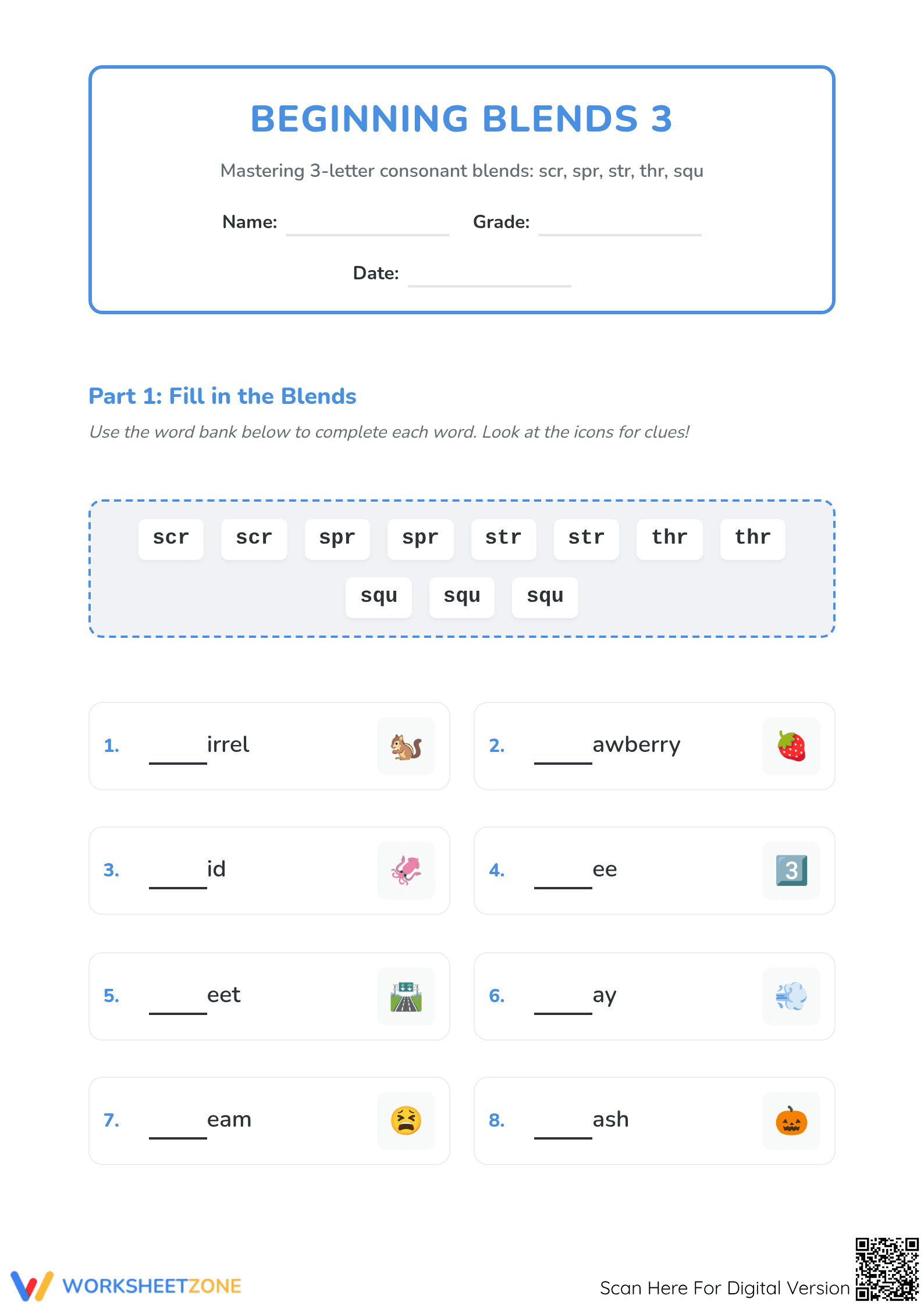


3-Letter Consonant Blends Worksheet | Grade 3 Essential
Paste this activity's link or code into your existing LMS (Google Classroom, Canvas, Teams, Schoology, Moodle, etc.).
Students can open and work on the activity right away, with no student login required.
You'll still be able to track student progress and results from your teacher account.
This Grade 3 phonics worksheet provides targeted practice with complex 3-letter consonant blends. Students identify, write, and apply blends like "str" and "squ" to build decoding fluency and spelling accuracy. By connecting visual icons to phonetic patterns, learners bridge the gap between letter recognition and reading comprehension.
At a Glance
- Grade: 3 · Subject: ELA
- Standard:
CCSS.ELA-LITERACY.RF.3.3— Know and apply grade-level phonics and word analysis skills in decoding words- Skill Focus: 3-Letter Consonant Blends
- Format: 3 pages · 20 problems · Answer key included · PDF
- Best For: Phonics centers and independent literacy practice
- Time: 15–25 minutes
The 3-page PDF features a structured word bank and 20 distinct tasks. It includes 11 icon-supported identification problems, 5 context-based sentence completion exercises, and 4 multiple-choice "Blend Challenge" questions. A comprehensive answer key is provided for quick grading or student self-correction.
Skill Progression
- Guided Practice: 11 problems using a word bank and visual icons to scaffold the identification of initial 3-letter blends.
- Supported Practice: 5 sentence-level tasks where students apply vocabulary in context to demonstrate semantic understanding.
- Independent Practice: 4 challenge questions requiring students to discriminate between similar-sounding blends without visual aids.
This sequence follows a gradual-release model, moving from high-support visual cues to independent phonetic discrimination.
Standards Alignment
This resource aligns with `CCSS.ELA-LITERACY.RF.3.3`, focusing on the application of grade-level phonics and word analysis skills. It specifically targets the decoding of multi-syllabic words and complex consonant clusters. Both standard codes can be copied directly into lesson plans, IEP goals, or district curriculum mapping tools.
How to Use It
Use this worksheet during the "You Do" phase of a phonics lesson after introducing 3-letter clusters. It serves as an excellent formative assessment tool; observe if students struggle more with the "squ" or "thr" sounds to inform small-group intervention. Expected completion time ranges from 15 to 25 minutes.
Who It's For
Designed for Grade 3 students, this is also suitable for Grade 4 learners requiring RTI support or English Language Learners (ELL) building foundational vocabulary. Pair this with a 3-letter blend anchor chart or a decodable reader focusing on "str" and "spr" words.
According to the RAND AIRS 2024 report on foundational literacy, explicit instruction in phonemic awareness and complex consonant blends is a critical predictor of later reading fluency. This worksheet addresses CCSS.ELA-LITERACY.RF.3.3 by providing 20 structured opportunities for students to decode and encode 3-letter blends including scr, spr, str, thr, and squ. Research by Fisher & Frey (2014) emphasizes that the gradual release of responsibility—moving from icon-supported identification to contextual sentence application—enhances long-term retention of phonetic patterns. By integrating visual scaffolding with high-frequency vocabulary, this resource ensures that Grade 3 and 4 learners develop the word analysis skills necessary for mastering complex texts. This evidence-based approach supports diverse learners in achieving phonetic mastery through repetitive, meaningful practice.


