


























Views
Downloads

Printable Beginning Blends Practice | Preschool ELA
Paste this activity's link or code into your existing LMS (Google Classroom, Canvas, Teams, Schoology, Moodle, etc.).
Students can open and work on the activity right away, with no student login required.
You'll still be able to track student progress and results from your teacher account.
Strengthen early literacy skills with this focused beginning blends practice worksheet. Students will develop phonological awareness by isolating the initial sounds of common objects and matching them to the correct consonant blend. This activity provides a clear, visual path for preschoolers to master the foundational mechanics of phonetic decoding and pronunciation.
At a Glance
- Grade: Preschool · Subject: English Language Arts (ELA)
- Standard:
CCSS.ELA-LITERACY.RF.K.3— Know and apply grade-level phonics and word analysis skills in decoding words- Skill Focus: Beginning consonant blend identification
- Format: 2 pages · 6 problems · Answer key included · PDF
- Best For: Early morning work and phonics centers
- Time: 10–15 minutes
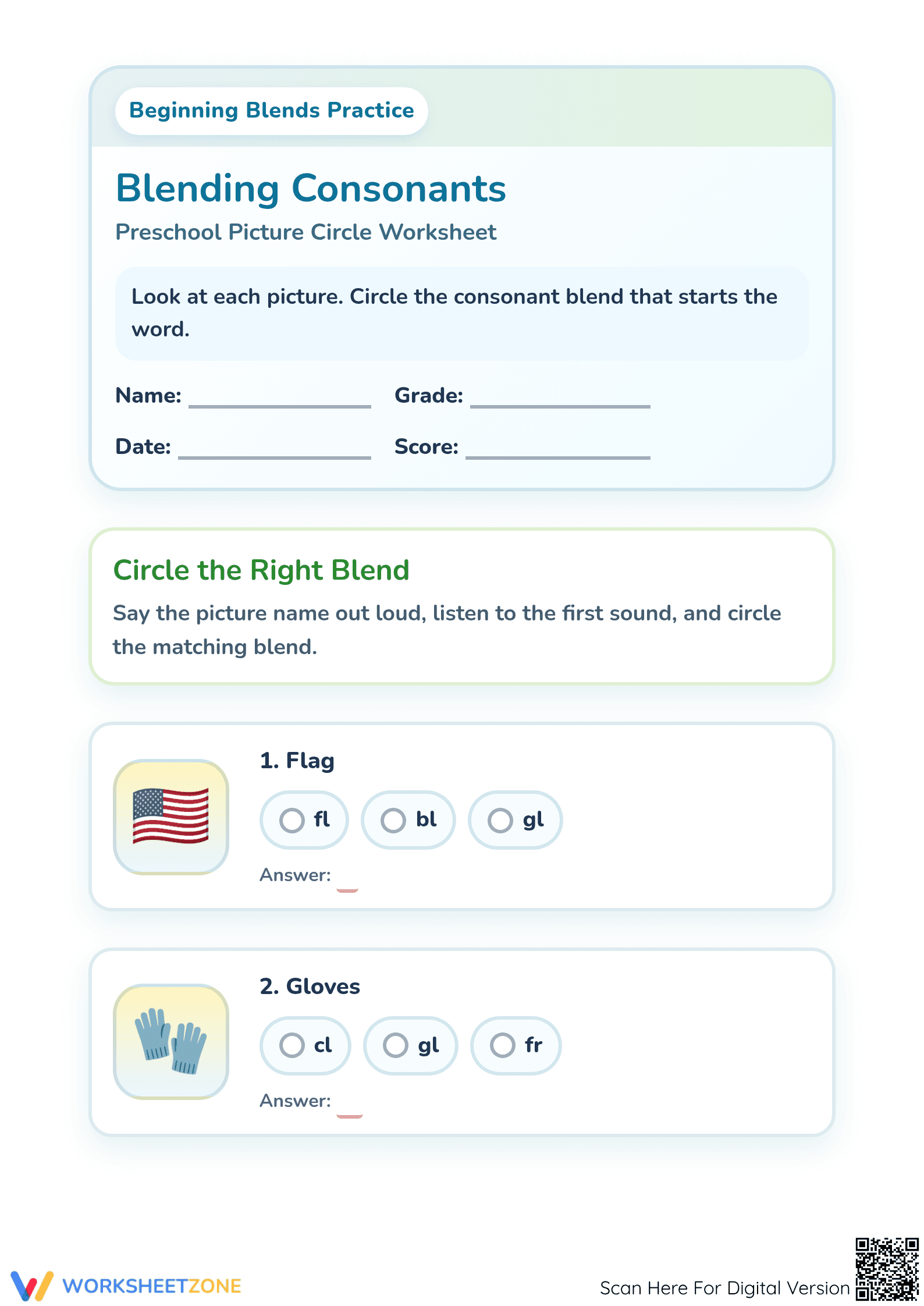
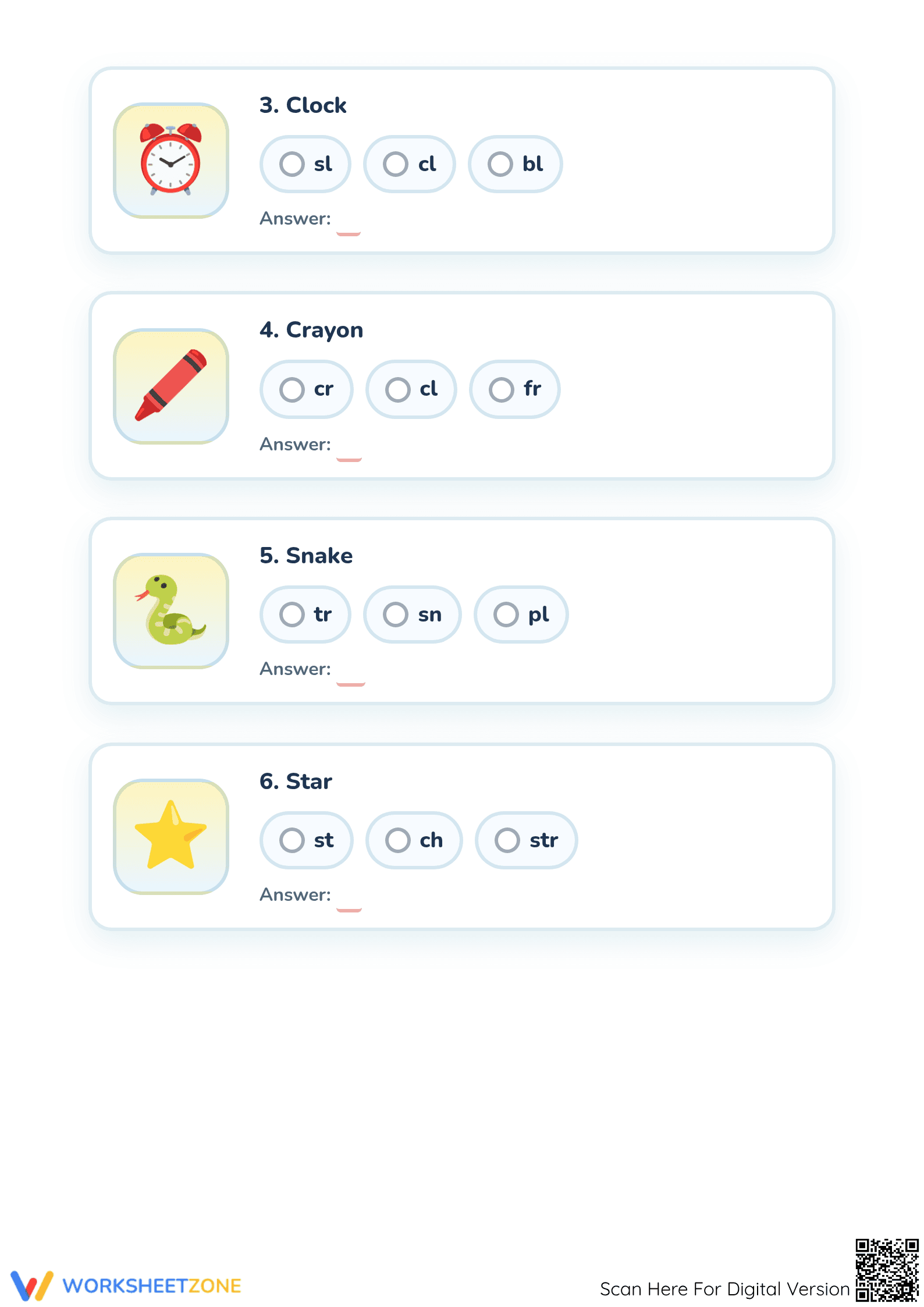
Inside this printable set, you will find two pages of high-quality illustrations designed to engage young learners. The worksheet features six distinct tasks where students see a familiar image, say the name out loud, and select the correct beginning blend from three choices. The items included are flag, gloves, clock, crayon, snake, and star. Each problem includes a clear "Answer" line for students to record their choice, reinforcing the connection between spoken sounds and written letters.
This resource is designed for a zero-prep workflow to save valuable instructional time. Step one: Print the two pages (takes less than 30 seconds). Step two: Distribute to your students with a quick verbal prompt to "say and circle." Step three: Review the work using the included answer key during whole-group instruction. Total teacher preparation time is under 2 minutes, making this an ideal solution for unexpected sub plans or quick transitions between lessons.
This activity is aligned with CCSS.ELA-LITERACY.RF.K.3, which focuses on demonstrating basic knowledge of letter-sound correspondences. By identifying blends like "fl," "gl," and "st," students build the prerequisite skills necessary for Kindergarten reading readiness. This standard code can be copied directly into lesson plans, IEP goals, or district curriculum mapping tools to ensure every minute of practice counts toward state-mandated learning objectives.
Teachers can use this worksheet in several concrete ways. First, use it as a quick formative assessment after a direct instruction lesson on beginning sounds to see which students are ready for more complex decoding. Second, place the pages in a literacy center with highlighters or bingo daubers to make the task more interactive. Observe if students are accurately producing the initial phonemes as they work. Completion time typically ranges from 10 to 15 minutes depending on the student's familiarity with the vocabulary.
This worksheet is primarily for preschool and Pre-K students who are beginning to recognize that words are made of individual sounds. It is also suitable for Kindergarten students needing additional intervention or English Language Learners (ELLs) focusing on consonant clusters. For a complete lesson, pair this worksheet with an anchor chart showing common beginning blends or a short picture book that emphasizes alliteration and phonetic patterns.
Research shows explicit phonics instruction, especially focusing on phoneme-grapheme correspondences, predicts future reading success. Structured worksheets, combining visual cues with phonetic choices, bridge the gap between abstract sounds and concrete literacy concepts for early learners. Utilizing this CCSS.ELA-LITERACY.RF.K.3 aligned resource provides the repetitive practice needed for long-term phonetic mastery. This systematic approach develops the automaticity crucial for fluent reading in primary grades. An included answer key offers immediate feedback, essential for correcting misconceptions. This printable worksheet helps track individual progress and identify blend patterns needing targeted instruction.


