




























Views
Downloads



Printable Latin Civic Vocabulary Word Search | Grade 6 ELA

Paste this activity's link or code into your existing LMS (Google Classroom, Canvas, Teams, Schoology, Moodle, etc.).
Students can open and work on the activity right away, with no student login required.
You'll still be able to track student progress and results from your teacher account.
Students explore Latin civic vocabulary by locating fourteen hidden words that illustrate key roots used in government terminology. This engaging word search reinforces meaning, spelling, and etymology while building confidence in decoding unfamiliar civic language.
At a Glance
- Grade: 6 · Subject: English Language Arts
- Standard:
Not standards-assessed — vocabulary enrichment— students discover and label Latin‑rooted civic terms- Skill Focus: Latin roots in civic vocabulary
- Format: 3 pages · 14 words · Answer key included · PDF
- Best For: quick vocabulary review or enrichment activity
- Time: 10–15 minutes
- Setting: whole class or small groups
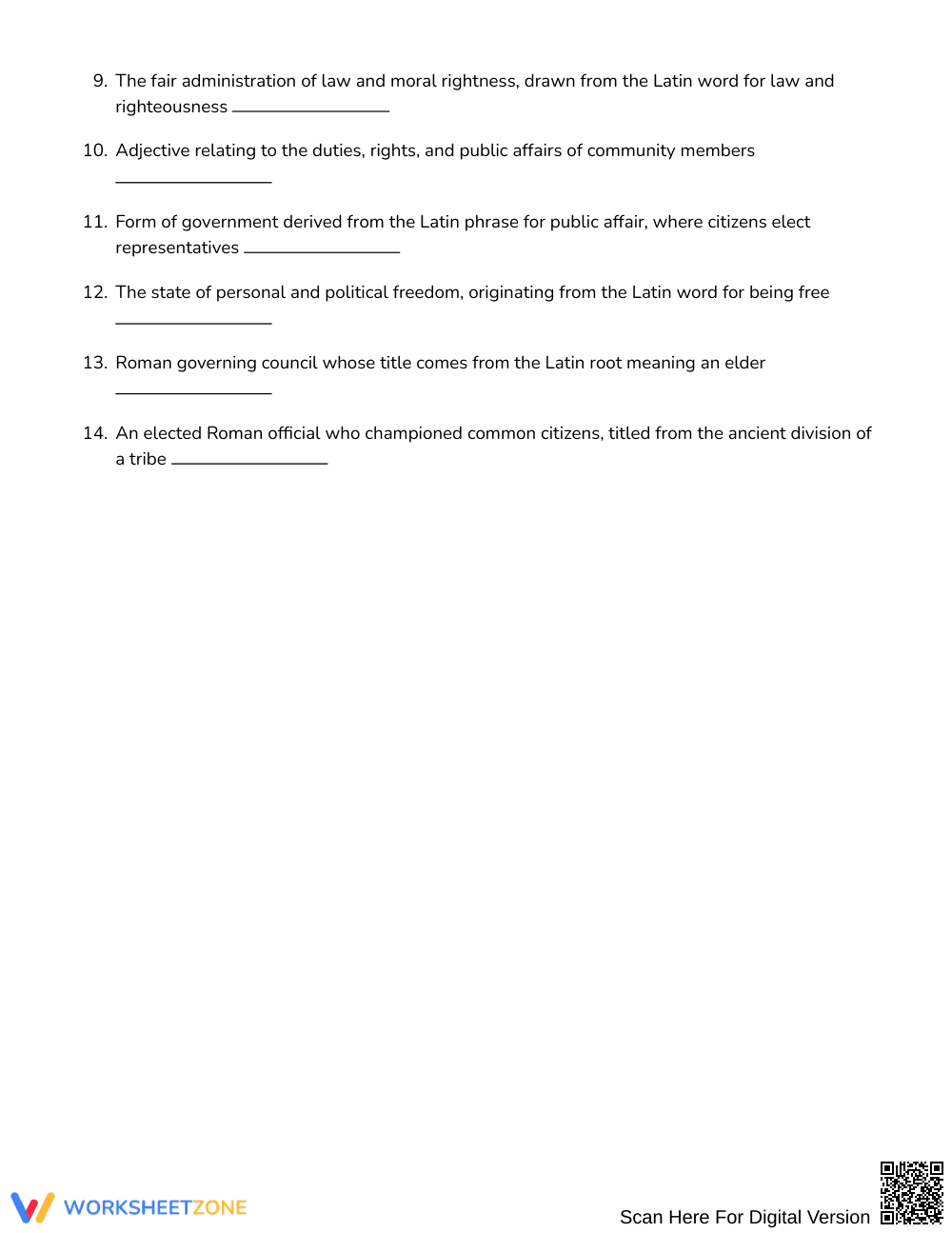
The activity consists of a 16 × 16 letter grid printed on the first page, followed by a list of fourteen civic terms and corresponding clues on the second page. The third page provides the answer key with the completed grid. Words may appear diagonally northeast, east, southeast, or straight south, and the word bank is presented in a shuffled order to encourage independent decoding.
To complete the search, learners scan the 16 × 16 grid for the fourteen target words. Each word runs in one of four directions—northeast, east, southeast, or south—so students must look horizontally and diagonally. The clues give definitions that highlight the Latin root, and the shuffled word bank prevents pattern guessing, ensuring authentic practice of root identification.
This resource is designed for vocabulary enrichment and is not aligned to any specific state or national standard. It supports the broader goal of expanding students’ understanding of Latin-derived civic terminology, a foundational skill for later reading of historical texts and civic discussions.
Use the word search as a warm‑up before a lesson on Roman government, allowing students to activate prior knowledge while the teacher reviews each clue. Alternatively, employ it as an independent enrichment activity during literature circles; observe students as they self‑monitor accuracy and note any unfamiliar roots for quick formative feedback.
Designed for Grade 6 ELA learners, this activity benefits students who need extra practice with word analysis as well as those ready for independent vocabulary challenges. Pair it with a short anchor chart of common Latin roots or a brief mini‑lecture on civic terminology to reinforce connections.
Research shows that explicit focus on word roots improves students’ ability to decode unfamiliar terms and boosts reading comprehension (Fisher & Frey, 2014). By engaging sixth‑graders in a targeted Latin‑root word search, this activity provides repeated exposure to civic vocabulary such as “republic” and “senate,” reinforcing the skill of recognizing and interpreting Latin‑derived roots in context. The clue‑driven format encourages active meaning‑making, while the shuffled word bank prevents rote memorization, aligning with best practices for vocabulary enrichment. Educators can integrate this resource into language arts units on ancient civilizations or civic education, offering a quick, printable tool that supports both formative assessment and independent practice. The inclusion of an answer key streamlines feedback, allowing teachers to confirm mastery of the Latin‑root skill efficiently. Overall, the activity aligns with research‑based strategies for building morphological awareness and can be reused throughout the year for cumulative review.


