Mastering Degree of Comparison with Comparatives and Superlatives Worksheets
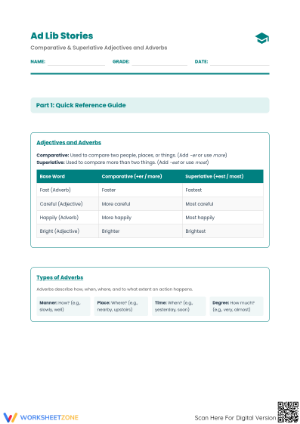
In the realm of English language arts, understanding how to compare items is a fundamental skill that allows students to describe the world with precision. Comparatives and superlatives worksheets serve as essential tools for teachers who aim to help their students grasp these linguistic structures. These resources provide the repetitive practice needed to move from a theoretical understanding of grammar to a practical application in both writing and speaking. Teachers often find that introducing these concepts through visual and written exercises helps cement the relationship between the base form of an adjective and its comparative or superlative counterpart. By using structured worksheets, students can systematically explore how language changes to reflect different degrees of quality or quantity.
Comparative Adjectives: Structure and Spelling Rules
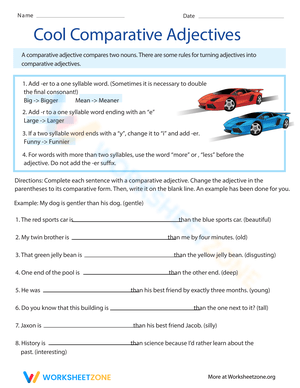
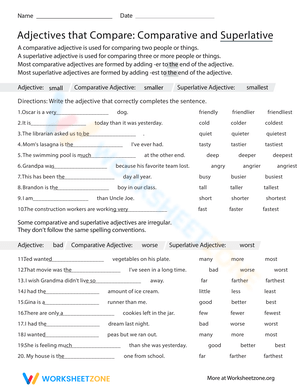
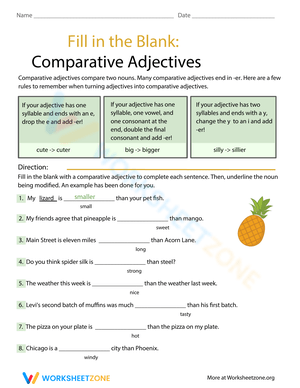
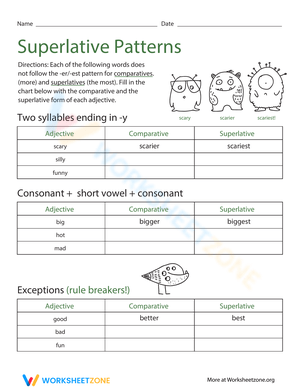
The construction of comparative adjectives follows specific patterns based on the phonetic structure of the base word. For most one-syllable adjectives, the rule is to add the suffix '-er' to the end of the word. For instance, 'tall' becomes 'taller' and 'fast' becomes 'faster'. However, when an adjective ends in a single vowel followed by a single consonant, students must remember to double the final consonant before adding the suffix, such as 'big' becoming 'bigger'. Comparatives and superlatives worksheets frequently include drills specifically designed to reinforce these spelling shifts, ensuring that students do not overlook these important technical details during their writing assignments.
For adjectives with two or more syllables, the rules become slightly more complex. While some two-syllable words ending in '-y' change the 'y' to an 'i' before adding '-er', many longer adjectives require the use of the word 'more' before the base adjective. For example, 'beautiful' becomes 'more beautiful' rather than adding a suffix. Teaching this distinction is a major component of grammar instruction, as it prevents students from creating non-standard forms like 'beautifuller'. Worksheets that categorize adjectives by their syllable count help students internalize these patterns more effectively than rote memorization alone.
Superlative Adjectives: Comparing Three or More Elements
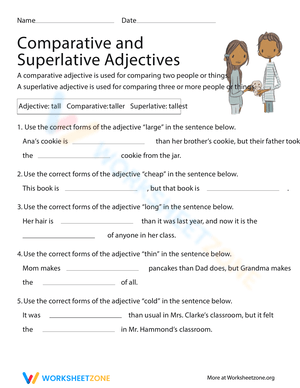
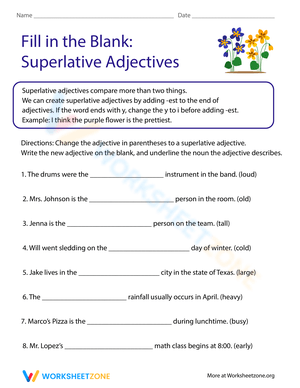
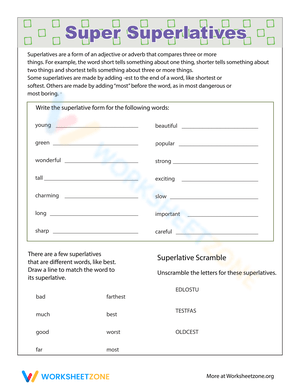
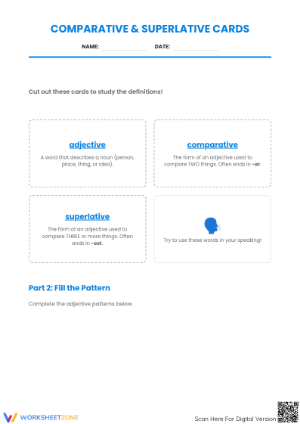
Superlative adjectives represent the highest degree of a quality within a group. Unlike comparatives, which deal with pairs, superlatives require a group of at least three items for a valid comparison. The standard rule for short adjectives is to add the suffix '-est', transforming 'small' into 'smallest'. It is also essential to teach students that the definite article 'the' almost always precedes a superlative adjective. This structural requirement is a key focus in many comparatives and superlatives worksheets, as omitting the article is a common error among early learners and English language students.
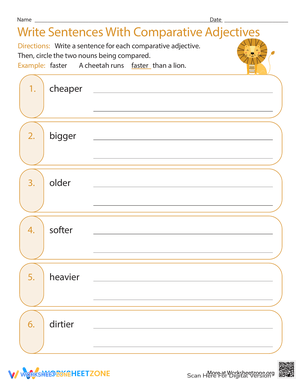
According to the Cambridge Dictionary entry on comparatives and superlatives, the word 'than' is used after a comparative adjective to introduce the second element of the comparison. This specific structural requirement is a primary focus in grammar instruction for 85% of early ESL curriculum models worldwide. This data point highlights why worksheets often pair comparative exercises with superlative ones, allowing students to contrast the use of 'than' in comparative sentences with the use of 'the' in superlative ones. By practicing these structures side-by-side, students develop a clearer sense of the syntax required for accurate expression.
Handling Irregular Adjectives and Common Spelling Shifts
While most adjectives follow predictable patterns, the English language contains several irregular forms that must be learned through focused practice. The most common examples are 'good', which becomes 'better' and 'best', and 'bad', which shifts to 'worse' and 'worst'. These words do not follow the standard suffix rules, and their unique forms can be challenging for students who rely solely on phonetic patterns. Comparatives and superlatives worksheets often feature dedicated sections for these irregulars, providing multiple opportunities for students to apply them in different sentence contexts until they become second nature.
Spelling shifts also occur frequently when adjectives end in 'y' or silent 'e'. When an adjective like 'happy' is turned into a comparative, the 'y' is replaced with an 'i' to create 'happier'. Similarly, 'large' simply takes an 'r' to become 'larger' since the 'e' is already present. Experts in linguistics note that these spelling modifications are not merely arbitrary rules but are designed to maintain the phonetic integrity of the word when suffixes are attached. Providing worksheets that focus on these specific transformations helps students avoid common spelling errors that could otherwise obscure their meaning in written work.
Teacher Tips for Integrating Grammar Practice
Integrating comparatives and superlatives worksheets into a broader lesson plan requires more than just handing out papers. Teachers should aim to create a multi-sensory experience where the written word is supported by verbal and visual activities. For example, teachers can use real classroom objects to demonstrate comparisons before students begin their worksheet exercises. By comparing the length of two pencils or the weight of three books, students can see the grammatical rules in action. This concrete experience makes the abstract rules found on the page much more accessible and easier to remember.
Another effective strategy is to encourage peer-to-peer comparison activities. After completing a section of a worksheet, students can work in pairs to write their own comparative and superlative sentences about their hobbies, favorite foods, or school subjects. This allows for immediate feedback from both the teacher and their peers. Additionally, using these worksheets as part of a literacy center allows for differentiated instruction, where some students can focus on basic one-syllable adjectives while others move on to more complex multi-syllable words and irregular forms. This targeted approach ensures that every student is challenged at their specific level of understanding.
Using Comparatives and Superlatives Worksheets for ESL Instruction
For students learning English as a second language, comparatives and superlatives represent a significant milestone in their linguistic development. The jump from simply describing an object to comparing it with others requires a more sophisticated grasp of syntax and vocabulary. Comparatives and superlatives worksheets are particularly helpful for ESL learners because they provide clear, predictable structures that reduce the cognitive load. By focusing on one pattern at a time, such as adjectives ending in '-y', teachers can help these students build confidence before moving on to more irregular or complex structures.
Formative Assessment and Progress Tracking in Grammar
Comparatives and superlatives worksheets are not only useful for instruction but also serve as valuable formative assessment tools. By reviewing a student's completed worksheet, a teacher can quickly identify specific areas of struggle, such as recurring spelling errors or a misunderstanding of when to use a superlative versus a comparative. This data allows for more personalized instruction and timely interventions. Rather than waiting for a unit test, teachers can use daily worksheet performance to adjust their teaching strategies and provide additional support where it is most needed.
Frequently Asked Questions About Comparative and Superlative Worksheets
1. When should students use more instead of the er suffix?
Students should use 'more' before adjectives that have three or more syllables, such as 'more interesting' or 'more difficult'. Some two-syllable adjectives also use 'more', especially those that do not end in 'y'. Teaching students to count the syllables in a word is the most effective way to help them decide which form to use. Worksheets that group adjectives by syllable count are excellent for practicing this specific rule.
2. Why is the article the necessary for superlative adjectives?
The article 'the' is necessary because a superlative adjective identifies a specific, unique item that holds the highest degree of a quality within a group. For example, in the phrase 'the tallest boy', there is only one person who holds that specific title. Without the article, the sentence would be grammatically incomplete and potentially confusing. This is a vital point to emphasize during grammar lessons and worksheet practice.
3. What are the most common irregular adjectives found on these worksheets?
The most common irregular adjectives are 'good', 'bad', 'little', and 'far'. These words have completely different forms for their comparative and superlative versions, such as 'good, better, best' and 'bad, worse, worst'. Because they do not follow standard rules, they appear frequently on worksheets to ensure students memorize them. Focused repetition is key to mastering these outliers in the English language.
4. How can worksheets help with spelling rules for comparatives?
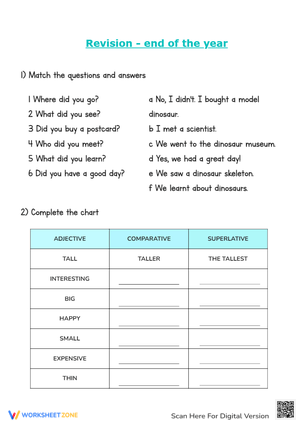
Worksheets provide targeted practice for spelling shifts, such as doubling a final consonant in 'thin' to make 'thinner' or changing a 'y' to an 'i' in 'heavy' to make 'heavier'. By repeatedly writing these transformations, students develop muscle memory for the correct spelling. Many worksheets include specific sections that isolate these rules, allowing students to focus on one type of spelling change at a time for better retention.
5. At what grade level should these grammar concepts be introduced?
Comparative and superlative adjectives are typically introduced in second or third grade, once students have a solid grasp of basic adjectives. The concepts are then revisited with increasing complexity in later elementary and middle school years. For ESL students, these concepts are introduced once they have attained a basic level of conversational English, as they are essential for more descriptive and detailed communication.












 Interactive Worksheet Maker
 Quiz Maker
 Word Search Maker
 Crossword Puzzle Maker
 Word Scramble Generator
 Sentence Scramble Generator
 Handwriting Worksheet Generator
 Name Tracing Generator
 Fill In The Blank Generator