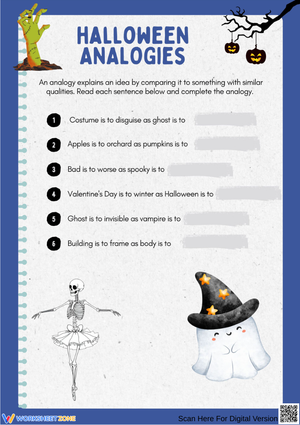
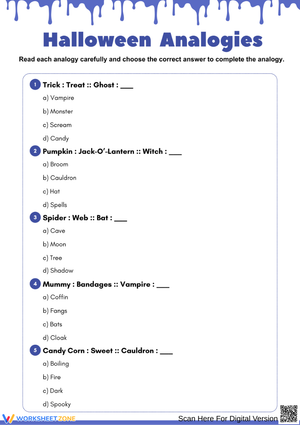
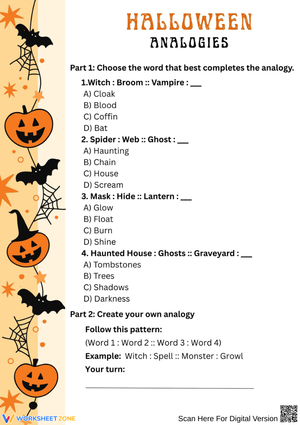
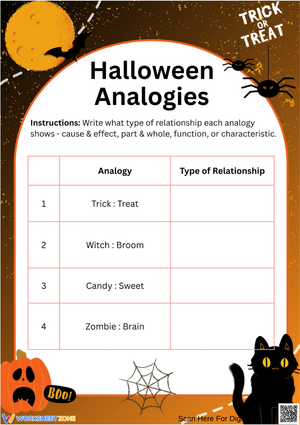
The Fundamentals of Word Relationship Analysis
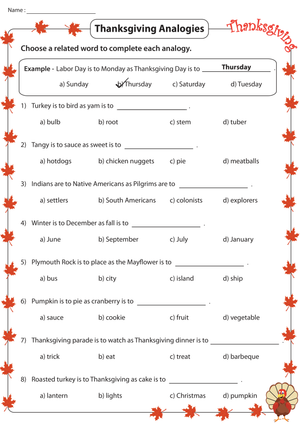
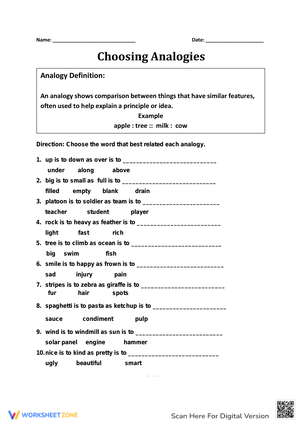
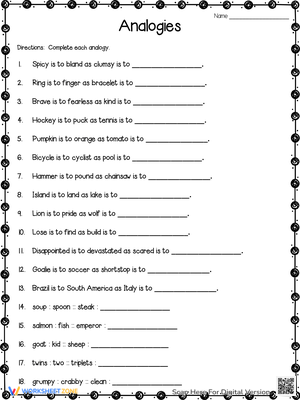
Analogies represent one of the most effective ways to build verbal reasoning and logic in the classroom. When students encounter an analogy, they are not just looking at four words; they are analyzing the structural relationship between two pairs. This cognitive exercise requires them to identify a rule that governs the first pair and apply it precisely to the second. In an educational setting, these worksheets provide a structured environment for students to practice this sophisticated level of thinking. By using printable materials, teachers can offer tactile, focused practice that moves away from screen-based distractions, allowing for deep concentration on linguistic nuances.
Instructional planning for analogies often starts with simple, concrete relationships before moving toward more abstract concepts. These foundational exercises help students visualize how components interact within a larger system. As they progress, the complexity of these relationships increases, challenging them to consider synonyms, antonyms, cause and effect, and object-to-function pairings. The goal is to move beyond simple word recognition into the realm of conceptual mapping, where words are seen as interconnected nodes of meaning rather than isolated definitions. Teachers find that printable resources are particularly valuable during small group rotations, allowing for immediate feedback and physical annotation.
Core Categories of Analogy Relationships
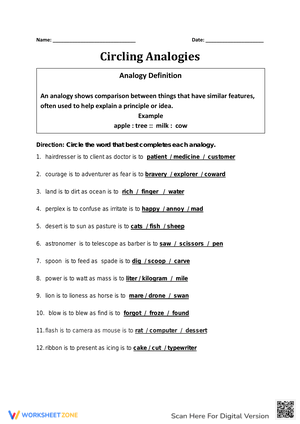
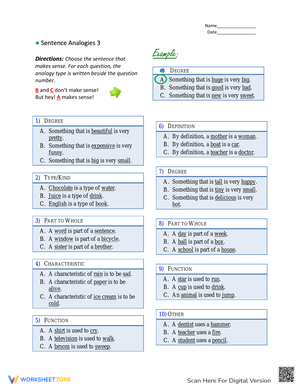
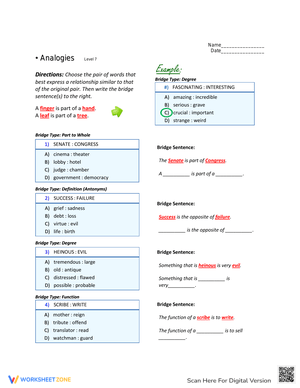
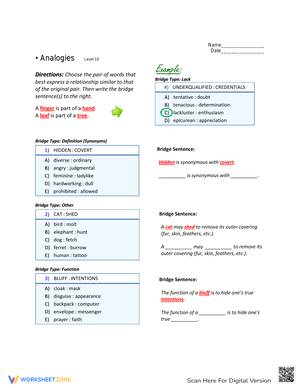
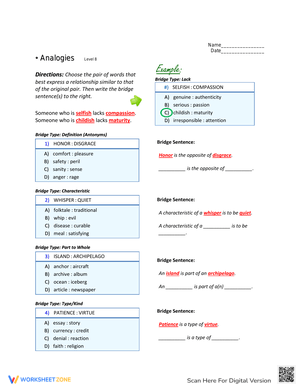
To teach analogies effectively, it is helpful to categorize them into recognizable patterns. Students who can name the relationship type are far more likely to solve the analogy correctly than those who simply guess. The most common category is the synonym-antonym pair. In these exercises, students must determine if the first pair of words share similar meanings or opposite meanings. This reinforces vocabulary depth by forcing students to consider the intensity and context of words. A worksheet might present 'happy is to joyful as sad is to...' and expect the student to recognize the synonym relationship to find 'miserable' as the corresponding term.
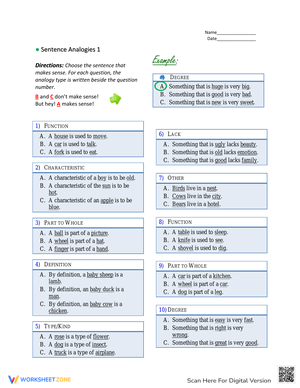
Another vital category is the part-to-whole relationship. This type of analogy is excellent for science-integrated ELA lessons or general descriptive writing. By analyzing how parts fit into a whole, students develop a better sense of organizational structure. This logic applies to everything from biology (cell is to organism) to geography (city is to state). When students practice these relationships on paper, they are building a mental catalog of how the world is organized, which directly translates to improved reading comprehension when they encounter complex informational texts. Object-to-use analogies provide a more functional approach to word study, asking students to consider what a thing does, such as 'hammer is to nail.'
Strategies for Decoding Complex Word Pairs
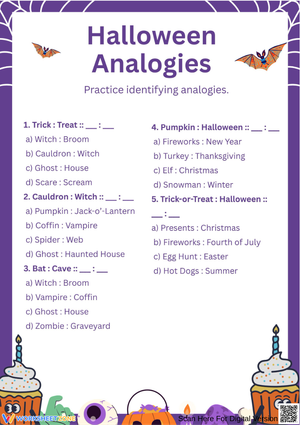
One of the most effective strategies for students is the 'sentence bridge' method. This involves creating a simple sentence that describes the relationship between the first two words and then plugging the second pair into that same sentence structure. For example, if the analogy is 'painter : brush :: baker : ____', the student would say, 'A painter uses a brush to do their job.' They then apply this to the second pair: 'A baker uses a ____ to do their job.' This method forces the student to be explicit about the relationship rather than relying on a vague sense of association. It is a powerful tool for self-correction and logical verification.
Identifying the 'bridge' requires a deep dive into word meaning. Often, students get tripped up by words that have multiple meanings. A worksheet that uses the word 'bank' might be referring to a financial institution or the side of a river. Printable practice allows students to circle these ambiguous words and write notes about the different possibilities. This level of meta-cognitive awareness is what separates high-performing readers from those who struggle with inferencing. By practicing with diverse analogy sets, students learn to slow down and consider the context provided by the other words in the pair, building a more sophisticated approach to verbal reasoning.
Teacher Tips for Classroom Implementation
Implementing analogy practice effectively requires more than just handing out a worksheet. To maximize the impact, consider starting each lesson with a 'think-aloud' where you model the process of solving a complex analogy. Show the students how you eliminate incorrect options and how you refine your sentence bridge if it feels too broad. For instance, if 'pen : write' leads to a bridge of 'you use it for,' you might find that multiple options fit. Refining it to 'a tool used specifically for producing text' makes it much easier to find the correct answer and reinforces the need for precision.
Use these printable resources as part of a multi-sensory approach. Have students cut out word pairs and sort them into piles based on relationship type. This physical interaction with the words helps kinesthetic learners grasp abstract logic. You can also create a classroom 'analogy wall' where students add their own word pairs that follow a specific weekly theme. Small group instruction is ideal for analogies because it allows for rich discussion about word meanings, providing a common reference point for teacher-led intervention and peer-to-peer collaboration. These collaborative moments are when the most significant logical breakthroughs occur.
Evidence-Based Benefits of Relational Logic
Research consistently shows that explicit instruction in word relationships has a significant impact on overall literacy. According to experts at Reading Rockets in their article 'Teaching Analogies: Strategies and Examples', analogy instruction helps students understand how words are related, which is a key component of vocabulary acquisition. They note that explicit instruction in these relationships can significantly improve reading comprehension scores for 82% of middle school students.
Instructional research indicates that analogy mastery acts as a cognitive bridge between basic vocabulary recognition and higher-order evaluative reasoning. When students move beyond identifying synonyms to recognizing functional relationships—such as object-to-purpose or cause-to-effect—they activate neural pathways associated with relational memory, which enhances long-term retention of complex academic terms by approximately 30% compared to rote memorization. This suggests that the time spent on analogy worksheets is about building the underlying architecture of the student's mind.
Scaffolding Analogy Instruction for Diverse Learners
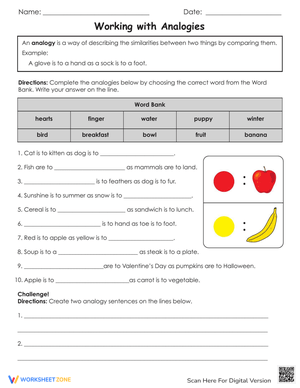
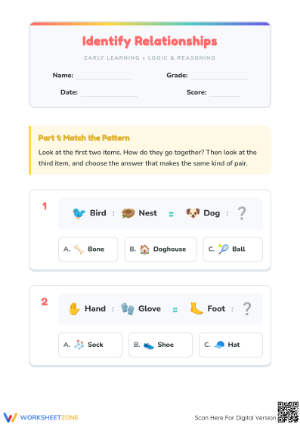
For students who find analogies particularly challenging, scaffolding is essential. Start with 'picture analogies' where the relationships are visual rather than verbal. Once they understand the concept of 'A is to B', transition to simple words with strong associations. Provide a word bank for the worksheets to reduce the cognitive load of retrieving vocabulary while they are still learning the logical framework. As their confidence grows, you can gradually remove these supports, moving toward open-ended analogies where they must provide both the fourth word and the relationship type, ensuring a gradual and successful progression.
Frequently Asked Questions
1. What are the most common types of analogies for elementary students?
In the elementary years, the most effective analogies focus on concrete, easily visualized relationships. These include synonym and antonym pairs (big is to large, hot is to cold), part-to-whole relationships (finger is to hand), and object-to-function pairings (pencil is to write). Classification analogies, such as 'apple is to fruit,' are also excellent for younger learners. As students progress into upper elementary and middle school, teachers can introduce more complex types like cause and effect, degree of intensity, and location-based relationships.
2. How should teachers use these worksheets for small group instruction?
For small group settings, these worksheets should serve as a launchpad for discussion. Instead of just checking for correct answers, ask students to articulate their 'bridge' sentences aloud. This verbalization helps the teacher identify where a student's logic might be failing. You can also use the worksheets for sorting activities, where students group analogies by their relationship type. This collaborative approach turns a solo activity into a dynamic learning experience that builds both social and cognitive skills.
3. At what grade level should I start teaching analogies?
Formal analogy instruction typically begins around the third grade, once students have a stable enough vocabulary to understand word relationships. However, the concept of 'relationships' can be introduced as early as kindergarten through visual analogies using pictures. By starting early with simple associations and gradually increasing the complexity of the logic and vocabulary, teachers can help students develop a strong foundation in verbal reasoning that will serve them throughout their academic career and beyond.
4. Can analogies be used to assess reading comprehension?
Yes, analogies are an excellent formative assessment tool for reading comprehension. They require students to understand not just the definition of a word, but how it functions in relation to other concepts. If a student can solve an analogy related to a text they have read, it demonstrates a high level of inferential thinking. For example, creating an analogy between a character's motivation and their actions shows that the student has grasped the internal logic of the story, moving beyond simple plot recall into deep literary analysis.
5. How do printable analogies compare to digital apps for learning?
While digital apps can be engaging, printable analogies offer distinct advantages for deep learning. The act of physically writing, circling, and annotating on paper has been shown to improve memory and focus. Printable materials also remove the distractions of notifications or the temptation to guess quickly to advance a game level. In a classroom, paper-based resources are easier to monitor and provide a tangible record of a student's thinking process, which is invaluable for teacher review and intervention planning.












 Interactive Worksheet Maker
 Quiz Maker
 Word Search Maker
 Crossword Puzzle Maker
 Word Scramble Generator
 Sentence Scramble Generator
 Handwriting Worksheet Generator
 Name Tracing Generator
 Fill In The Blank Generator