The Strategic Role of Antonyms in Early Language Acquisition
Teaching opposites, or antonyms, is a fundamental component of early literacy instruction that goes far beyond simple word memorization. When students learn to identify opposites, they are engaging in a complex cognitive process known as semantic association. This process allows learners to categorize information and understand the relationship between different concepts, which provides a framework for future vocabulary growth. By presenting words in pairs, teachers help students build a mental map of language where words are connected by their meanings rather than just their sounds or spellings. This relational thinking is a key milestone in language development, particularly for children in Kindergarten through second grade who are transitioning from basic communication to more descriptive and precise expression.
Printable opposites worksheets serve as an essential tool in this developmental journey. These resources provide the structured practice necessary for students to internalize these word pairings through repetition and varied application. In a classroom setting, these worksheets allow for immediate feedback and can be used to identify specific gaps in a student's understanding. For example, a student might easily grasp the concept of 'big' and 'small' while struggling with more abstract pairings like 'near' and 'far.' By using printable resources, teachers can target these specific areas, providing additional support where it is needed most. This targeted approach ensures that every student builds a solid foundation in vocabulary, which is a significant predictor of later reading comprehension success.
Scaffolding Vocabulary with Visual Opposites
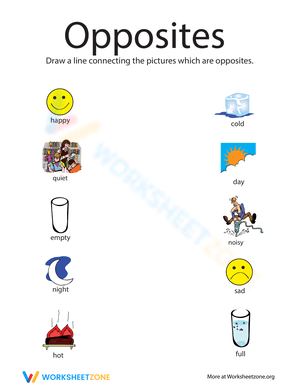
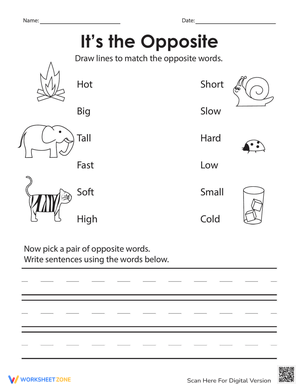
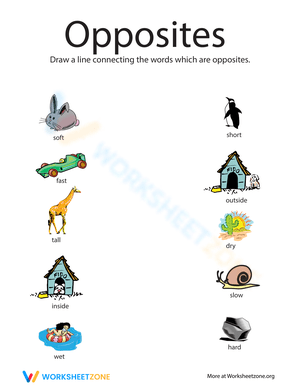
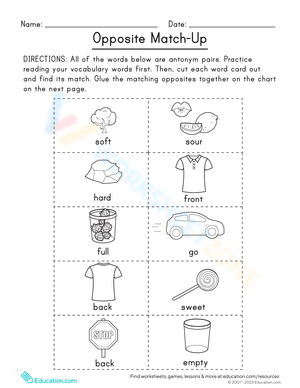
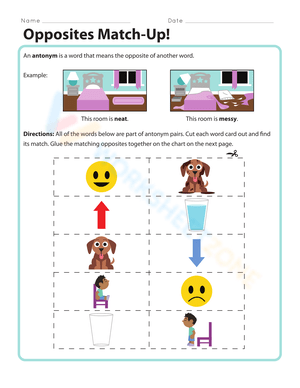
For early learners and those just beginning to explore the nuances of the English language, visual aids are indispensable. Opposites are inherently visual concepts, making them ideal for picture-based instruction. Using printable worksheets that feature clear, engaging illustrations helps students make the connection between a word and its meaning more effectively than text alone. Visual scaffolding allows children to use their observational skills to deduce the meaning of antonyms, which builds confidence and encourages independent learning. When a child sees a picture of a sun next to the word 'hot' and an ice cube next to the word 'cold,' the concept becomes concrete and memorable.
Incorporating these visual elements into daily lessons can be done through matching exercises, coloring activities, and circle-the-opposite tasks. These varied formats keep students engaged and accommodate different learning styles. Some students may thrive with tactile activities like cutting and pasting, while others may prefer the visual clarity of a matching worksheet. By providing a diverse range of printable opposites worksheets, teachers can ensure that all students have the opportunity to engage with the material in a way that resonates with them. This variety not only makes learning more enjoyable but also reinforces the concepts through multiple sensory channels, leading to deeper retention and more flexible use of the new vocabulary in their own speaking and writing.
Differentiating Instruction for ESL and Early Learners
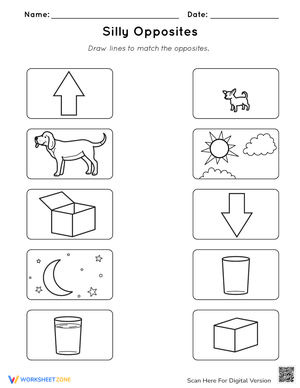
In diverse classrooms, differentiating instruction is necessary to meet the needs of English Language Learners (ESL) and students at various developmental levels. Opposites are particularly useful for ESL instruction because they provide a clear contrast that helps clarify meaning. For a student who is still learning the basics of English, understanding that 'up' is the direct opposite of 'down' provides a clear anchor for both words. Using printable worksheets specifically designed for ESL learners can help bridge the gap between their primary language and English by focusing on high-frequency antonyms that are used in everyday conversation.
Teachers often observe that students struggle with abstract opposites, such as 'empty' and 'full,' compared to physical ones like 'big' and 'small,' suggesting that instructional sequence should prioritize concrete sensory pairings before moving to abstract concepts. This observation highlights the importance of choosing the right materials for each stage of a child's development. For students who are just starting out, focusing on tangible opposites that they can see and touch in the classroom is often the most effective strategy. As they become more comfortable with these concepts, teachers can gradually introduce more abstract pairings through worksheets that require higher-level thinking and reasoning. This progressive approach ensures that all students are challenged at an appropriate level without becoming overwhelmed.
Teacher Tips: Integrating Opposites into Daily Routines
Integrating the study of opposites into the daily classroom routine can significantly enhance a student's vocabulary development. Teachers can use transitions, morning meetings, and even recess as opportunities to reinforce these concepts. For example, during a transition, a teacher might ask students to move 'quickly' to their desks and then 'slowly' line up for lunch. These real-world applications make the vocabulary more relevant and help students understand how these words are used in context. Combining these verbal cues with printable opposites worksheets provides a comprehensive learning experience that covers both oral and written language skills.
Another effective strategy is to create an 'Opposite of the Day' board where a pair of antonyms is featured with pictures and example sentences. Students can be encouraged to use these words throughout the day, and teachers can provide printable activities that correspond to the featured words. This consistent exposure helps solidify the meanings and encourages students to incorporate new words into their active vocabulary. Additionally, using these worksheets as part of small-group instruction or as independent center activities allows teachers to monitor progress and provide individual support. By making opposites a regular part of the classroom environment, teachers can create a language-rich atmosphere that supports the growth of all learners.
Evidence-Based Strategies for Teaching Word Relationships
Effective vocabulary instruction is grounded in research-based strategies that emphasize the importance of deep word knowledge and the ability to use words in multiple contexts. One such strategy is the explicit teaching of word relationships, which includes antonyms, synonyms, and homonyms. By focusing on how words are related, teachers can help students develop a more sophisticated understanding of language and improve their ability to express themselves clearly. Printable worksheets that require students to categorize words or identify relationships are excellent tools for this type of instruction.
Teaching word relationships like antonyms helps students develop a nuanced understanding of language. According to Reading Rockets, explicitly teaching antonyms allows learners to expand their expressive vocabulary by providing precise alternatives for common words, which is a key predictor of later reading comprehension success in primary grades. This citation underscores the critical role that antonyms play in early literacy. When students understand that they have choices in the words they use, they can become more effective communicators and more engaged readers. Using printable resources to reinforce these evidence-based strategies ensures that students receive the high-quality instruction they need to succeed.
Frequently Asked Questions
1. What age should a child start learning opposites?
Most children begin to grasp the concept of opposites around the age of three or four. At this stage, they can understand simple, concrete pairings like big and small or up and down. As they enter Kindergarten and the early primary grades, they can be introduced to more abstract and complex antonyms through structured instruction and printable worksheets.
2. How can opposites help in early literacy development?
Learning opposites helps children expand their vocabulary and improve their understanding of word relationships. This foundational skill is closely linked to reading comprehension, as it allows students to better understand the context of what they are reading. By identifying antonyms, students also learn to use more precise language in their own speaking and writing.
3. What are the most effective activities to teach antonyms?
Effective activities include visual matching exercises, sorting tasks, and real-world applications within the classroom routine. Using printable opposites worksheets that incorporate illustrations is particularly helpful for early learners. Games like 'I Spy' with opposites or creating a classroom 'Opposite Wall' can also be highly engaging and effective.
4. Are these printable worksheets suitable for ESL students?
Yes, printable opposites worksheets are excellent resources for ESL students. They provide clear contrasts that help clarify the meaning of new English words. Focusing on visual aids and high-frequency antonyms can help ESL learners build their vocabulary quickly and gain confidence in their language skills.
5. How do opposites improve vocabulary and comprehension skills?
Opposites help students build semantic networks, which are mental maps of how words are related. This allows them to categorize information more effectively and retrieve words more easily during speaking and writing. In reading, understanding antonyms helps students grasp the nuances of a text and better comprehend the author's message.












 Interactive Worksheet Maker
 Quiz Maker
 Word Search Maker
 Crossword Puzzle Maker
 Word Scramble Generator
 Sentence Scramble Generator
 Handwriting Worksheet Generator
 Name Tracing Generator
 Fill In The Blank Generator