The Importance of Mastering Abbreviations in Elementary Literacy
Abbreviations are a fundamental component of the English language, serving as efficient linguistic shortcuts that we encounter daily. From reading addresses on mail to understanding calendar entries, the ability to decode and produce abbreviated forms is a vital skill for elementary students. Mastering these shortened forms not only enhances reading fluency but also improves writing efficiency and technical accuracy. When students learn how to correctly use a period after a title or how to shorten the days of the week, they are building a bridge between informal communication and formal grammatical standards.
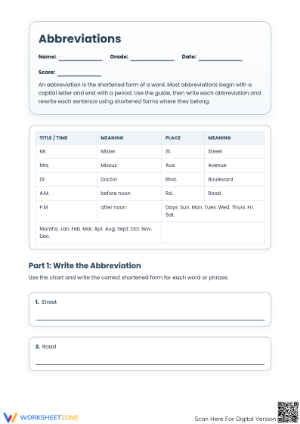
Furthermore, the study of abbreviations offers an excellent opportunity to reinforce punctuation rules. The consistent use of the period in most abbreviations provides a repetitive yet meaningful way to practice end-mark conventions. This reinforcement is particularly beneficial for students who struggle with capitalization and punctuation in their general writing. As they become more comfortable with 'Mr.,' 'Mrs.,' and 'Dr.,' they begin to see the period as a tool for clarity rather than just a mark at the end of a sentence.
Core Categories of Abbreviations for Young Learners
When introducing abbreviations to elementary students, it is helpful to categorize them into manageable groups. This thematic approach allows students to build connections between related terms, making the memorization process more intuitive. The primary categories typically include personal titles, days of the week, months of the year, units of measurement, and geographic terms. Each category carries its own set of conventions, such as which terms require capitalization and which ones always demand a terminal period.
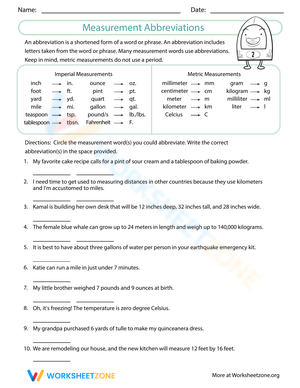
According to Common abbreviations taught in elementary school from https://luckylittlelearners.com, students typically encounter abbreviations for titles, days of the week, and months by second grade, requiring focused practice to distinguish between those that use periods and those that do not. This targeted instruction ensures that students develop a strong foundation before moving on to more complex abbreviations found in mathematics and science, such as units of measurement like 'kg' or 'ml,' which often follow different punctuation standards.
Geographic abbreviations and units of measure represent other critical categories that bridge the gap between subjects. Learning that 'Ave.' stands for 'Avenue' or 'in.' for inches is essential for students as they begin to explore their local communities and perform technical calculations. Helping students identify these nuances prevents future errors in both their writing and their academic work. As they become proficient, students gain a sense of mastery over the technical aspects of writing, allowing them to focus more on the creative and analytical components of their assignments.
Instructional Strategies for Teaching Abbreviation Rules
Effective instruction in abbreviations goes beyond simple rote memorization. It involves active engagement with text and meaningful application in writing. One successful strategy is the 'Abbreviation Hunt,' where students look through newspapers, magazines, or classroom books to find as many shortened forms as possible. This activity encourages students to see abbreviations as living parts of the language rather than isolated vocabulary words. Once found, students can record the abbreviation and its full-word counterpart in a grammar journal, creating a personalized reference guide for their writing workshops.
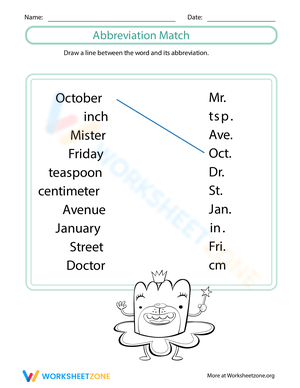
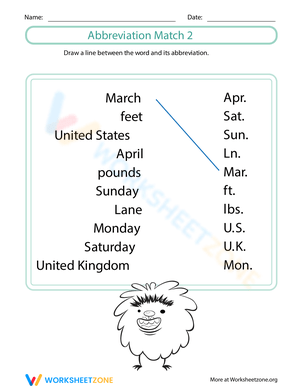
Another powerful tool is the use of matching games and interactive activities. Whether through physical cards or digital platforms, matching the full word to its abbreviation helps reinforce the visual connection between the two forms. This is particularly helpful for abbreviations that don't look like their parent words, such as 'lb.' for pound or 'oz.' for ounce. For these 'irregular' abbreviations, teachers might use mnemonic devices or brief historical anecdotes to explain why the abbreviation exists. Direct instruction should also focus on the 'why' behind the rules, helping students become more discerning and thoughtful writers.
Classroom Implementation: Integrating Abbreviations into Daily Writing
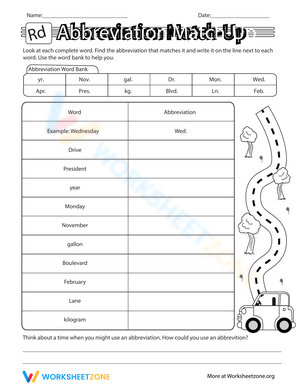
To truly master abbreviations, students must move from recognition to production. Classroom implementation should involve frequent opportunities to use these forms in authentic writing tasks. One simple way to integrate this is through the daily classroom calendar or morning message. Instead of always writing the full name of the day and month, the teacher can use abbreviated forms and ask students to identify the full words. This daily exposure reinforces the most common abbreviations without requiring a dedicated lesson every time, normalizing the use of these forms in a functional context.
Teachers often observe that students struggle most with abbreviations that lack a direct phonetic link to the original word, such as 'lb.' for pound or 'oz.' for ounce, which necessitates visual anchors and repetitive contextual exposure beyond simple matching exercises. To address this, teachers can implement 'word of the day' challenges focused specifically on these non-phonetic abbreviations, asking students to use them in sentences related to their science or math lessons. This cross-curricular approach ensures that the knowledge is reinforced across different domains, leading to deeper retention and more confident usage.
Writing letters or addressing envelopes is another classic activity that provides rich, meaningful practice. Students can write letters to a 'pen pal' or a community member, ensuring they use correct titles for their recipients and proper abbreviations for addresses. This task highlights the necessity of accuracy in a way that feels relevant to the student. By making abbreviation practice a regular, integrated part of the literacy block, teachers ensure that every student becomes proficient in this essential skill.
Common Challenges and Misconceptions with Shortened Word Forms
One of the most frequent challenges students face is over-generalization. After learning that many abbreviations end with a period, some students begin to add periods to every short word they encounter. They might write 'the.' or 'and.' thinking they are following a generalized rule. Correcting this requires careful instruction on the definition of an abbreviation versus a short word. Using visual aids, such as T-charts comparing words that are always short with those that are abbreviated, can help clarify this distinction during the drafting phase of writing.
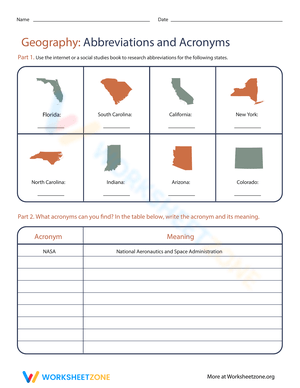
Another common misconception involves capitalization and the distinction between different types of shortened words. Students often forget that abbreviations for proper nouns must still be capitalized, such as writing 'mon.' instead of 'Mon.' Reinforcing the idea that an abbreviation inherits the properties of the word it represents is a helpful way to explain this rule. While more advanced topics like acronyms and initialisms might be introduced later, the focus for elementary learners should remain on the most common, period-ending abbreviations that they encounter in their reading.
Differentiating Instruction with Abbreviations worksheets
Every classroom contains students with a wide range of abilities, and abbreviation instruction must be differentiated to meet these diverse needs. For students who are just beginning to grasp the concept, simple matching activities with high-frequency abbreviations are most effective. These learners benefit from clear, uncluttered abbreviations worksheets that focus on one category at a time. Providing a reference chart with pictures alongside the abbreviations can offer additional support for English Language Learners or students with processing difficulties, ensuring they can participate fully in the lesson.
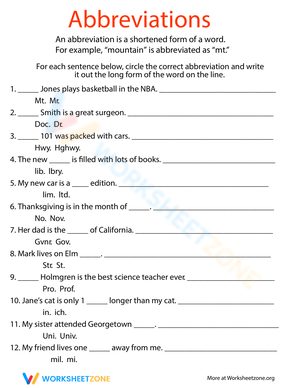
For students who have mastered the basics, the challenge should be increased by introducing more complex tasks. These learners can work on identifying abbreviations in dense texts or converting a full paragraph into a version that uses appropriate abbreviations where possible. Using worksheets that include 'proofreading' tasks—where students must find intentionally placed errors in a text—can engage their critical thinking skills and require a deeper level of linguistic analysis.
Frequently Asked Questions About Abbreviations
1. What is the most common mistake students make with abbreviations?
The most frequent error is the omission of the period. Students often forget that the period is an essential part of the abbreviation's structure, signaling that the word has been shortened. Consistent practice with abbreviations worksheets can help reinforce this habit until it becomes automatic in their writing.
2. At what grade level should abbreviations be introduced?
Most elementary curricula introduce basic abbreviations, such as personal titles and days of the week, in the first or second grade. By third grade, students are expected to use these forms accurately in their own writing and begin exploring more complex categories like geographic terms.
3. Do all abbreviations require a period?
No, not all abbreviations require a period. While most grammar-based abbreviations in the US do use them (e.g., 'Mr.,' 'Jan.'), many scientific and mathematical abbreviations (e.g., 'cm,' 'kg') and acronyms (e.g., 'NASA') do not. Teachers should explain these exceptions as they arise in different subjects.
4. Why are some abbreviations so different from the original word?
Some abbreviations, like 'lb.' for pound or 'oz.' for ounce, are derived from Latin or other ancient languages. Sharing these interesting facts with students can make learning abbreviations more engaging and help them remember these irregular forms more easily during their grammar lessons.
5. How can I help students who struggle with the capitalization of abbreviations?
Remind students that an abbreviation usually keeps the capitalization of the original word. If the full word is a proper noun, like a day of the week, the abbreviation must also be capitalized. Visual reminders and T-charts are excellent tools for reinforcing this rule in the classroom.












 Interactive Worksheet Maker
 Quiz Maker
 Word Search Maker
 Crossword Puzzle Maker
 Word Scramble Generator
 Sentence Scramble Generator
 Handwriting Worksheet Generator
 Name Tracing Generator
 Fill In The Blank Generator