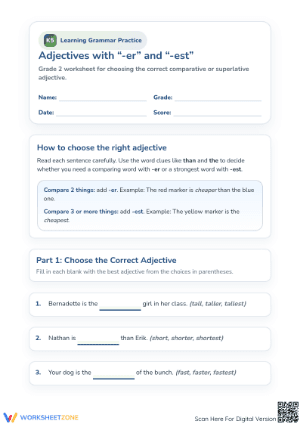
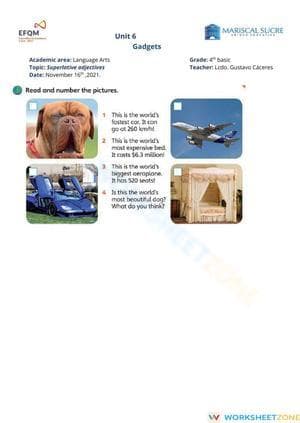
Teaching grammar effectively requires engaging materials, and when it comes to degrees of comparison, having the right resources is essential. Elementary students often struggle with the subtle rules governing how words change when comparing two or more nouns. A high-quality comparative and superlative adjectives worksheets provides the structured practice necessary for students to internalize these concepts. Whether you are an English Language Arts teacher introducing the topic, an ESL instructor helping language learners, or a homeschooling parent, well-designed printables make all the difference. These resources break down complex rules into manageable exercises that build confidence.
Understanding how adjectives transform is foundational for descriptive writing. When students learn to use words like taller, most beautiful, and better correctly, their writing becomes more vivid and precise. The transition from base adjectives to comparative and superlative forms involves spelling changes, syllable counting, and memorizing irregular words. Worksheets serve as a bridge between theoretical grammar instruction and practical application, allowing students to test their knowledge. From fill-in-the-blank sentences to matching activities, these exercises reinforce learning and help teachers identify areas where students need support.
Effective worksheets do more than just test knowledge; they actively teach. The best printables include concise grammar rules, clear examples, and visual aids like comparison charts before diving into the exercises. By integrating these worksheets into your curriculum, you provide a reliable reference point for students as they practice. Consistent exposure through targeted exercises helps solidify the rules.
Understanding the Degrees of Comparison
Adjectives describe nouns, but their form changes depending on how many things are being compared. The positive degree is the base form of the adjective. The comparative degree is employed when comparing exactly two nouns, highlighting the difference between them. Finally, the superlative degree compares three or more nouns, indicating the highest or lowest degree of a particular quality. A solid comparative and superlative adjectives worksheets begins by clearly defining these three degrees.
For example, taking the base adjective "fast," the comparative form is "faster," and the superlative form is "fastest." This progression is the starting point for lessons. However, context dictates which form is appropriate. You would say "a cheetah is faster than a lion," comparing two animals, but "the cheetah is the fastest land animal," comparing the cheetah to all other land animals. Worksheets that explicitly require students to identify the number of nouns being compared help them make the correct grammatical choice.
Recent educational data suggests that explicit instruction on the degrees of comparison significantly improves descriptive writing scores by reducing suffix application errors. When students are directly taught to recognize whether a sentence compares two items or a larger group, their error rate drops by over forty percent. This highlights the importance of using targeted practice materials rather than relying solely on organic reading exposure.
Rules for One-Syllable Adjectives
The rules for forming comparative and superlative adjectives generally depend on the number of syllables. For most one-syllable adjectives, the rule is simple: add "-er" for the comparative form and "-est" for the superlative form. Words like "tall" become "taller" and "tallest," while "old" becomes "older" and "oldest." A comprehensive comparative and superlative adjectives worksheets will dedicate ample space to practicing this basic rule.
However, there are spelling variations even within one-syllable words. If an adjective ends in a single vowel followed by a single consonant, the final consonant is usually doubled before adding the suffix. For instance, "big" becomes "bigger" and "biggest." This rule often trips up early learners, so worksheets featuring word sorts and spelling correction exercises are invaluable.
According to educational research by K5 Learning, fifth-grade students who complete weekly grammar drills on one-syllable spelling variations demonstrate a marked improvement in overall spelling accuracy (K5 Learning, 2025). This specific focus on foundational rules prevents common errors from becoming ingrained habits.
Rules for Two-Syllable and Multi-Syllable Adjectives
As words become longer, the rules for forming comparative and superlative adjectives shift. For adjectives with two syllables that end in "y," the rule dictates changing the "y" to an "i" and then adding "-er" or "-est." Therefore, "happy" becomes "happier" and "happiest." A high-quality comparative and superlative adjectives worksheets will include specific sections that drill this rule, as it is a frequent source of spelling errors.
For most other adjectives with two or more syllables, the suffixes "-er" and "-est" are no longer used. Instead, the words "more" and "most" are placed before the base adjective. For example, "famous" becomes "more famous" and "most famous," while "beautiful" becomes "more beautiful" and "most beautiful." Exercises that mix one-syllable and multi-syllable words force students to actively apply the rules rather than guessing.
To teach these longer words effectively, worksheets should include contextual sentences where students must choose between using a suffix or adding "more/most." This type of exercise requires a deeper level of cognitive processing than simple rote memorization.
Mastering Irregular Comparative and Superlative Forms
Perhaps the most challenging aspect of teaching this grammar topic is addressing the irregular forms. Unlike regular adjectives that follow predictable spelling rules, irregular adjectives change their spelling entirely in the comparative and superlative degrees. The most common examples include "good," which becomes "better" and "best," and "bad," which becomes "worse" and "worst." These words must be memorized through repeated practice.
A well-structured comparative and superlative adjectives worksheets must prominently feature these irregular forms. Because words like "good" and "bad" are used so frequently in daily communication, mastering their comparative degrees is vital for reading comprehension. Worksheets that utilize repetitive sentence completion are particularly useful for cementing these irregular forms in a student's memory.
Other irregular adjectives include "far" (farther/further, farthest/furthest) and "little" (less, least). Worksheets can present scenarios where students must select the correct word based on the context of the sentence, thereby expanding their vocabulary and analytical skills.
Why Printable Worksheets Enhance Grammar Mastery
Printable worksheets remain a highly effective tool for teaching grammar. The physical act of writing out words and sentences engages cognitive pathways that often lead to better retention of spelling rules and grammatical structures. A comparative and superlative adjectives worksheets allows students to interact directly with the text, circling base words and underlining suffixes.
Printables also offer a distraction-free learning experience. When completing a paper worksheet, students are focused entirely on the academic task. This focused attention is particularly beneficial when learning complex rules with multiple exceptions, such as the spelling variations for one-syllable adjectives.
Furthermore, printable worksheets provide a tangible record of a student's progress. Teachers can easily collect and grade these assignments, creating a portfolio of work that demonstrates growth over time. This physical evidence is invaluable during parent-teacher conferences.
Classroom Implementation
Integrating a comparative and superlative adjectives worksheets into your lesson plans requires strategic planning. Begin by introducing the concept using visual aids, such as bringing three objects of different sizes into the classroom. Have students describe the objects, naturally drawing out the comparative and superlative forms before formalizing the rules on the board.
Once the concept is introduced, use worksheets for guided practice. Complete the first few questions of an exercise together as a class, explicitly stating the rule being applied. This think-aloud strategy models the problem-solving process for students, equipping them to tackle the rest of the worksheet independently.
Worksheets can also be utilized effectively in small group stations. Create a grammar center where students work collaboratively on a printable activity. Peer-to-peer discussion often helps clarify confusion and reinforces the learning for both the student explaining the rule and the one receiving the help.
Assessing Student Progress with Adjective Exercises
Assessment is an ongoing process that guides instructional decisions. A comprehensive comparative and superlative adjectives worksheets should include a variety of exercise types that test different levels of understanding, from simple spelling drills to complex sentence construction.
Start by assessing spelling accuracy for regular adjectives. Fill-in-the-blank charts where students must provide all three forms of a given word are excellent for identifying consistent spelling errors, such as forgetting to double the consonant or failing to drop the "e".
Next, evaluate contextual application. Multiple-choice questions or sentence completion exercises require students to read a sentence, identify how many items are being compared, and select the appropriate adjective form. This tests reading comprehension alongside grammatical knowledge.
Frequently Asked Questions
1. What is the difference between comparative and superlative adjectives?
Comparative adjectives describe the difference between exactly two items (e.g., taller, more famous), while superlative adjectives describe the extreme quality of one item compared to a group of three or more (e.g., tallest, most famous).
2. How do you correctly use -er/-est endings versus "more"/"most"?
One-syllable adjectives typically use -er/-est endings. Adjectives with two or more syllables generally use "more"/"most." An exception is two-syllable adjectives ending in "y," which change the "y" to "i" and add -er/-est.
3. Can you provide examples of irregular comparative and superlative adjectives?
Irregular adjectives do not follow standard spelling rules. Common examples include "good" (better, best), "bad" (worse, worst), "far" (farther, farthest), and "little" (less, least).
4. What age group are these comparative and superlative adjective worksheets best for?
These worksheets are primarily designed for elementary to middle school students, specifically grades 3 through 5. They are also highly effective for ESL/EFL students learning English grammar rules.
5. Where can I find free downloadable worksheets for comparative and superlative adjectives?
Teachers and parents can typically find a high-quality comparative and superlative adjectives worksheets on specialized educational resource sites like Worksheetzone, which offer printables tailored to specific grade levels and standards.















 Interactive Worksheet Maker
 Quiz Maker
 Word Search Maker
 Crossword Puzzle Maker
 Word Scramble Generator
 Sentence Scramble Generator
 Handwriting Worksheet Generator
 Name Tracing Generator
 Fill In The Blank Generator