




























Views
Downloads

Comparative Adjectives Worksheet | Grade 2 Essential

Paste this activity's link or code into your existing LMS (Google Classroom, Canvas, Teams, Schoology, Moodle, etc.).
Students can open and work on the activity right away, with no student login required.
You'll still be able to track student progress and results from your teacher account.
This Grade 2 English Language Arts worksheet provides comprehensive practice for students learning to modify nouns using comparative and superlative forms. By engaging with contextual storytelling and structured word tables, learners develop the ability to distinguish between comparing two items versus three or more. The resource ensures students can accurately apply suffix rules and identify irregular forms in their writing.
At a Glance
- Grade: 2 · Subject: ELA
- Standard:
CCSS.ELA-LITERACY.L.2.1.E— Use adjectives and adverbs to describe and compare nouns accurately- Skill Focus: Comparative and superlative modifiers
- Format: 3 pages · 23 problems · Answer key included · PDF
- Best For: Grammar centers and independent practice
- Time: 20–30 minutes
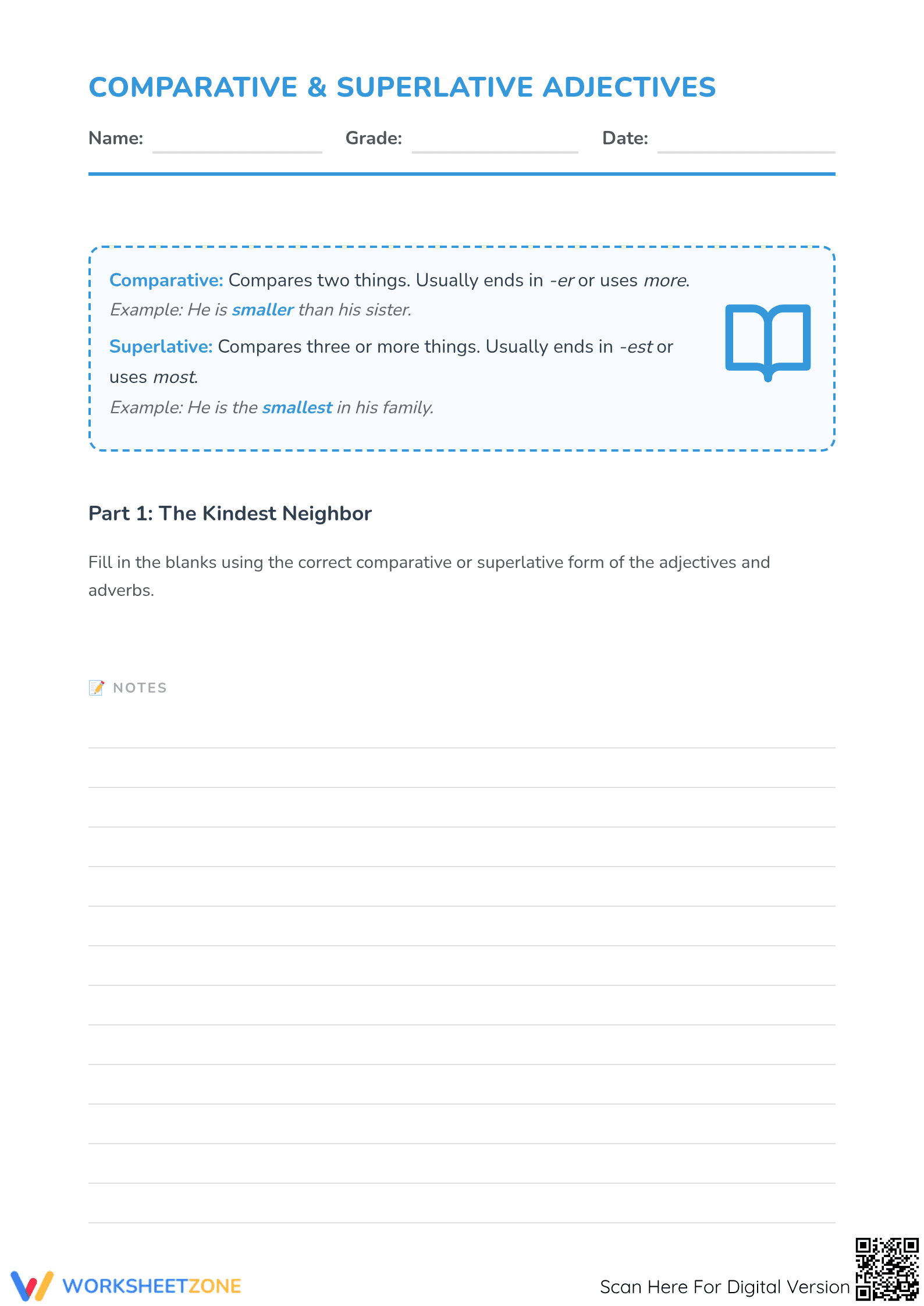
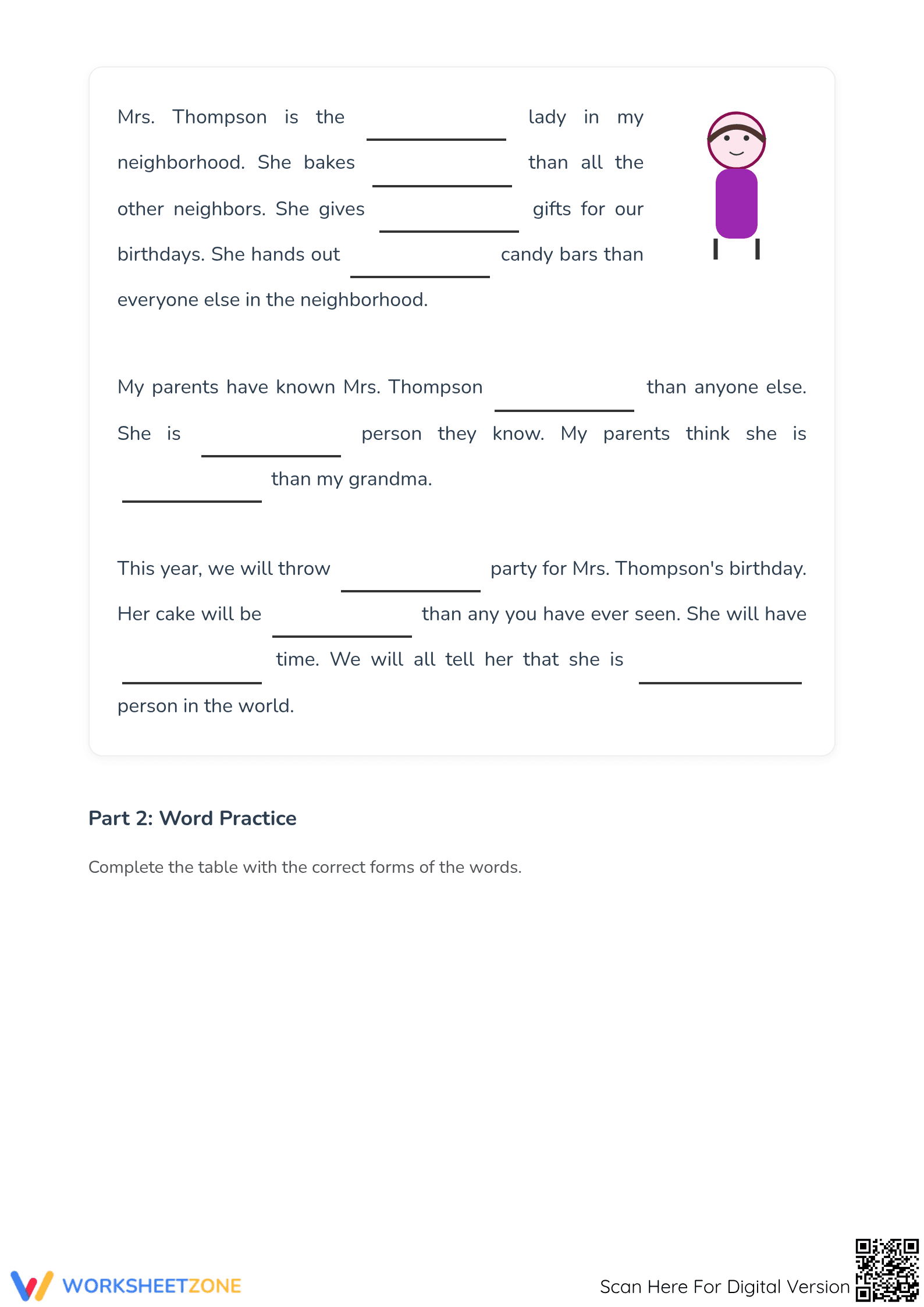
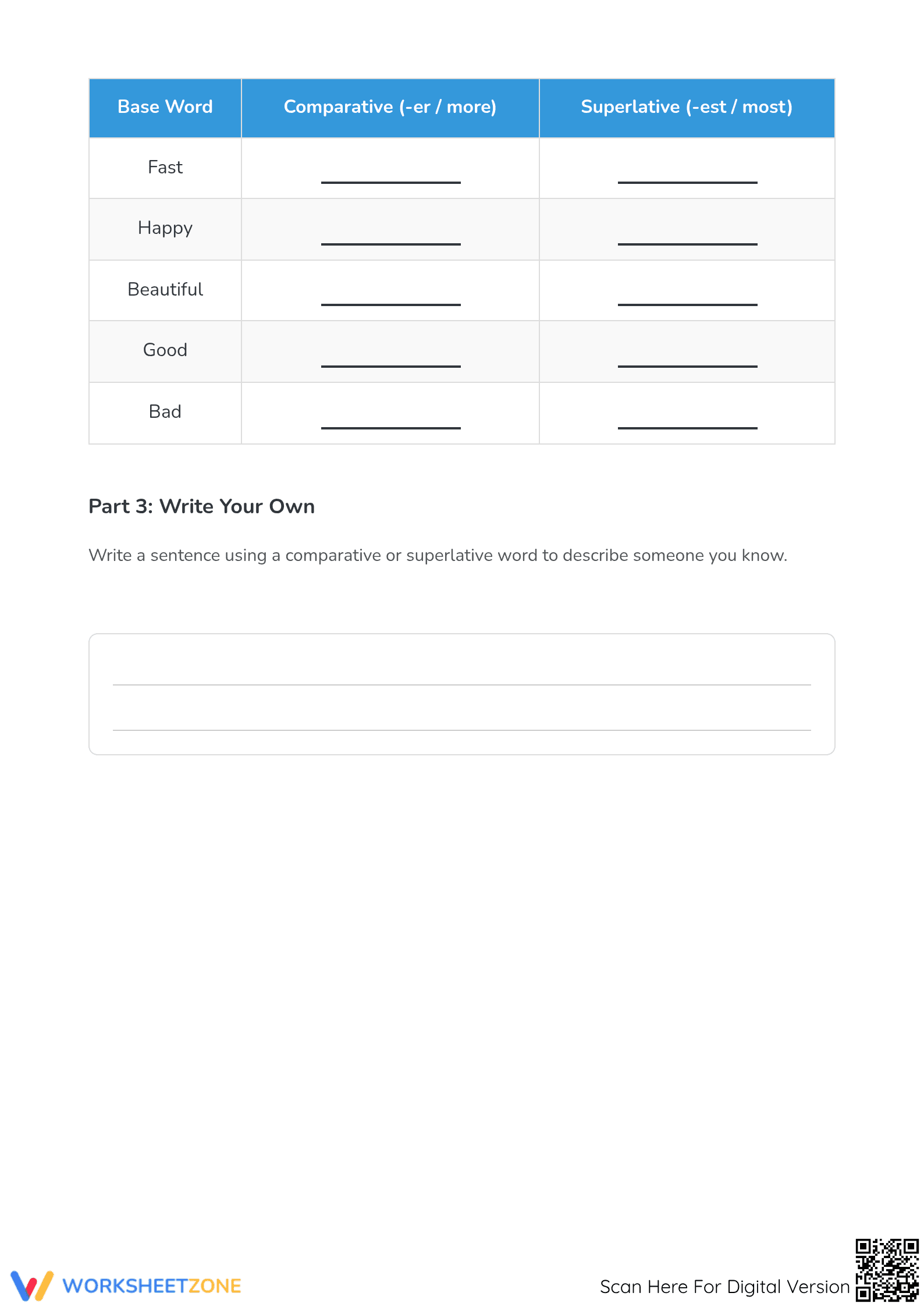
What's Inside: This three-page PDF includes a clear instructional header with definitions and examples for immediate reference. The packet features a multi-paragraph cloze story titled "The Kindest Neighbor," a comprehensive word practice table covering both regular and irregular adjectives like "good" and "bad," and a creative writing prompt. A full three-page answer key is provided to facilitate quick grading or student self-correction.
Skill Progression
- Guided Practice: Students complete 12 contextual blanks within a narrative story, using environmental cues to determine if a comparative or superlative form is required.
- Supported Practice: A structured table requires students to transform 5 base words into their -er and -est counterparts, including words requiring spelling changes like "happy" to "happier."
- Independent Practice: A final open-ended task asks students to synthesize their learning by composing an original sentence using a modifier to describe someone they know.
This sequence follows a gradual-release model, moving from recognition within a text to isolated word manipulation and finally to original production.
Standards Alignment
This resource is aligned to `CCSS.ELA-LITERACY.L.2.1.E`, which requires students to use adjectives and adverbs and choose between them depending on what is to be modified. It also touches upon Grade 3 conventions regarding the formation of comparative and superlative adjectives. Both standard codes can be copied directly into lesson plans, IEP goals, or district curriculum mapping tools.
How to Use It
Use this worksheet during the "You Do" phase of a grammar lesson after introducing the -er and -est suffixes. It serves as an excellent formative assessment; observe students during the table completion section to see if they remember to change the 'y' to 'i' in words like "happy." Expect most second graders to complete the three pages in approximately 25 minutes.
Who It's For
This resource is designed for general education second-grade students, but it is also highly effective for English Language Learners (ELLs) who need explicit practice with comparative structures. It pairs naturally with a classroom anchor chart displaying common irregular adjectives like "better" and "best."
Research by Fisher & Frey (2014) emphasizes that language acquisition is most effective when grammar skills are practiced within a meaningful context rather than in total isolation. This worksheet applies that principle by centering the primary tasks around a cohesive story about a kind neighbor, allowing students to see how comparative and superlative adjectives function to provide specific details in narrative writing. By combining this contextual application with a 23-task structured drill, the resource addresses the dual needs of cognitive understanding and procedural fluency. According to the CCSS.ELA-LITERACY.L.2.1.E framework, mastering these modifiers is a critical stepping stone toward more complex sentence structures in upper elementary grades. The inclusion of irregular forms like "good" and "bad" ensures that students are prepared for the nuances of the English language that often trip up early writers. This balanced approach supports long-term retention and immediate classroom utility for diverse learners.


