




























Views
Downloads



Essential Fewer and Less Worksheet | Grade 2 ELA

Paste this activity's link or code into your existing LMS (Google Classroom, Canvas, Teams, Schoology, Moodle, etc.).
Students can open and work on the activity right away, with no student login required.
You'll still be able to track student progress and results from your teacher account.
This Grade 2 ELA worksheet helps students master the grammatical distinction between "fewer" and "less." By focusing on countable versus uncountable nouns, learners develop the precision needed for clear communication. Students will practice identifying noun types and applying the correct comparative adjective across multiple sentence contexts to ensure long-term retention of this essential rule.
At a Glance
- Grade: 2 · Subject: ELA
- Standard:
CCSS.ELA-LITERACY.L.2.1.E— Use adjectives and adverbs correctly based on what they modify in sentences- Skill Focus: Fewer vs. Less Usage
- Format: 4 pages · 27 problems · Answer key included · PDF
- Best For: Grammar centers and independent practice
- Time: 20–30 minutes
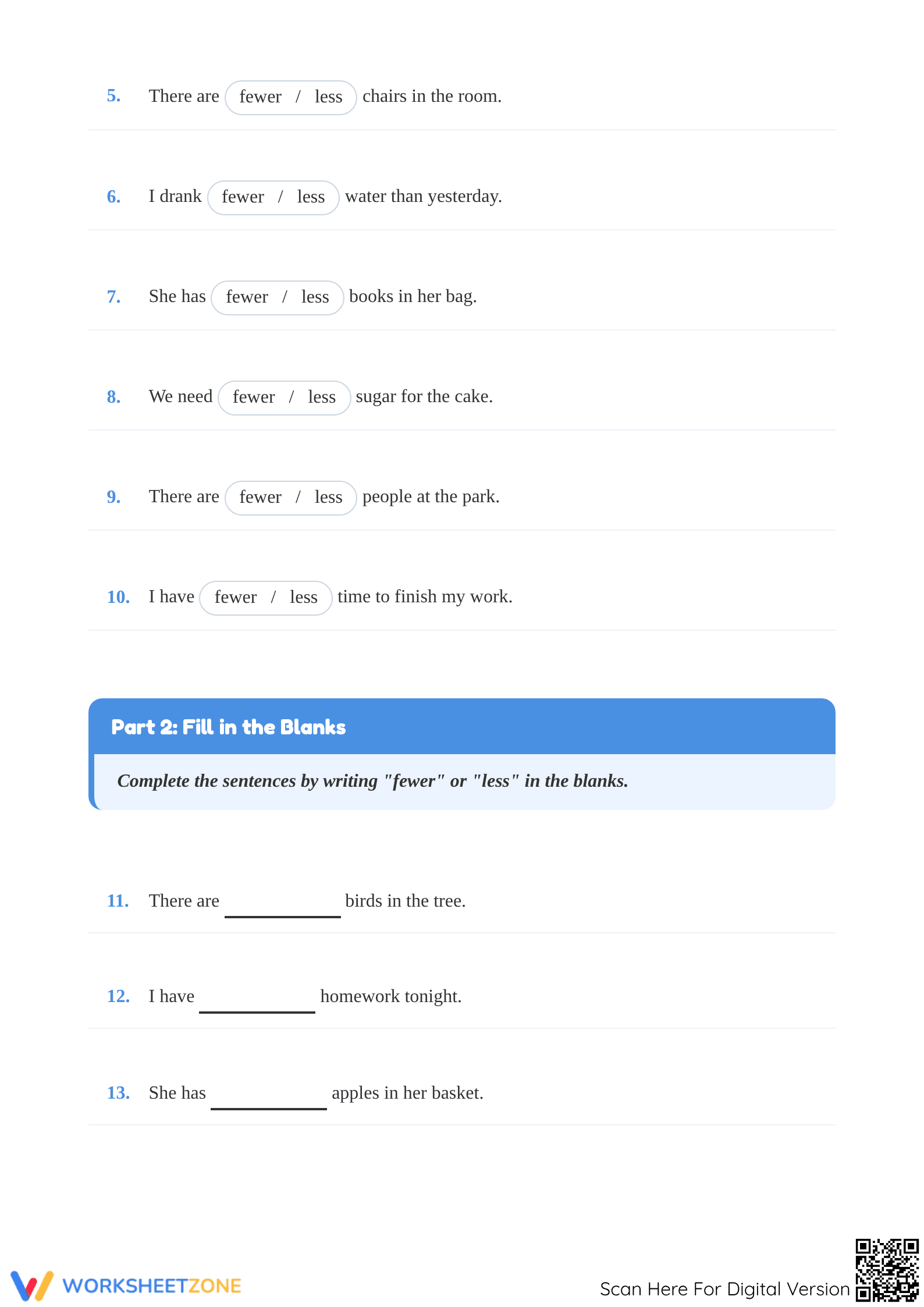
Inside this 4-page PDF, you will find a comprehensive instructional layout. It begins with a "Remember the Rule!" anchor box that defines countable and uncountable nouns. The packet includes 10 multiple-choice circling tasks, 10 fill-in-the-blank sentences, a 5-item categorization table, and 2 original sentence-writing prompts. A full answer key is provided for rapid grading.
Skill Progression
- Guided Practice: Students begin by choosing between two options in 10 provided sentences, using the visual rule box as a constant reference point.
- Supported Practice: Learners complete a word-sorting table that requires them to categorize nouns like "rain" or "cars" before selecting the correct modifier.
- Independent Practice: The challenge section requires students to generate their own original sentences using both terms correctly to demonstrate conceptual mastery.
This sequence follows the gradual-release model to move students from simple recognition to active production.
Standards Alignment
This resource is aligned to `CCSS.ELA-LITERACY.L.2.1.E`, which requires students to use adjectives and adverbs and choose between them depending on what is to be modified. It also supports general conventions of standard English grammar and usage. Both standard codes can be copied directly into lesson plans, IEP goals, or district curriculum mapping tools.
How to Use It
Use this as a formative assessment after a mini-lesson on nouns. During the word-sorting phase, observe if students can explain why "milk" is uncountable while "cookies" are countable. This worksheet also serves as an excellent homework assignment or a quiet activity for early finishers, typically taking 20 to 30 minutes to complete.
Who It's For
This is designed for second-grade students but is highly effective for English Language Learners (ELL) who struggle with quantifier nuances. It pairs naturally with a classroom anchor chart on "Count vs. Non-count Nouns" or a direct instruction lesson on comparative adjectives.
According to the RAND AIRS 2024 report on elementary literacy, targeted grammar interventions that isolate specific usage rules—such as the distinction between "fewer" and "less"—significantly improve student writing clarity. This worksheet addresses CCSS.ELA-LITERACY.L.2.1.E by providing 27 distinct opportunities for students to apply the rule of countable versus uncountable nouns. Research indicates that the gradual release of responsibility, moving from recognition to production, helps solidify these linguistic conventions in early learners. By engaging with multiple task formats, students move beyond rote memorization toward functional mastery of comparative adjectives. This resource provides the necessary scaffolding to ensure Grade 2 students can accurately modify nouns in both speech and writing. Educators can utilize the included answer key to identify specific misconceptions regarding mass nouns versus count nouns, allowing for immediate corrective feedback and data-driven instructional adjustments in the classroom.


