




























Views
Downloads

Good and Better Adjectives Worksheet | Printable Grade 2

Paste this activity's link or code into your existing LMS (Google Classroom, Canvas, Teams, Schoology, Moodle, etc.).
Students can open and work on the activity right away, with no student login required.
You'll still be able to track student progress and results from your teacher account.
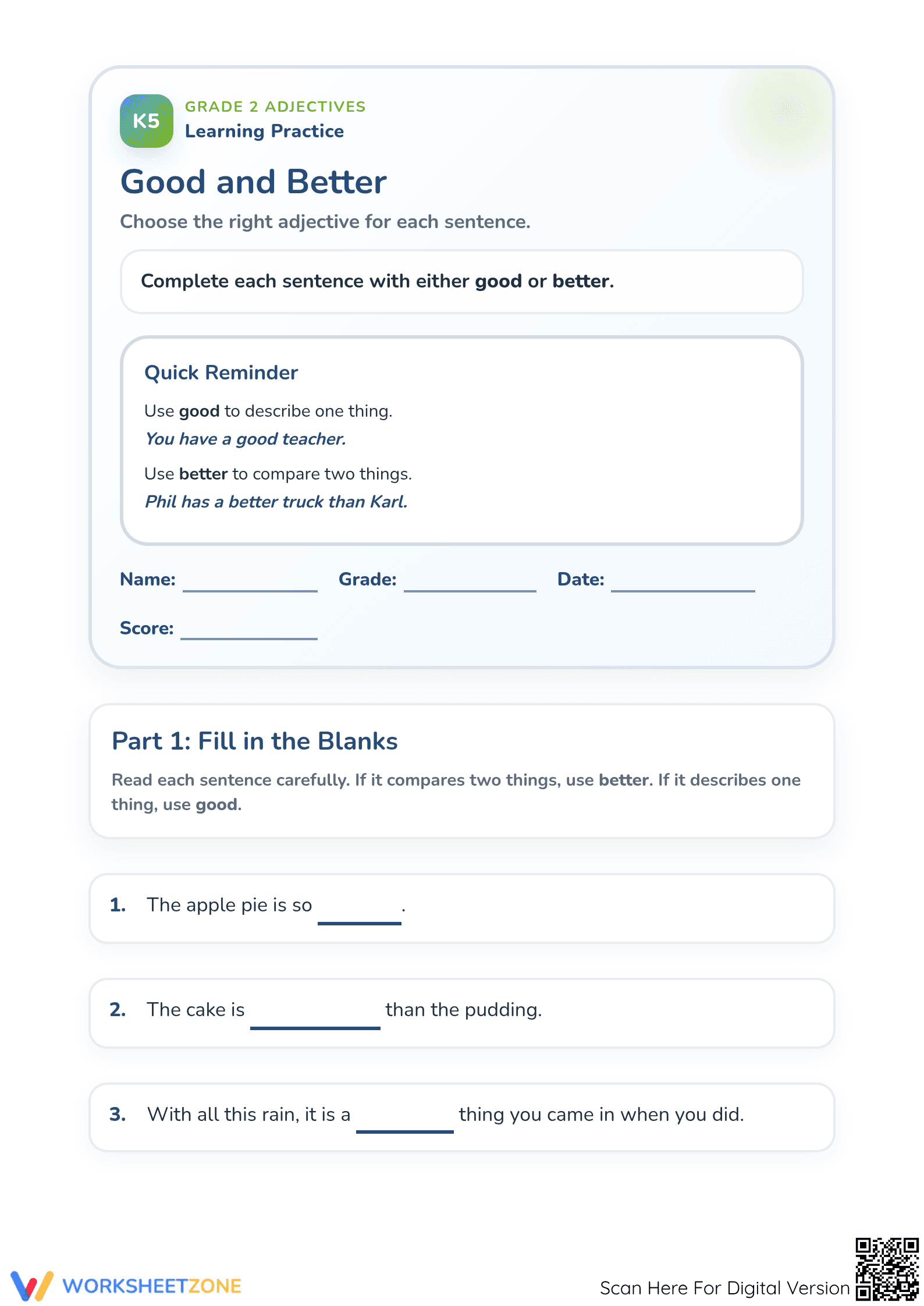
This Grade 2 ELA worksheet focuses on the correct application of the adjectives "good" and "better." Students learn to distinguish between simple descriptions and comparative statements through 16 targeted sentence-completion tasks. By identifying whether a sentence describes one item or compares two, learners build essential grammatical accuracy and descriptive writing skills.
At a Glance
- Grade: 2 · Subject: ELA
- Standard:
CCSS.ELA-LITERACY.L.2.1.E— Use adjectives and choose between them depending on what is modified- Skill Focus: Comparative Adjectives (Good vs. Better)
- Format: 3 pages · 16 problems · Answer key included · PDF
- Best For: Grammar centers and independent practice
- Time: 15–20 minutes
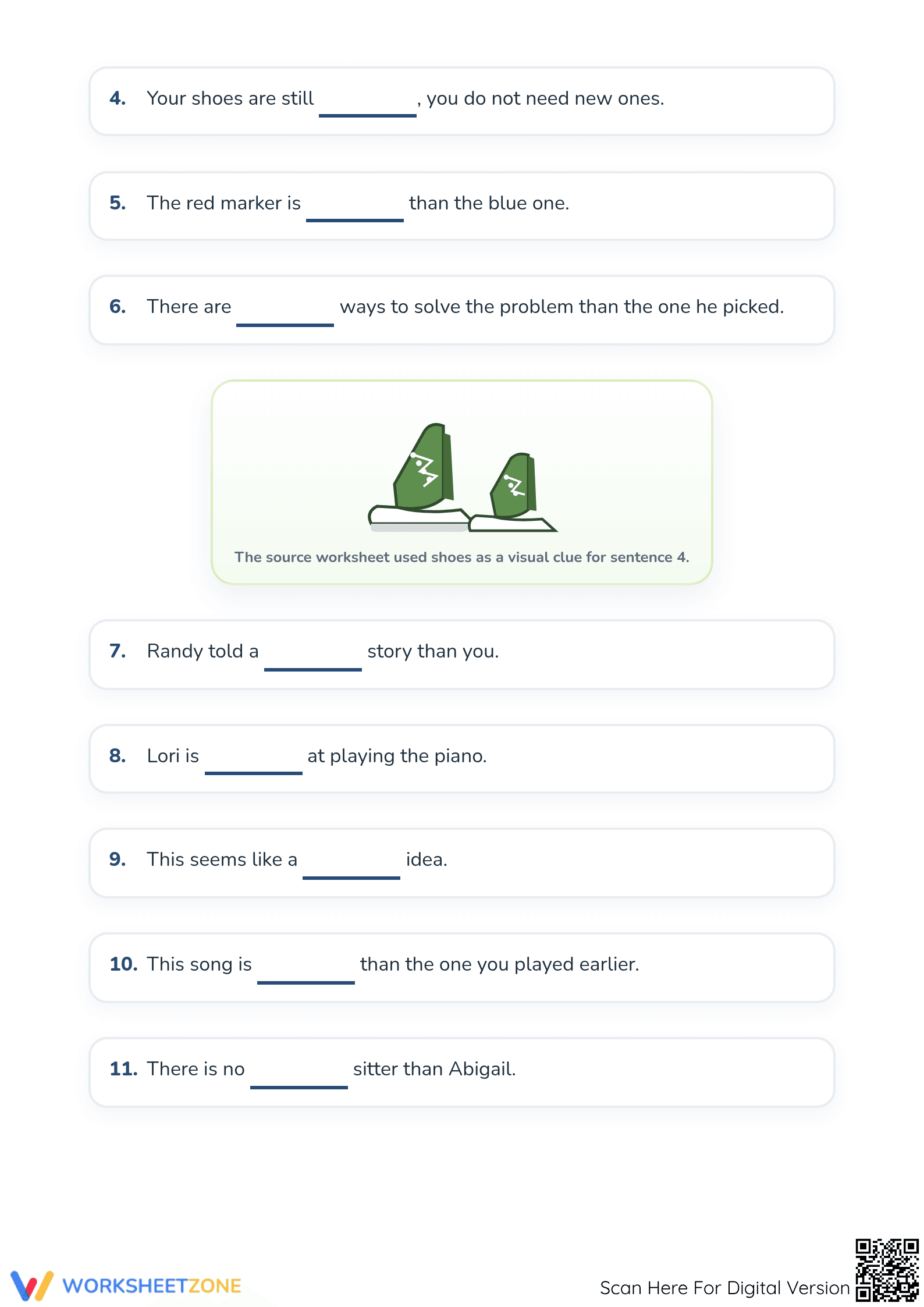
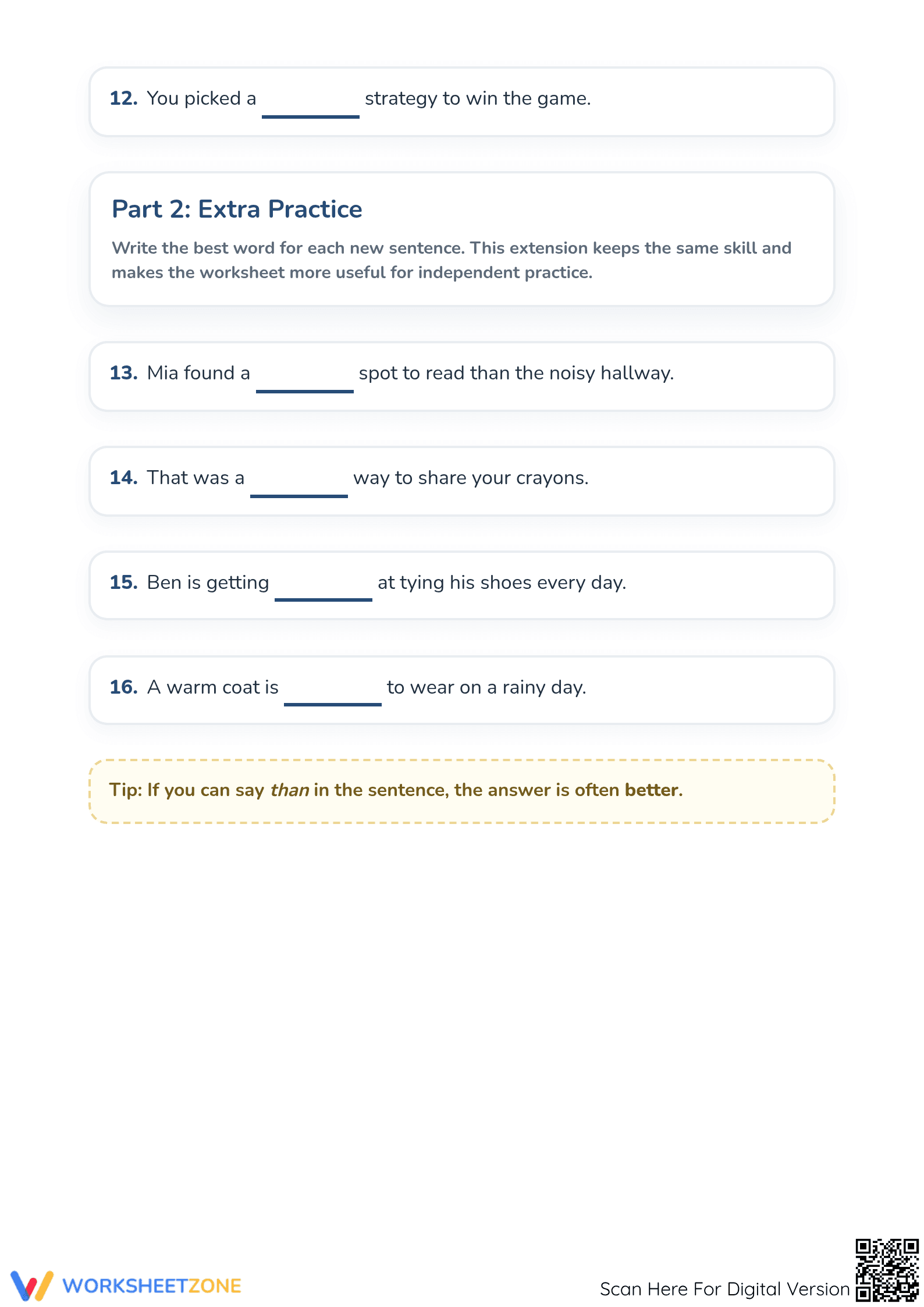
This comprehensive 3-page PDF includes a clear "Quick Reminder" anchor box that defines the rules for using "good" versus "better." The worksheet features 16 fill-in-the-blank sentences divided into two parts. Part 1 provides 12 foundational problems, while Part 2 offers 4 extra practice items. A full answer key is provided for rapid grading or student self-correction.
- Guided Practice: The initial anchor box and first three problems provide a high level of support, using clear comparative cues like the word "than" to signal the need for "better."
- Supported Practice: Problems 4 through 12 remove immediate visual cues, requiring students to analyze sentence context to determine if a comparison is occurring between two distinct nouns.
- Independent Practice: The "Extra Practice" section on page 3 challenges students to apply their knowledge to new contexts with minimal scaffolding, reinforcing the "I Do, We Do, You Do" instructional model.
This resource is specifically aligned to CCSS.ELA-LITERACY.L.2.1.E, which requires students to use adjectives and adverbs correctly. It focuses on the irregular comparative form of "good," ensuring students avoid common errors like "gooder." This standard code can be copied directly into lesson plans, IEP goals, or district curriculum mapping tools.
Use this worksheet as a formative assessment after a mini-lesson on comparative adjectives. During independent work, observe if students are circling the word "than" as a strategy to identify comparative sentences. This activity typically takes 15 to 20 minutes and works well as a quiet transition activity or a homework assignment to reinforce classroom instruction.
This resource is designed for second-grade students mastering basic grammar. It is also highly effective for English Language Learners (ELL) who need explicit practice with irregular adjectives. Pair this worksheet with a comparative adjective anchor chart or a short reading passage to see these words used in a narrative context.
Research from Fisher & Frey (2014) emphasizes the importance of the gradual release of responsibility, a framework mirrored in this worksheet's structure. By moving from a clear rule-based anchor box to independent sentence completion, students are more likely to internalize the grammatical distinction between positive and comparative adjectives. The specific focus on CCSS.ELA-LITERACY.L.2.1.E ensures that Grade 2 students are meeting national benchmarks for language conventions. Studies in the NAEP reports suggest that early mastery of irregular adjective forms, such as "good" and "better," significantly improves overall writing clarity and syntactic variety in primary grades. This 16-task resource provides the necessary repetition for students to move from rote memorization to functional application in their daily writing. By providing immediate feedback through the included answer key, teachers can address misconceptions in real-time, fostering a more robust understanding of how adjectives modify nouns in different contexts.


