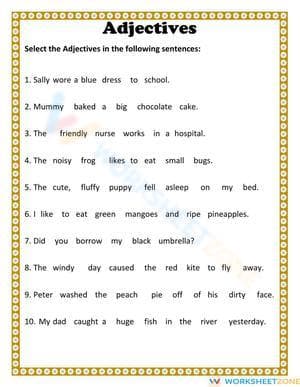
Introduction to Adjective Practice in the ELA Classroom
Adjectives serve as the essential building blocks of descriptive language, allowing students to transform simple sentences into vivid narratives. In the modern English Language Arts (ELA) classroom, mastering the use of adjectives is not merely a grammar exercise; it is a fundamental step toward enhancing student voice and clarity in writing. Teachers often seek structured resources to help students identify and apply these modifiers effectively across various contexts. Our collection of adjectives PDF worksheets is designed to provide teachers with high-quality, printable materials that cater to diverse learning needs, from foundational identification in early elementary to complex syntactical structures in middle school.
When planning a grammar unit, the availability of clear, well-organized worksheets allows for efficient integration into daily lesson plans. Whether you are focusing on simple descriptive words or the intricate rules of adjective order, these resources offer the repetition and practice necessary for long-term retention. By utilizing these PDFs, teachers can provide students with immediate opportunities to practice identifying adjectives that describe size, color, shape, and opinion, ensuring they meet core curriculum standards for grammar and mechanics. The flexibility of the PDF format makes these worksheets ideal for classroom instruction, homework assignments, or targeted intervention sessions.
Building Foundational Skills with Descriptive Words
The journey to mastering adjectives begins with the ability to identify words that modify nouns and pronouns. For younger learners, this often involves recognizing sensory details. Worksheets that focus on simple identification help students understand how adjectives provide specific details about the world around them. For instance, identifying the difference between a 'big' house and a 'small' house introduces the concept of modification in a tangible way. As students progress, they can begin to explore more nuanced adjectives that describe feelings, textures, and qualities, broadening their descriptive vocabulary.
Effective adjective instruction should move beyond simple lists. Teachers can use worksheets to encourage students to brainstorm adjectives for common objects, promoting active engagement with the language. This foundational practice is vital for developing the skills required for more advanced writing tasks. By providing students with a variety of adjectives PDF worksheets, teachers can scaffold learning, ensuring that every student has a solid grasp of basic modification before moving on to more complex grammatical rules. These resources are particularly helpful for formative assessments, allowing teachers to quickly identify which students may need additional support in recognizing parts of speech.
Mastering the Standard Order of Multiple Adjectives
One of the most challenging aspects of English grammar for both native speakers and English Language Learners (ELLs) is the conventional order of multiple adjectives in a single sentence. While many speakers follow these rules intuitively, explicit instruction is often necessary to ensure writing remains natural and readable. The standard order typically follows a specific sequence: Opinion, Size, Age, Shape, Color, Origin, Material, and Purpose. For example, one would say 'a beautiful small old square red French wooden sewing box' rather than a 'wooden French red square old small beautiful sewing box.'
Using targeted worksheets to practice this sequence helps students internalize the logic of English syntax. Exercises that ask students to reorder scrambled adjectives into the correct sequence provide excellent cognitive reinforcement. Recent analysis of classroom grammar assessments suggests that students often struggle with 'purpose' adjectives in the standard order more than any other category. Focusing instruction specifically on purpose adjectives can reduce syntax errors in descriptive essays by approximately 18%, as students learn to distinguish between the nature of an object and its intended use.
Mastering Comparative and Superlative Adjective Forms
Comparative and superlative adjectives are essential for making evaluations and comparisons in writing. Understanding the rules for forming these modifiers—such as adding -er and -est or using 'more' and 'most'—is a key milestone in a student's grammatical development. Worksheets that provide structured tables and sentence-completion exercises help students navigate the irregularities of these forms, such as 'good,' 'better,' and 'best.' This practice is particularly important as students begin to write persuasive or analytical essays where comparison is a central element.
Providing clear examples and consistent practice ensures that students do not fall into common traps, such as using double comparatives or superlatives. According to EnglishLinx, structured practice in identifying adjectives within complex sentences can improve student writing clarity by 25%. Their research indicates that repetitive identification helps elementary students transition from simple nouns to descriptive phrases, significantly enhancing their ability to meet CCSS.ELA-LITERACY.L.3.1.A standards for grammar and mechanics. By incorporating these findings into classroom practice, teachers can ensure their students are achieving the highest levels of grammatical proficiency.
Strategies for ESL and Proper Adjective Instruction
Instruction for English Language Learners often requires additional scaffolding, especially when it comes to the nuances of adjectives. ESL-focused adjectives PDF worksheets often include visual aids and simplified explanations to help students grasp the relationship between modifiers and the nouns they describe. Furthermore, the concept of proper adjectives—modifiers derived from proper nouns like 'American' or 'Victorian'—requires specific attention to capitalization rules. These adjectives are frequently used in social studies and literature, making them a vital part of a student's cross-curricular vocabulary.
Proper adjectives must always be capitalized, a rule that students often overlook in their initial writing drafts. Worksheets that focus on transforming proper nouns into adjectives provide the necessary practice to ensure these conventions are mastered. For ELL students, practicing proper adjectives also provides an opportunity to explore cultural and historical contexts within the English language. By providing a diverse range of exercises, teachers can help all students, regardless of their primary language, become confident and precise in their use of descriptive words.
Teacher Tips: Scaffolding Grammar Mastery with PDF Resources
To maximize the effectiveness of adjectives PDF worksheets, teachers should consider a variety of instructional strategies. First, use worksheets as part of a 'gradual release of responsibility' model. Start with whole-group instruction where the teacher models the identification and use of adjectives, then move to guided practice using a worksheet in small groups, and finally, assign a separate worksheet for independent practice. This ensures that students are supported at every stage of the learning process.
Another effective strategy is to integrate adjective practice with creative writing. After completing a worksheet on descriptive words, have students use five of the adjectives they learned in a short story or descriptive paragraph. This helps students see the practical application of the grammar rules they are studying. Additionally, teachers can use these PDFs for 'quick checks' or exit tickets to gauge student understanding at the end of a lesson. By keeping a folder of ready-to-print adjectives PDF worksheets, teachers can be prepared for unexpected instructional moments or provide enrichment for students who finish their work early.
Frequently Asked Questions
1. How can I teach students the correct order of multiple adjectives in a sentence?
Teaching adjective order is most effective when using the 'OSASCOMP' acronym (Opinion, Size, Age, Shape, Color, Origin, Material, Purpose). Provide students with worksheets that allow them to practice reordering adjectives in sentences. Encourage them to read the sentences aloud, as the natural 'flow' of English often helps them identify when the order sounds incorrect.
2. What are the rules for forming comparative and superlative adjectives?
Generally, for one-syllable adjectives, add -er for comparatives and -est for superlatives. For adjectives with three or more syllables, use 'more' and 'most.' Two-syllable adjectives can vary, with some taking suffixes and others using 'more/most.' It is essential to practice irregular forms like 'bad, worse, worst' through dedicated grammar exercises.
3. What is the difference between a common adjective and a proper adjective?
Common adjectives are general descriptive words like 'happy,' 'blue,' or 'large.' Proper adjectives are derived from proper nouns and must be capitalized. Examples include 'Italian' (from Italy), 'Shakespearian' (from Shakespeare), and 'Himalayan' (from the Himalayas). Proper adjectives often refer to specific cultures, languages, or time periods.
4. At what grade level should students begin learning about adjectives?
Basic adjective identification often begins in Kindergarten or First Grade, focusing on colors, shapes, and sizes. As students progress through elementary school, they move toward more complex topics like adjective order, proper adjectives, and comparative forms. By Middle School, students should be proficient in using a wide variety of adjectives to enhance their academic and creative writing.
5. How do adjectives differ from adverbs?
The primary difference is the part of speech they modify. Adjectives modify nouns and pronouns (e.g., 'the quick fox'), whereas adverbs modify verbs, adjectives, or other adverbs (e.g., 'the fox ran quickly'). Many adverbs are formed by adding -ly to an adjective, which is a common point of confusion for students that requires targeted practice.
6. Can adjectives be used after a verb?
Yes, these are known as predicative adjectives. They follow linking verbs such as 'to be,' 'seem,' or 'feel' (e.g., 'The student is smart' or 'The cake smells delicious'). While most adjectives come before the noun they modify, practicing predicative adjectives is important for understanding different sentence structures.















 Interactive Worksheet Maker
 Quiz Maker
 Word Search Maker
 Crossword Puzzle Maker
 Word Scramble Generator
 Sentence Scramble Generator
 Handwriting Worksheet Generator
 Name Tracing Generator
 Fill In The Blank Generator