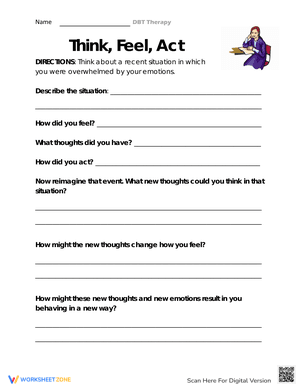
A solid chain analysis worksheet breaks the incident into five parts: vulnerability factors (what made the student more likely to react, like poor sleep or a rough morning at home), the prompting event (the specific trigger), the chain links (the thoughts, feelings, and body sensations that built between the trigger and the behavior), the problem behavior itself, and the consequences that followed, both immediate and longer-term.
Laying it out this way forces a slower, more honest look at the sequence than a quick verbal recap ever will. Students who struggle to explain why they reacted often find it easier to point to a specific link on paper and say, that's where I started losing it, than to narrate the whole thing from memory under stress.
Adapting the Worksheet by Age and Support Level
The full DBT model was built for adolescents and adults, so elementary teams typically need to simplify it. For younger students, that usually means fewer chain links, simpler vocabulary for feelings, and picture supports next to each stage of the sequence so a second or third grader can point instead of write. Middle and high school students can generally work with the complete model, including more nuanced vulnerability factors like sleep debt, peer conflict, or academic stress stacking up before an incident.
Whichever version you use, keep the sequence and the five core categories intact. The value of the tool comes from consistency across incidents, not from how detailed any single version looks.
Connecting Chain Analysis to Tier 2 PBIS Supports
Tier 2 supports like Check-In/Check-Out and social skills groups are designed to serve roughly 15% of students who need more than core Tier 1 instruction, and when delivered by typical school personnel rather than outside clinicians, these interventions are estimated to produce positive effects for up to 67% of referred students. Chain analysis strengthens that impact by giving Tier 2 teams a clear, specific replacement skill to target, rather than a vague plan to reduce problem behavior.
Once a worksheet identifies the exact link where a student's chain veered off course, whether it's a specific thought pattern, a sensory trigger, or a peer interaction, that becomes the skill you teach and reinforce through Check-In/Check-Out or a social skills group. The worksheet turns a general support into a targeted one.
Using Chain Analysis Data Across Multiple Incidents
A single completed worksheet is useful. A stack of them from the same student, collected over several incidents, is where the real pattern recognition happens. Behavior teams reviewing multiple chain analyses often start noticing recurring vulnerability factors, like Monday mornings after a chaotic weekend, or a specific class period right before lunch, that never showed up clearly in isolated incident reports.
That pattern data is exactly what strengthens a behavior intervention plan. Instead of writing a BIP goal around reducing outbursts in general, teams can target the specific prompting events and chain links that show up again and again, and build proactive supports around those moments instead of just responding after the fact.
Classroom Implementation
Chain analysis works best as a calm, private conversation, not a rushed exchange in a busy hallway. Give yourself 15 to 20 minutes in a quiet space once the student has regulated enough to reflect, not immediately in the heat of the moment. Walk through the worksheet together rather than handing it over to complete alone, especially the first few times, so you can model the kind of specific, concrete language the tool needs to be useful.
General education teachers can absolutely use a simplified version for quick classroom reflection, but the full model works best in the hands of counselors, behavior specialists, or trained paraprofessionals who can facilitate it consistently. Consistency matters here: if every staff member fills out the worksheet differently, the pattern data across incidents becomes much harder to use. A short training session on how to word prompts and probe for specifics goes a long way toward keeping the data comparable.
Frequently Asked Questions
1. What is a DBT chain analysis worksheet and how is it different from a standard behavior incident report?
An incident report typically records what happened and when. A chain analysis worksheet goes further, mapping the vulnerability factors, prompting event, chain of thoughts and feelings, and consequences that led up to the behavior, so staff can identify where an intervention could change the outcome.
2. Which grade levels or student populations benefit most from chain analysis worksheets in schools?
Chain analysis is most often used with students receiving Tier 2 or Tier 3 individualized behavior support. Middle and high schoolers can typically use the full model, while elementary students benefit from a simplified version with fewer links and picture supports.
3. How long should a chain analysis conversation take with a student after an incident?
Plan for about 15 to 20 minutes once the student is regulated enough to reflect. Rushing the conversation, or attempting it immediately after the behavior, tends to produce vague or incomplete answers.
4. Can general education teachers use these worksheets, or are they only for counselors and specialists?
General education teachers can use a simplified version for a quick classroom reflection, but the full DBT model is best facilitated by counselors, behavior specialists, or trained paraprofessionals who can apply it consistently across incidents.
5. How does chain analysis fit into a student's existing behavior intervention plan (BIP) or Tier 2 supports?
Completed worksheets across multiple incidents help teams spot recurring triggers and chain links, which can sharpen BIP goals and give Tier 2 supports like Check-In/Check-Out a specific replacement skill to reinforce rather than a general behavior reduction target.















 Interactive Worksheet Maker
 Quiz Maker
 Word Search Maker
 Crossword Puzzle Maker
 Word Scramble Generator
 Sentence Scramble Generator
 Handwriting Worksheet Generator
 Name Tracing Generator
 Fill In The Blank Generator