What Boundaries Circle Worksheets Teach
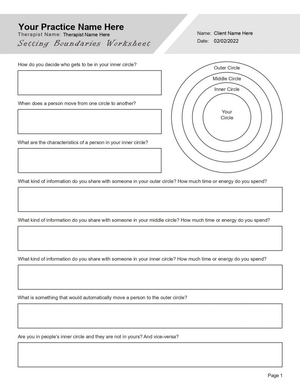
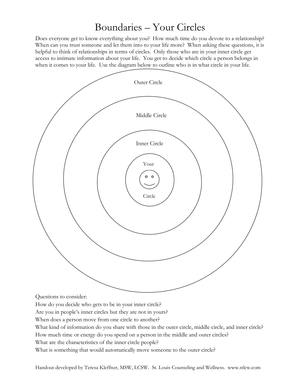
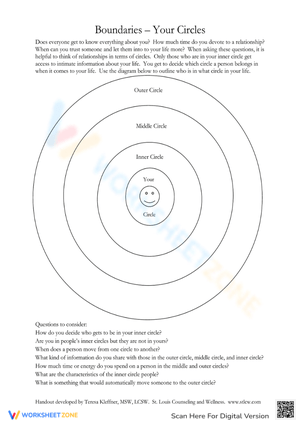
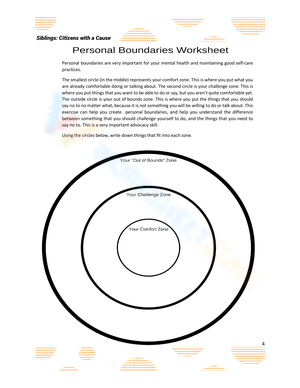
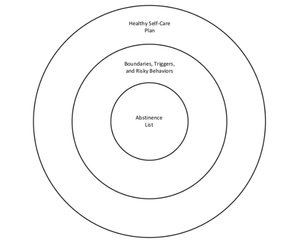
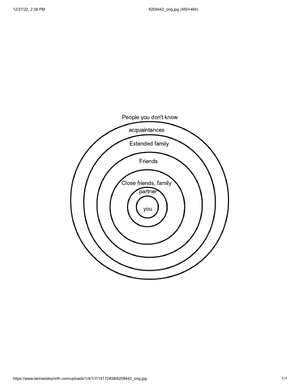
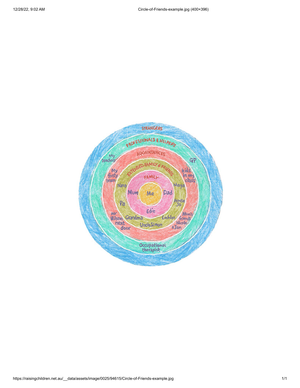
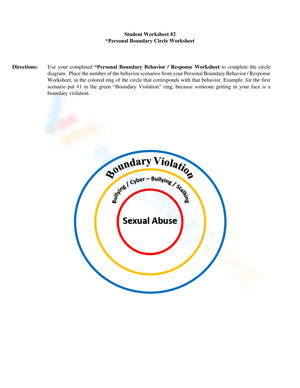
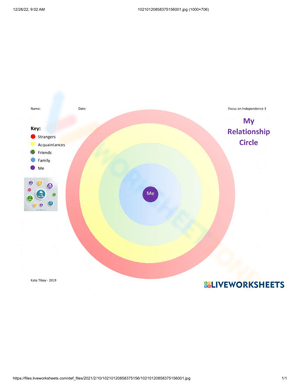
Boundaries circle worksheets give students a printable, concentric-ring diagram for sorting the people in their lives by trust level. Instead of talking about personal space in the abstract, students place family, friends, classmates, and strangers into rings that show who they can trust with information, closeness, and physical contact. For US teachers and school counselors, that visual makes an invisible social rule into something students can point to, label, and revisit.
The tool fits behavior lessons, morning meetings, calm-down corners, and small-group counseling far better than whole-group academic blocks. Students who struggle to read social cues get a concrete reference they can carry between the counseling office and the classroom. That portability matters: a boundary only holds if the student remembers it in the hallway, not just at the counseling table.
How the Concentric Trust Model Maps to Relationships
Most versions use three to four rings, often color-coded. A blue center ring holds immediate family and the small group of adults a child fully trusts. A green ring holds close friends and extended family. A yellow ring holds known acquaintances such as classmates, bus drivers, and teachers. Some versions add an orange or red ring for strangers.
Each ring carries a different rule for personal space and information. A student might hug someone in the blue ring but only wave to someone in the yellow ring. Pairing the diagram with yes/no scenario cards, such as Is it okay for this person to know my home address?, turns the color sorting into judgment practice students can defend out loud.
Boundaries Circles vs. the Circle of Control
Teachers often confuse two similar-looking tools. A boundaries circle sorts people by trust. A Circle of Control, adapted from Stephen Covey's 7 Habits, sorts situations by what a student can and cannot change: their own choices, words, and actions inside the circle; other people's behavior and unexpected events outside it.
Both build self-management, but they answer different questions. Use a boundaries circle when a student needs help deciding who gets access. Reach for a Circle of Control when a student is stuck reacting to things outside their power. A quick way to remember the split: boundaries circles answer who, and the Circle of Control answers what. Keeping that distinction clear stops students from blending the two tools into one vague lesson about feelings.
Classroom Implementation
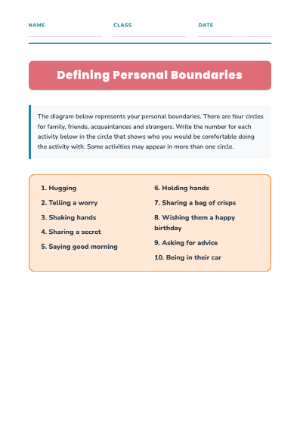
A boundaries circle activity fits a 15-20 minute block. Open with a quick model on the board, then hand out the printable and read three or four scenario cards aloud. Students place each person or situation in a ring and mark the yes/no card that matches.
- Model one example in each ring before students work independently.
- Read scenarios aloud so reading level never blocks the social thinking.
- Circulate and note which students place strangers in inner rings or push family to the edge.
- Debrief as a group, asking two or three students to defend one placement.
Prep is light. Print one circle per student, pull four to six scenario cards that match your group's grade, and keep colored pencils nearby if your version uses color coding. For a calm-down corner, laminate one large circle so a student can sort with dry-erase markers whenever they need to reset. The same printable carries across a full unit, so you can revisit it in week one and week six without new materials.
Differentiating Across Grade Levels
Early elementary students do best with simple yes/no scenarios and two or three rings. Keep the categories concrete: people who live with me, people I know, people I don't know. Upper elementary and middle school students can handle four rings and nuanced trust levels, including the idea that a person can move rings over time as a friendship grows or a situation changes.
Middle schoolers benefit from a layer of nuance around online relationships. A follower, a group-chat member, and a gaming contact rarely fit the same ring as a face-to-face friend, and sorting them prompts a useful conversation about what strangers can learn online. Adding one or two digital scenarios keeps the tool relevant for students whose social lives run partly on a screen.
Common Challenges and How to Debrief
Two patterns show up often. Some students over-trust, placing nearly everyone in the inner rings because they want to be kind or fear leaving someone out. Others under-trust, pushing teachers and classmates to the outer ring after a hard experience. Neither is a mistake to red-pen. Instead, ask a gentle question: What would this person need to do to move one ring closer? That framing keeps the student in charge of the boundary while opening the door to healthier reasoning.
Debriefing works best when you normalize disagreement. Two students can place the same person in different rings and both be right, because trust depends on their real experience. Say that out loud. When students hear that their circle is theirs to draw, they stop guessing the correct answer and start reporting what they actually feel, which is the data a counselor needs.
Reading Boundaries Circles as Formative Data
The real value shows up in the outliers. When a student consistently places strangers in the blue center ring or pushes a parent to the outer edge, that pattern is a formative signal, not a wrong answer to correct on the spot. Counselors who log these placements across a small group can spot the two or three students who need individualized boundary-setting support before a behavior incident forces the conversation. Treat the completed sheet as a snapshot of how a child currently reads trust, and revisit it after four to six weeks to see whether teaching moved the placements.
According to CASEL, relationship skills and self-management rank among the five core social and emotional learning competencies, and boundaries circle worksheets target both in a single task. One 20-minute sorting activity gives students repeated practice deciding who earns access to their personal space, information, and physical contact.
Frequently Asked Questions
1. What grade levels are boundaries circle worksheets appropriate for?
They work best in K-5, with simplified two- or three-ring versions for kindergarten and first grade and four-ring versions for grades 3-8. The core idea, sorting people by trust, scales up as students handle more nuance.
2. How is a boundaries circle different from a Circle of Control?
A boundaries circle sorts people by trust level. A Circle of Control sorts situations by what a student can and cannot change. Both build self-management, but they answer different questions and work well as a paired unit.
3. How long should a boundaries circle lesson take?
Plan 15-20 minutes for a small-group counseling session or morning meeting: a few minutes to model, about ten minutes to sort and answer scenarios, and five minutes to debrief.
4. How can teachers adapt the circles for different family structures?
Keep the inner ring flexible. Let students define the people who take care of me rather than naming specific roles, so the activity respects every family structure and cultural norm without singling anyone out.
5. What SEL competencies does this activity support?
It targets relationship skills and self-management, two of the five competencies in the CASEL framework, by giving students structured practice in reading trust and managing their own responses.












 Interactive Worksheet Maker
 Quiz Maker
 Word Search Maker
 Crossword Puzzle Maker
 Word Scramble Generator
 Sentence Scramble Generator
 Handwriting Worksheet Generator
 Name Tracing Generator
 Fill In The Blank Generator