


























Views
Downloads
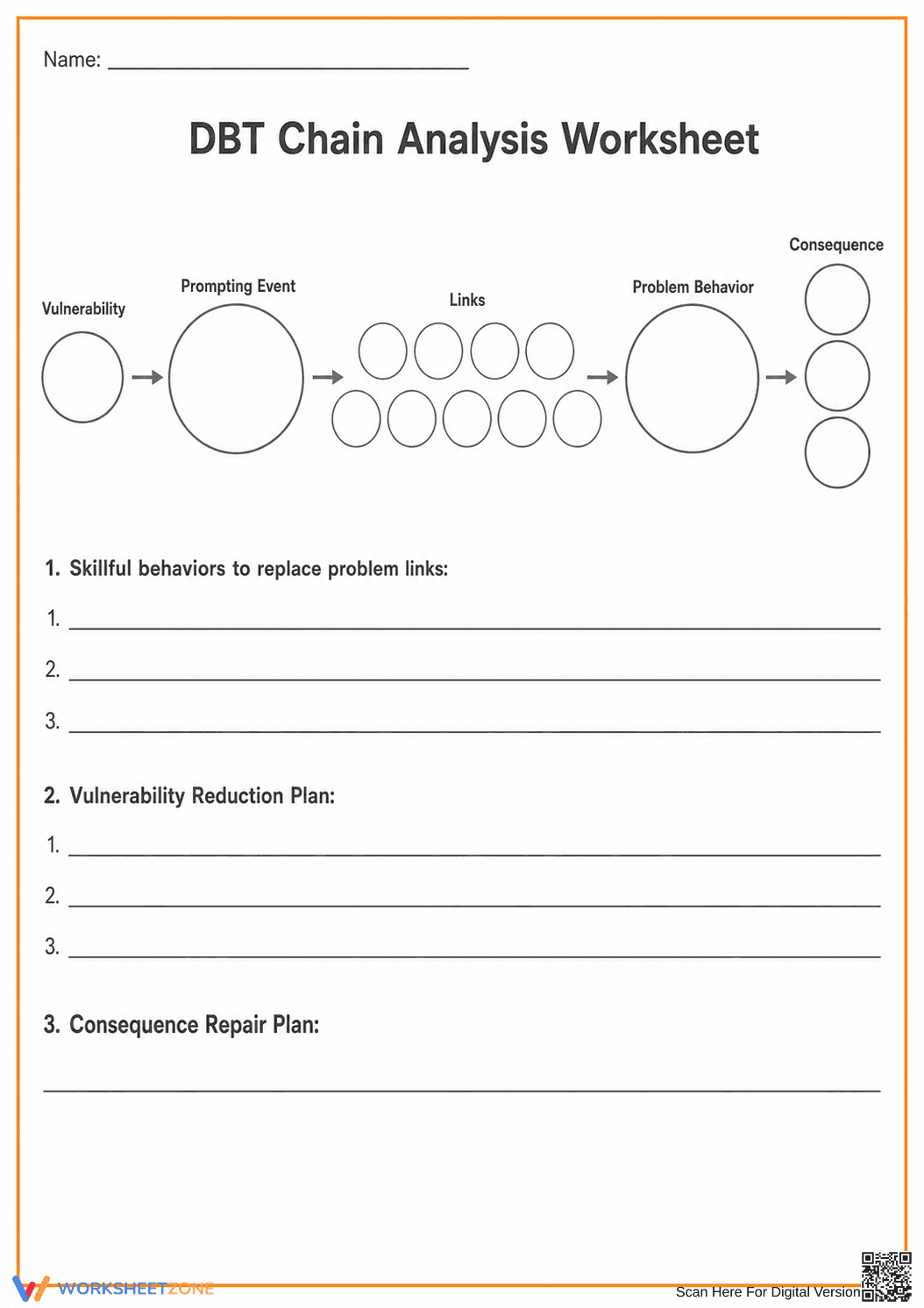

Grade 8 Behavior Analysis — Printable No-Prep Worksheet
Paste this activity's link or code into your existing LMS (Google Classroom, Canvas, Teams, Schoology, Moodle, etc.).
Students can open and work on the activity right away, with no student login required.
You'll still be able to track student progress and results from your teacher account.
This Grade 8 behavior analysis worksheet helps students map out the sequence of events leading to specific actions. By breaking down triggers and consequences, learners develop critical self-awareness to replace problematic responses with constructive alternatives.
At a Glance
- Grade: 8 · Subject: Social Skills
- Standard:
CCSS.ELA-LITERACY.W.8.3— Organize an event sequence that unfolds naturally and logically- Skill Focus: Behavior analysis and sequence mapping
- Format: 1 page · 4 sections · No answer key · PDF
- Best For: Independent reflection and behavioral counseling
- Time: 15–25 minutes
This single-page resource features a visual flowchart guiding students through a chain analysis. The top half includes a diagram with spaces for the vulnerability, prompting event, behavioral links, problem behavior, and consequence. The bottom half provides three structured writing sections where students draft skillful replacement behaviors, a vulnerability reduction plan, and a consequence repair plan. Because this is a personal reflection tool, no answer key is required.
- Print (1 minute): Print the single-page PDF. No special formatting or double-sided copying is required.
- Distribute (1 minute): Hand out during a social-emotional learning block, advisory period, or counseling session.
- Review (3 minutes): Briefly explain the flowchart components so students understand how to trace actions backward to the initial prompting event.
With under two minutes of total teacher preparation time, this resource is highly effective for immediate intervention or as a meaningful, zero-prep activity for a substitute teacher handling an advisory class.
Aligned to CCSS.ELA-LITERACY.W.8.3, this worksheet requires students to organize an event sequence that unfolds naturally and logically. By mapping out the chronological links between a trigger and a consequence, students practice narrative sequencing in a highly personal, applied context. Both standard codes can be copied directly into lesson plans, IEP goals, or district curriculum mapping tools.
Use this tool immediately following a behavioral incident to help a student objectively analyze their choices and de-escalate. Alternatively, assign it during a proactive social skills lesson where students analyze a hypothetical scenario to practice the chain analysis process. As a formative assessment tip, review the replacement behaviors section to gauge if the student can independently generate realistic, positive coping strategies. Expected completion time is 15 to 25 minutes.
This resource is primarily designed for middle school students who benefit from structured emotional regulation support. It is highly effective for students with IEPs for behavioral goals or those participating in Tier 2 counseling interventions. Pair this worksheet with a direct instruction lesson on identifying personal triggers or a classroom anchor chart detailing common coping mechanisms.
Integrating structured reflection tools like this CCSS.ELA-LITERACY.W.8.3 aligned worksheet helps students organize an event sequence that unfolds naturally and logically, which is a critical component of both narrative writing and behavioral development. According to the RAND AIRS 2024 report, explicit instruction in social-emotional sequencing and self-regulation significantly improves long-term student outcomes, enhances peer relationships, and drastically reduces classroom disruptions. By utilizing a visual chain analysis, educators provide a concrete, accessible framework for abstract emotional concepts, allowing learners to systematically identify personal vulnerabilities, recognize environmental triggers, and plan constructive, prosocial alternatives. This evidence-based approach ensures that behavioral interventions are both educational and restorative, rather than merely punitive. When students can articulate the step-by-step progression of their actions, they build the metacognitive skills necessary for lifelong emotional intelligence and academic resilience.


