


























Views
Downloads

Classroom Rules Mini Book | Grade K-2 Printable
Paste this activity's link or code into your existing LMS (Google Classroom, Canvas, Teams, Schoology, Moodle, etc.).
Students can open and work on the activity right away, with no student login required.
You'll still be able to track student progress and results from your teacher account.
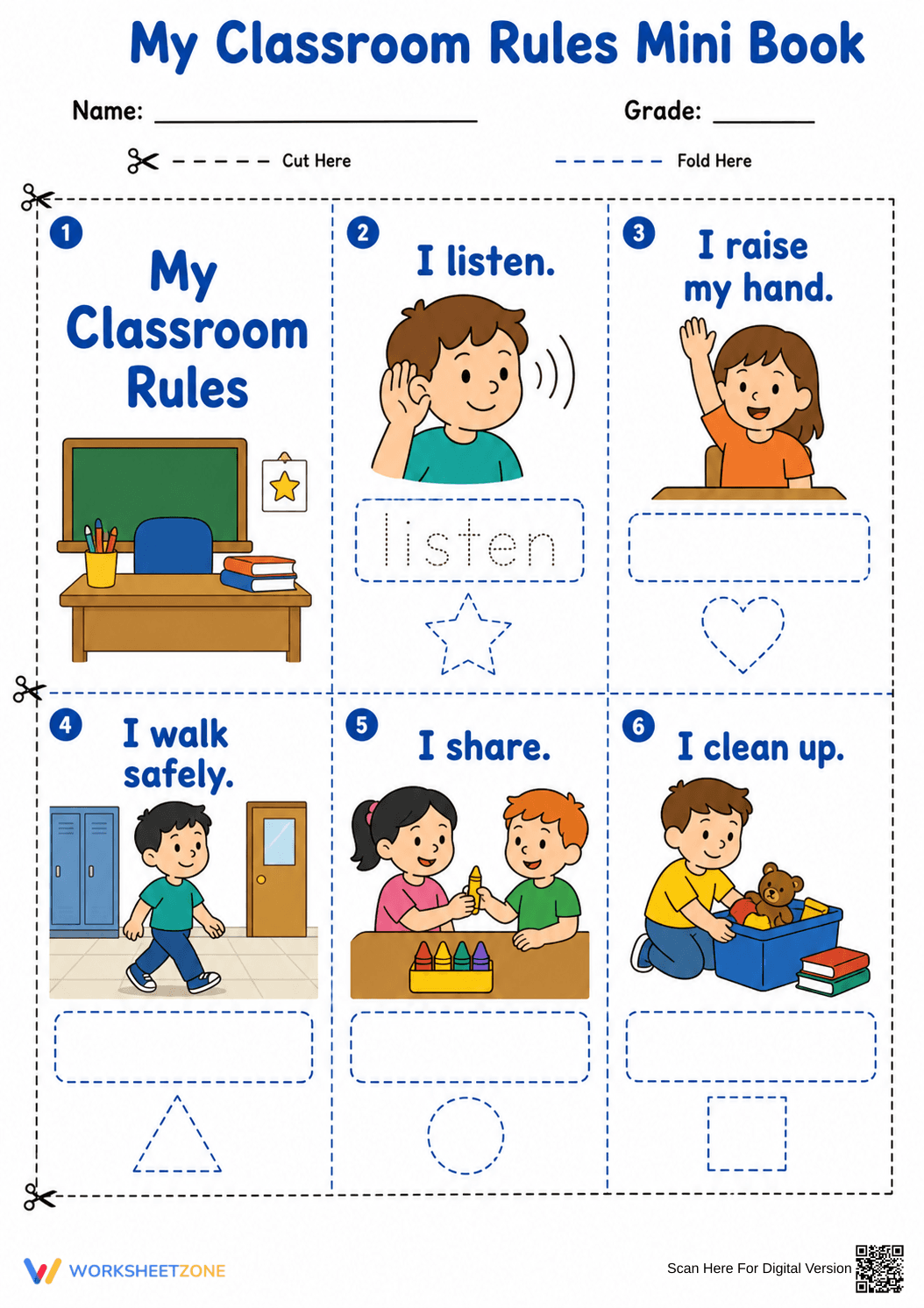
This Grade K-2 classroom rules mini book helps students internalize behavioral expectations through hands-on creation. By cutting, folding, and tracing, learners engage with five essential school behaviors. This activity transforms abstract expectations into a tangible reference tool that students can keep in their desks for daily reinforcement and self-regulation.
At a Glance
- Grade: K-2 · Subject: Social Emotional Learning
- Standard:
SL.K.1.A— Follow agreed-upon rules for discussions and behavioral expectations in the classroom- Skill Focus: Classroom Management & Fine Motor
- Format: 1 page · 6 panels · No answer key needed · PDF
- Best For: First week of school activity
- Time: 15–20 minutes
What's Inside
This single-page PDF features a 6-panel layout designed for easy assembly. It includes a title page and five specific behavioral prompts: listening, raising hands, walking safely, sharing, and cleaning up. Each panel contains a high-quality illustration, a tracing word for literacy support, and a geometric shape for coloring or additional fine-motor practice. The clear dashed lines indicate exactly where students should cut and fold.
Zero-Prep Workflow
- Print: Generate one copy per student. The black-and-white friendly design ensures clear icons even on standard school copiers. (1 minute)
- Distribute: Provide students with scissors and crayons. Students follow the "Cut Here" and "Fold Here" guides to assemble their personal books. (10 minutes)
- Review: Lead a whole-group discussion for each rule. Have students trace the action words as you model the behavior. (5 minutes)
Standards Alignment
The primary standard addressed is `CCSS.ELA-LITERACY.SL.K.1.A`, which requires students to follow agreed-upon rules for discussions and interactions. By identifying and tracing these rules, students demonstrate an understanding of the social norms required for a productive learning environment. This standard code can be copied directly into lesson plans, IEP goals, or district curriculum mapping tools.
How to Use It
Use this mini book during the first week of school as a primary instruction tool for classroom management. After discussing each rule, have students complete the corresponding panel. For formative assessment, observe students during the "I walk safely" or "I clean up" panels to see if they can articulate why these rules keep the classroom community safe. This resource is also perfect for a substitute teacher's emergency folder.
Who It's For
This resource is designed for Kindergarten, 1st Grade, and 2nd Grade students, particularly those who benefit from tactile learning. It is an excellent pairing for a "First Day of School" read-aloud or an anchor chart session. It also serves as a helpful visual support for English Language Learners and students with IEPs who require explicit social skill instruction.
According to the RAND AIRS 2024 report on social-emotional learning, providing students with concrete, portable reminders of behavioral expectations significantly reduces classroom disruptions in early elementary settings. This mini book aligns with the `SL.K.1.A` standard by moving beyond verbal instruction to a multi-sensory experience where students physically construct their understanding of school rules. Research by Fisher & Frey (2014) emphasizes that the gradual release of responsibility begins with clear, modeled expectations that students can reference independently. By tracing the words "listen" and "share," students connect literacy skills with social behaviors, reinforcing the standard's goal of collaborative participation. This 1-page printable provides a structured framework for teachers to establish a positive classroom culture while simultaneously supporting fine motor development and early writing skills through a high-engagement, low-prep format that fits into any morning meeting or SEL block.


