


























Views
Downloads
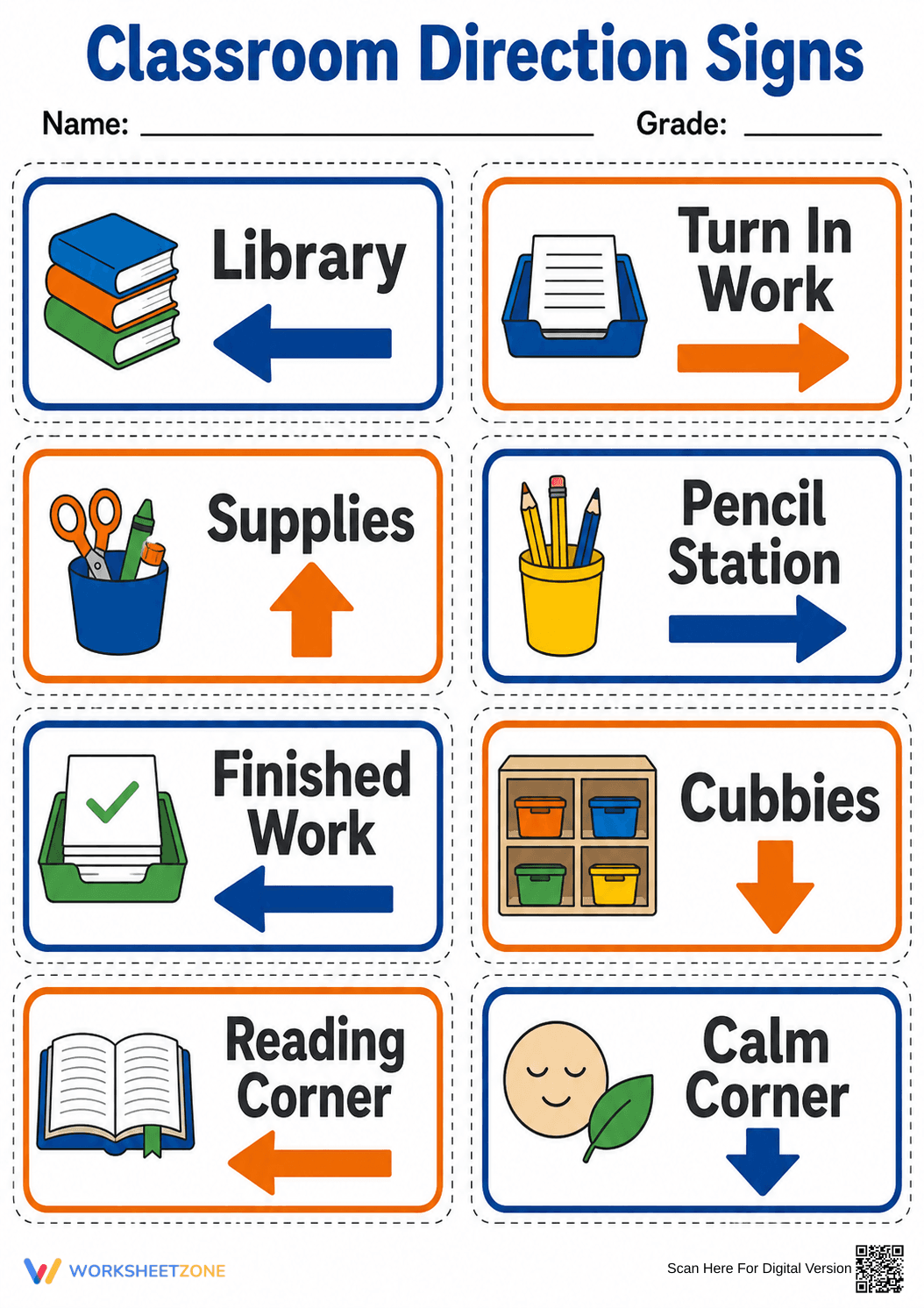

Printable Classroom Direction Signs | Grade K-5
Paste this activity's link or code into your existing LMS (Google Classroom, Canvas, Teams, Schoology, Moodle, etc.).
Students can open and work on the activity right away, with no student login required.
You'll still be able to track student progress and results from your teacher account.
Effective classroom management begins with clear visual communication. These printable classroom direction signs provide students with immediate wayfinding cues, fostering independence during transitions and center rotations. By pairing bold text with recognizable icons and directional arrows, teachers can reduce repetitive verbal instructions and create a more organized, student-centered learning environment.
At a Glance
- Grade: K-5 · Subject: Classroom Management
- Standard:
CCSS.ELA-LITERACY.RI.K.7— Use illustrations and text to describe relationships in a classroom setting- Skill Focus: Wayfinding and Independence
- Format: 1 page · 8 signs · Visual icons included · PDF
- Best For: Classroom setup and visual organization
- Time: 5–10 minutes
This resource features 8 distinct direction signs on a single A4 page. Each sign includes a high-contrast border, a specific classroom label, a directional arrow, and a supporting icon. The labels cover essential zones: Library, Turn In Work, Supplies, Pencil Station, Finished Work, Cubbies, Reading Corner, and Calm Corner. Dotted cut lines surround each rectangular sign to ensure easy preparation and a professional look once displayed.
The zero-prep workflow for this resource is designed for busy educators. First, print the single-page PDF on standard paper or heavy cardstock (1 minute). Second, use the dotted guides to cut the 8 individual signs using a paper trimmer or scissors (3 minutes). Third, post the signs at eye level near the corresponding classroom stations using adhesive or magnets (2 minutes). Total teacher preparation time is under 6 minutes, making this an ideal addition to a back-to-school setup or a mid-year reorganization.
This resource aligns with CCSS.ELA-LITERACY.RI.K.7, which focuses on the relationship between illustrations and text. By using these signs, students practice reading their environment through multi-modal cues. This supports functional literacy and environmental print recognition. Both standard codes can be copied directly into lesson plans, IEP goals, or district curriculum mapping tools.
Use these signs during the first week of school to conduct a Classroom Scavenger Hunt. Have students find each station and explain what happens there. For formative assessment, observe which students rely on the icons versus the text to navigate. This activity takes approximately 10 minutes during a morning meeting or orientation session and helps establish clear procedural expectations from day one.
This resource is ideal for elementary teachers (K-5) looking to streamline classroom procedures. It is particularly effective for English Language Learners (ELLs) and students with executive functioning challenges who benefit from visual schedules and environmental cues. Pair this with a classroom map or an anchor chart about classroom expectations to provide a comprehensive support system for student movement.
Environmental print and visual wayfinding are critical components of a functional literacy environment. According to Fisher & Frey (2014), the use of visual cues and environmental labeling supports the gradual release of responsibility by providing permanent scaffolds for student independence. These 8 classroom direction signs utilize the CCSS.ELA-LITERACY.RI.K.7 standard to bridge the gap between abstract text and physical space. By integrating icons with directional arrows, the resource reduces cognitive load during transitions, allowing students to focus on academic tasks rather than procedural confusion. Research from the RAND AIRS 2024 report suggests that structured classroom environments with clear visual boundaries correlate with higher student engagement and fewer behavioral disruptions. This printable set serves as a foundational tool for establishing a predictable, navigable classroom that supports diverse learners through universal design principles.


