


























Views
Downloads
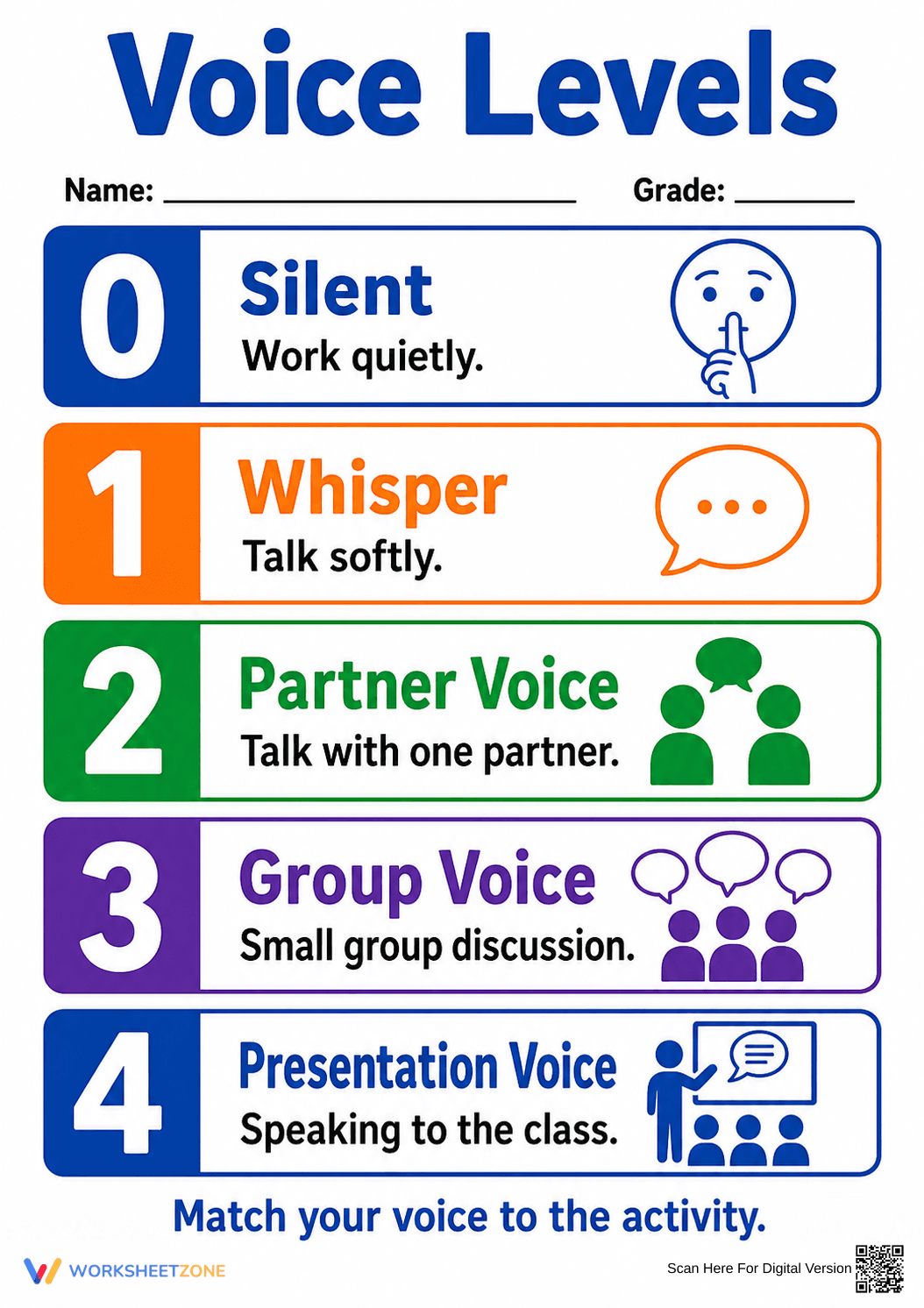

Printable Voice Levels Chart | Grades K-5
Paste this activity's link or code into your existing LMS (Google Classroom, Canvas, Teams, Schoology, Moodle, etc.).
Students can open and work on the activity right away, with no student login required.
You'll still be able to track student progress and results from your teacher account.
This printable voice levels chart establishes clear classroom expectations for student volume during different activities. By providing visual cues for five distinct noise levels, teachers can effectively manage classroom behavior and foster a productive learning environment. Students learn to self-regulate their speaking volume based on the instructional context.
At a Glance
- Grade: K-5 · Subject: Classroom Management
- Standard:
CCSS.ELA-LITERACY.SL.1.1.A— Follow agreed-upon rules for discussions- Skill Focus: Voice regulation
- Format: 1 page · 5 levels · No answer key · PDF
- Best For: Classroom display
- Time: 5–10 minutes
This single-page visual resource features five color-coded voice levels ranging from zero to four. Each tier includes a clear numerical indicator, a descriptive title such as "Whisper" or "Group Voice," a brief behavioral expectation, and a corresponding icon to support early readers. The clean layout ensures visibility from across the room, making it an essential reference tool for daily routines.
Implementing this visual support requires minimal teacher preparation:
- Print (1 minute): Generate a high-quality color copy of the PDF file.
- Distribute (1 minute): Laminate the poster for durability and mount it in a highly visible location at the front of the room.
- Review (3 minutes): Introduce the chart to the class, modeling each volume level and explaining when each is appropriate.
Total setup takes under five minutes, making it an ideal, zero-prep addition to back-to-school routines or mid-year classroom resets.
This resource aligns with CCSS.ELA-LITERACY.SL.1.1.A: "Follow agreed-upon rules for discussions (e.g., listening to others with care, speaking one at a time about the topics and texts under discussion)." It also supports general behavioral expectations for collaborative work across all elementary grades. Both standard codes can be copied directly into lesson plans, IEP goals, or district curriculum mapping tools.
Teachers can reference this chart before transitioning into new activities. For example, prior to independent reading, the teacher can point to level zero to establish the expectation for silence. During collaborative projects, the teacher can indicate level three to authorize small group discussions. As a formative assessment observation tip, educators can monitor how quickly students adjust their volume when a new level is announced, providing immediate positive reinforcement for compliance. Expected introduction time is five to ten minutes.
This poster is designed for primary and upper elementary students in Grades K-5. The inclusion of visual icons makes it highly accessible for English Language Learners and students who benefit from non-verbal behavioral cues. It pairs perfectly with beginning-of-the-year procedures lessons or anchor charts detailing specific group work expectations.
Establishing clear, visual expectations for classroom behavior is a foundational component of effective classroom management. This resource directly supports CCSS.ELA-LITERACY.SL.1.1.A by helping students follow agreed-upon rules for discussions and collaborative work. According to Fisher & Frey (2014), explicit instruction in self-regulation and clear visual supports significantly reduce behavioral disruptions and increase academic engagement time. When students understand exactly what volume is expected of them, they are better equipped to participate appropriately in both independent and group settings. By utilizing a standardized numerical system for voice regulation, educators create a predictable environment that lowers cognitive load and anxiety for learners. This structured approach to communication ensures that all students can focus on their academic tasks without unnecessary auditory distractions, ultimately fostering a more supportive and productive educational climate.


