


























Views
Downloads
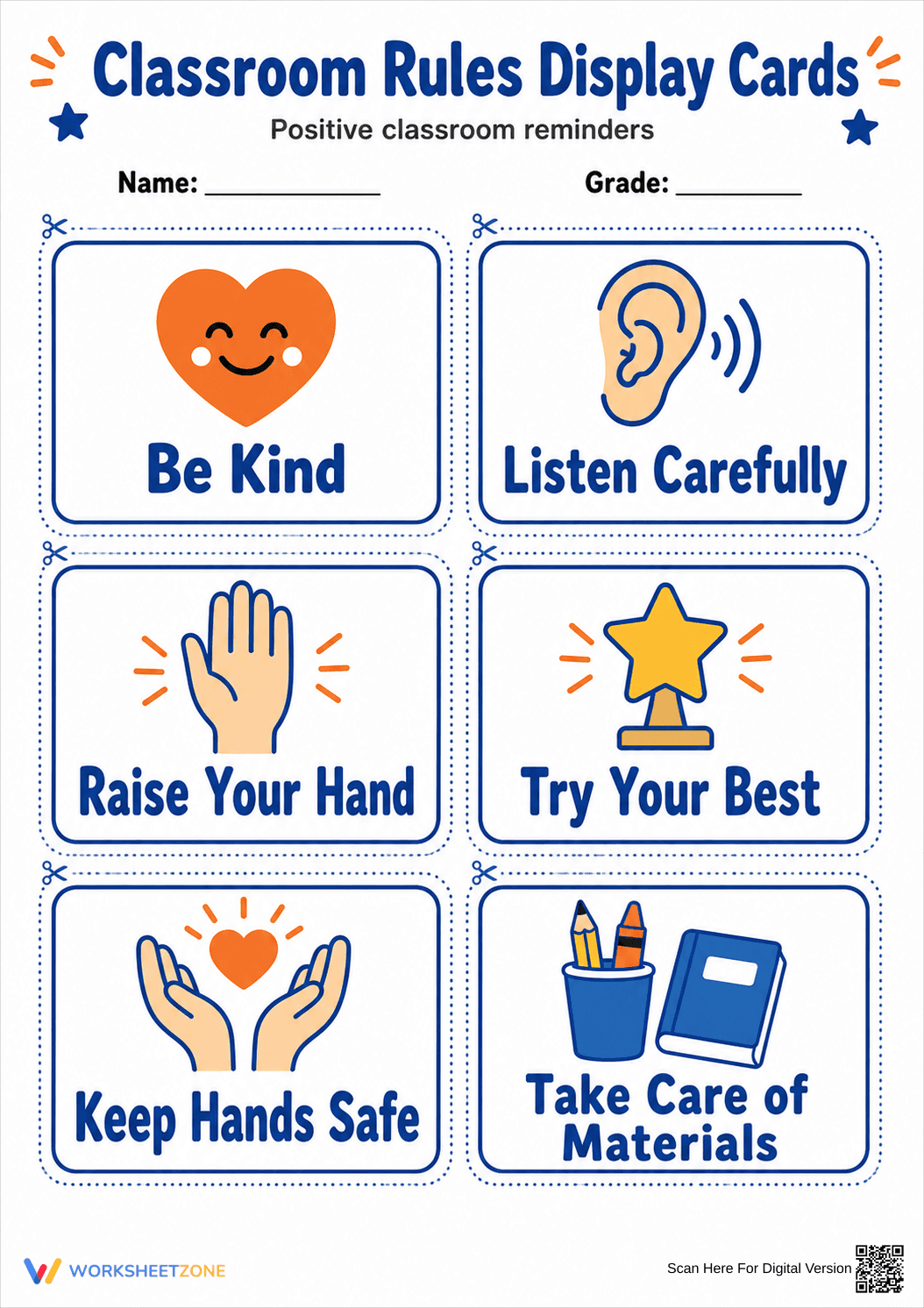

Classroom Rules Display Cards | Grade K Printable
Paste this activity's link or code into your existing LMS (Google Classroom, Canvas, Teams, Schoology, Moodle, etc.).
Students can open and work on the activity right away, with no student login required.
You'll still be able to track student progress and results from your teacher account.
Establish positive classroom expectations early with these visual rule cards. This resource provides young learners with clear, actionable reminders for daily behavior. By displaying these six foundational rules, teachers help students understand how to interact safely and respectfully in their shared learning environment.
At a Glance
- Grade: K · Subject: ELA
- Standard:
CCSS.ELA-LITERACY.SL.K.1.A— Follow agreed-upon rules for discussions- Skill Focus: Positive Behavior Expectations
- Format: 1 page · 6 cards · No answer key · PDF
- Best For: Classroom decor and management
- Time: 10–15 minutes
This single-page printable features six distinct classroom rule cards arranged in an easy-to-cut grid. Each card pairs a short, positive phrase with a simple icon to support early readers. The design utilizes a clean white background with blue and orange accents, ensuring visibility on a wall or desk. Dotted lines guide precise cutting.
Zero-Prep Workflow
Setting up these visual reminders requires minimal effort.
- Print (1 minute): Generate the PDF on heavy cardstock.
- Distribute (2 minutes): Cut along the dotted lines to separate the six cards.
- Review (5 minutes): Introduce each card during morning meeting.
Total teacher prep time is under two minutes, providing an immediate classroom management tool.
Standards Alignment
This resource aligns directly with CCSS.ELA-LITERACY.SL.K.1.A, which requires students to follow agreed-upon rules for discussions, such as listening to others and taking turns speaking. By making these abstract concepts visual, the cards provide a concrete reference point for collaborative conversations. A supporting focus on general social-emotional learning helps establish a safe community. Both standard codes can be copied directly into lesson plans, IEP goals, or district curriculum mapping tools.
How to Use It
These cards are versatile for daily routines. Before a whole-group lesson, hold up the "Listen Carefully" card to non-verbally prompt expected behaviors. During independent work, reference "Take Care of Materials" to keep students responsible. As a formative assessment observation tip, note which students independently reference the visual cues before interacting with peers. Initial introduction takes 10 to 15 minutes.
Who It's For
This printable is designed primarily for Kindergarten through second-grade students who benefit from explicit, visual behavioral cues. The combination of simple text and clear icons makes it highly accessible for early readers, English Language Learners, and students requiring visual schedules or behavioral supports. For differentiation, teachers can provide individual students with a personal, scaled-down set of these cards taped to their desks. This resource pairs perfectly with an anchor chart about community building or a direct instruction lesson on classroom citizenship.
Integrating visual supports like the CCSS.ELA-LITERACY.SL.K.1.A standard for following agreed-upon rules for discussions is a critical component of effective early childhood education. When students can see and reference positive behavior expectations, they are more likely to internalize and demonstrate those skills. According to Fisher & Frey (2014), establishing clear, visible routines and expectations significantly reduces behavioral disruptions and increases academic engagement time. By explicitly teaching and displaying these six foundational rules, educators create a predictable environment where young learners feel secure. This structured approach to classroom management not only supports immediate behavioral compliance but also fosters long-term self-regulation and peer collaboration skills. Providing visual cues ensures that all students, regardless of their reading level or language proficiency, have equitable access to the community standards, ultimately driving a more cohesive and supportive classroom culture.


