


























Views
Downloads
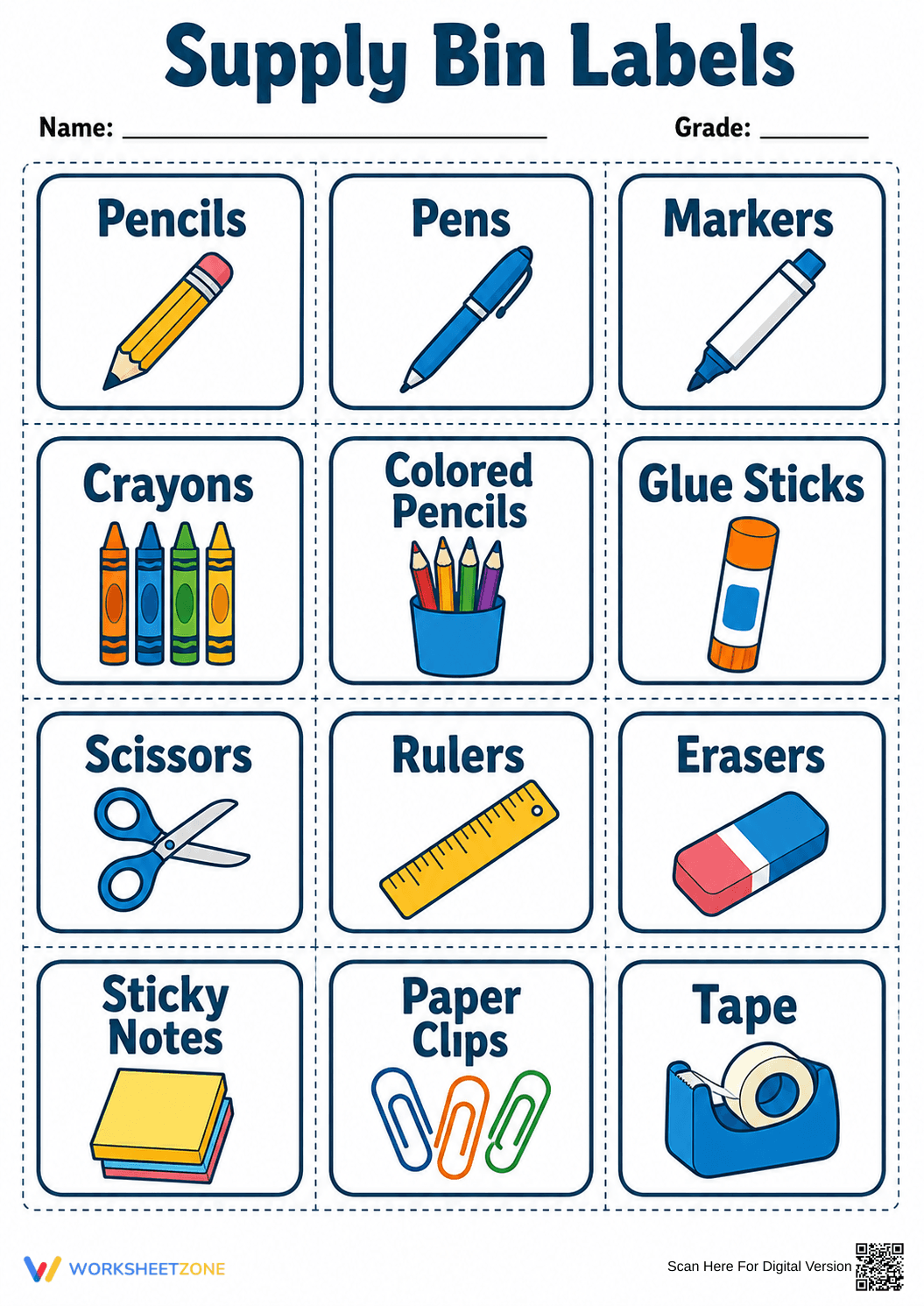

Classroom Supply Bin Labels | Essential Printable Set
Paste this activity's link or code into your existing LMS (Google Classroom, Canvas, Teams, Schoology, Moodle, etc.).
Students can open and work on the activity right away, with no student login required.
You'll still be able to track student progress and results from your teacher account.
These printable classroom supply bin labels help students independently locate and return materials, fostering a highly organized learning environment. By pairing bold text with clear visual icons, these labels support early readers and English Language Learners in navigating the classroom. This resource ensures that every bin has a designated home for essential school tools.
At a Glance
- Grade: K-5 · Subject: Classroom Management
- Standard:
CCSS.ELA-LITERACY.RI.K.7— Use illustrations and text to identify key classroom objects and locations- Skill Focus: Organization and Visual Literacy
- Format: 1 page · 12 labels · No answer key needed · PDF
- Best For: Classroom setup and student independence
- Time: 5–10 minutes
This single-page PDF features 12 distinct labels for common classroom items including pencils, markers, glue sticks, and scissors. Each label is designed as a rounded rectangle with a high-contrast icon and bold, legible font. Dotted cut lines are provided around each label to ensure uniform sizing and easy preparation for bins or drawers.
The zero-prep workflow for this resource is designed for maximum efficiency. First, print the single sheet on standard A4 paper or cardstock (1 minute). Second, use a paper trimmer or scissors to follow the dotted cut lines (3 minutes). Third, adhere the labels to your bins using clear tape or adhesive pockets (5 minutes). Total teacher preparation time is under 10 minutes, making this an ideal task for a sub plan or back-to-school prep.
This resource aligns with CCSS.ELA-LITERACY.RI.K.7 by using illustrations to describe key ideas and identify objects. It also supports general organizational standards found in many state frameworks. This standard code can be copied directly into lesson plans, IEP goals, or district curriculum mapping tools to document environmental supports for student learning.
Use these labels during the first week of school to establish routines for material management. Introduce each bin during a classroom tour and have students practice returning items to the correct spot. As a formative assessment, observe if students can independently find supplies without teacher intervention. This set is ideal for morning meeting routines or transition periods throughout the school day.
This resource is for elementary teachers looking to streamline classroom organization. It is particularly effective for students with executive functioning challenges or those in early literacy stages. Pair these labels with a visual schedule or a "Where does it go?" anchor chart to create a fully supportive physical environment that encourages student autonomy.
According to Fisher & Frey (2014), the physical environment of a classroom serves as a "third teacher," where environmental print and clear signage facilitate student agency and reduce cognitive load during transitions. These labels utilize dual-coding theory by combining text and icons, which research from the RAND AIRS 2024 report suggests is critical for supporting diverse learners in inclusive settings. By standardizing the visual language of the classroom, educators provide a predictable structure that allows students to focus more energy on academic tasks rather than logistical navigation. The alignment with CCSS.ELA-LITERACY.RI.K.7 ensures that even decorative elements contribute to the development of visual literacy and informational text comprehension. This printable set provides 12 essential markers that are foundational for a well-managed, student-centered learning space.


