


























Views
Downloads
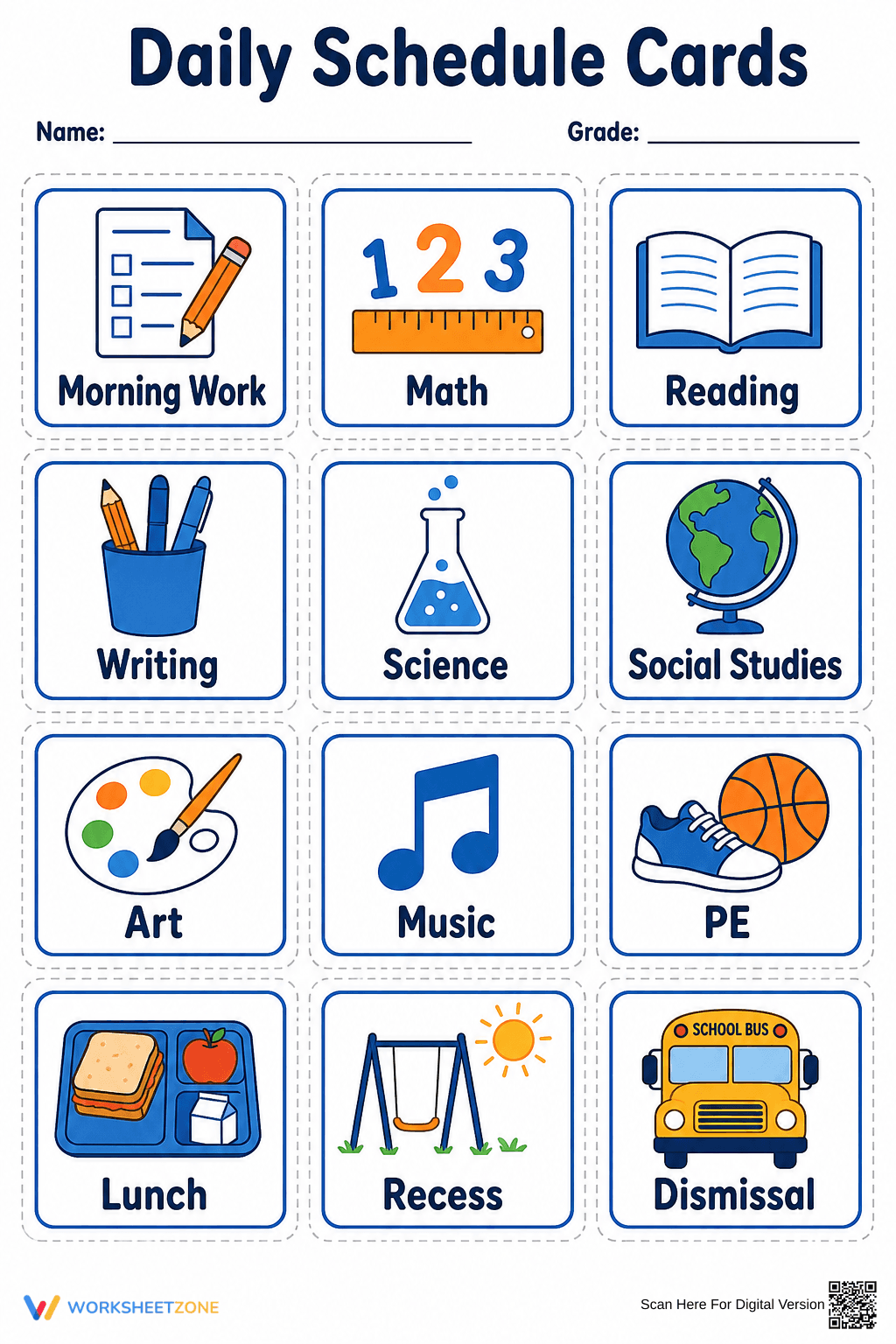

Printable Daily Schedule Cards | Elementary Classroom Ready
Paste this activity's link or code into your existing LMS (Google Classroom, Canvas, Teams, Schoology, Moodle, etc.).
Students can open and work on the activity right away, with no student login required.
You'll still be able to track student progress and results from your teacher account.
These printable classroom schedule cards provide a visual framework for elementary students to understand and follow daily routines. By using clear icons and bold text, teachers can reduce transition anxiety and foster independence. This resource ensures students know exactly what to expect throughout the school day, improving overall classroom behavior and time management.
At a Glance
- Grade: K-5 · Subject: Classroom Management
- Standard:
CCSS.ELA-LITERACY.SL.K.1— Follow agreed-upon rules for discussions and participating in classroom routines.- Skill Focus: Routine awareness and transitions
- Format: 1 page · 12 cards · No answer key needed · PDF
- Best For: Morning meeting and daily visual schedules
- Time: 5–10 minutes
This single-page PDF features 12 distinct schedule cards designed for high visibility. Each card includes a high-quality icon representing a specific subject or activity, paired with clear, sans-serif typography. The cards cover essential blocks including Math, Reading, Science, and Lunch. Dotted cut lines are provided around each card to ensure uniform sizing when prepared for display on whiteboards or pocket charts.
The zero-prep workflow for this resource is designed for the busy educator. First, print the single sheet on heavy cardstock (1 minute). Second, cut along the provided dotted lines to create 12 individual cards (3 minutes). Third, display the cards in a pocket chart or with magnets on a whiteboard (1 minute). Total teacher preparation time is under 5 minutes, making it an ideal solution for setting up a new classroom or updating a sub folder.
This resource aligns with `CCSS.ELA-LITERACY.SL.K.1`, which focuses on following agreed-upon rules for participating in classroom activities. By providing a visual anchor, the cards support students in meeting behavioral expectations during transitions. This standard code can be copied directly into lesson plans, IEP goals, or district curriculum mapping tools to document classroom environment supports.
Use these cards during your morning meeting to preview the day's events with students. Pointing to each card as you discuss the timeline helps English Language Learners and students with executive functioning challenges build a mental map of the day. As a formative assessment, ask a student to identify which card comes next after a transition to check for situational awareness and comprehension of the daily flow.
This resource is for elementary teachers looking for a clean, cohesive aesthetic for their classroom decor. It is particularly effective for early childhood settings where pre-readers rely on visual cues to understand their environment. Pair these cards with a digital timer or a "Where are we?" arrow to create a comprehensive time-management system for your learners.
Research from Fisher & Frey (2014) emphasizes the importance of environmental print and visual scaffolds in creating a predictable learning environment. Visual schedules like these 12 cards reduce the cognitive load on students during transitions, allowing them to reserve mental energy for academic tasks. By aligning with CCSS.ELA-LITERACY.SL.K.1, these cards serve as more than just decoration; they are functional tools that support the development of self-regulation and social-emotional competence. According to NAEP data, classrooms with clear, consistent routines show higher levels of student engagement and fewer instructional disruptions. This resource provides the necessary visual structure to implement these evidence-based practices immediately. Teachers can use these cards to build a foundation of literacy by connecting spoken words to printed labels and representative icons throughout the school day.


