


























Views
Downloads
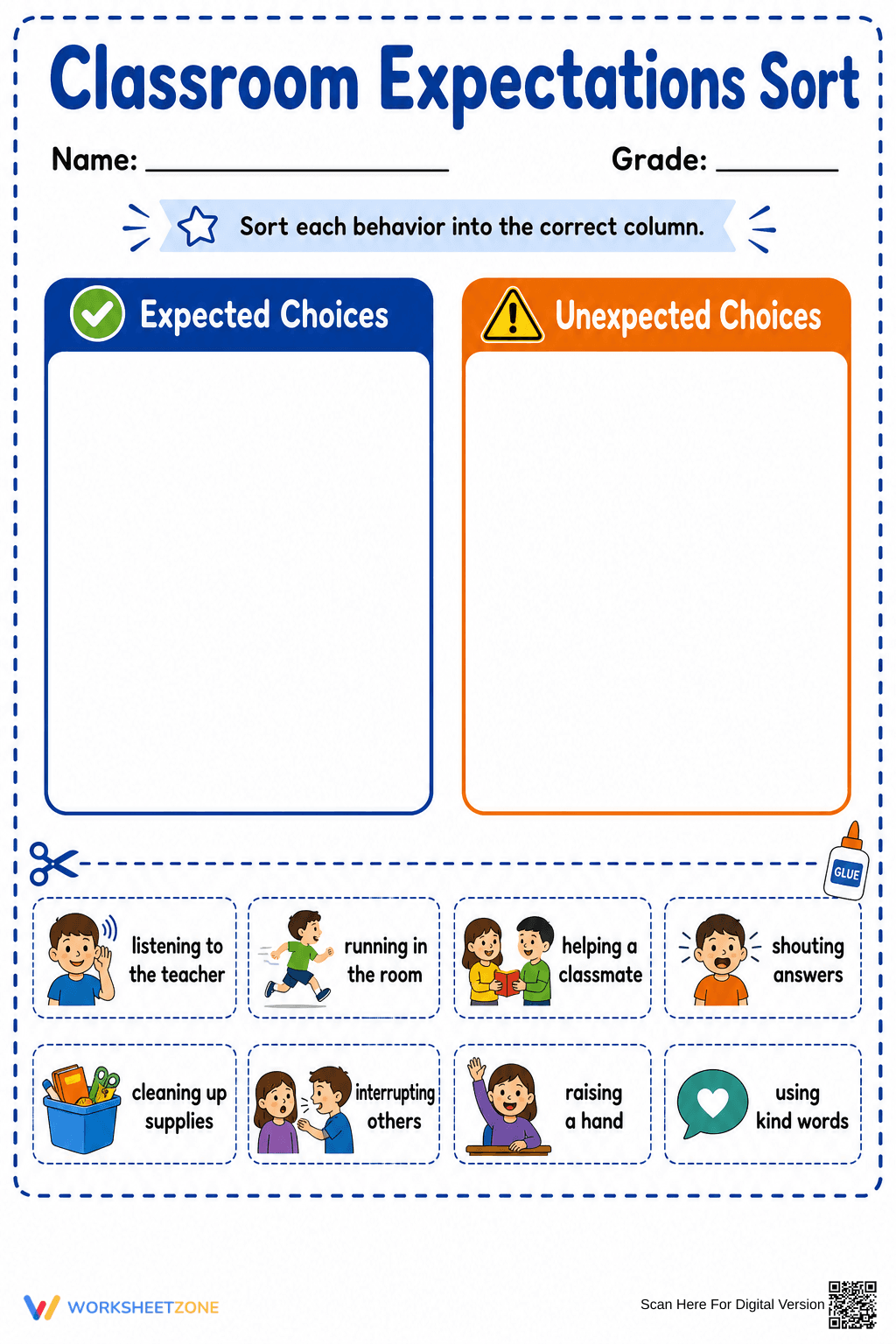

Grade 1 Classroom Expectations — Printable Sort Worksheet
Paste this activity's link or code into your existing LMS (Google Classroom, Canvas, Teams, Schoology, Moodle, etc.).
Students can open and work on the activity right away, with no student login required.
You'll still be able to track student progress and results from your teacher account.
This Grade 1 social-emotional learning worksheet helps students identify appropriate school behaviors by categorizing actions into expected and unexpected choices. By physically sorting visual examples of classroom conduct, young learners build foundational self-management skills and establish a positive environment for the school year.
At a Glance
- Grade: 1 · Subject: SEL
- Standard:
CCSS.ELA-LITERACY.SL.1.1.A— Follow agreed-upon rules for discussions and behavior- Skill Focus: Classroom Expectations
- Format: 1 page · 8 problems · Answer key included · PDF
- Best For: Back-to-school routines
- Time: 15–20 minutes
This single-page resource features a clear, two-column sorting chart labeled "Expected Choices" and "Unexpected Choices." At the bottom, students will find eight behavior strips to cut out, pairing a simple text description with a supportive visual icon. Behaviors include listening to the teacher, running, helping a classmate, and shouting. A complete answer key is provided.
Zero-Prep Workflow
This activity is designed for immediate classroom implementation with minimal teacher setup.
- Print (1 minute): Generate enough copies for your class roster. The black-and-white friendly design ensures crisp printing.
- Distribute (1 minute): Hand out the worksheets along with scissors and glue sticks. No additional materials are required.
- Review (3 minutes): Briefly read the eight behavior strips aloud to support emerging readers before they begin sorting.
With under two minutes of total teacher prep time, this worksheet is an excellent addition to emergency sub plans.
Standards Alignment
This activity aligns with CCSS.ELA-LITERACY.SL.1.1.A, which requires students to follow agreed-upon rules for discussions, such as listening to others and taking turns speaking about the topics and texts under discussion. It also supports general CASEL self-management competencies by asking students to regulate their responses to classroom situations. Both standard codes can be copied directly into lesson plans, IEP goals, or district curriculum mapping tools.
How to Use It
Introduce this sorting activity during the first week of school after a direct instruction lesson on classroom rules. It serves as an excellent independent practice task while the teacher circulates to observe fine motor skills and comprehension. Alternatively, use it mid-year as a quick behavioral reset or morning work assignment. As a formative assessment tip, watch how students categorize "interrupting others" versus "raising a hand" to gauge their understanding of impulse control. Expected completion time ranges from 15 to 20 minutes.
Who It's For
This worksheet is primarily designed for first-grade students, though it functions well for kindergarteners with read-aloud support or second graders needing a behavioral refresher. The inclusion of visual icons makes it highly accessible for English Language Learners and students receiving special education services. Pair this resource with a classroom anchor chart detailing your specific daily routines to reinforce the concepts practiced here.
Establishing clear behavioral norms early in the academic year significantly impacts long-term student achievement. This resource targets CCSS.ELA-LITERACY.SL.1.1.A, helping students follow agreed-upon rules for discussions and behavior. According to Fisher & Frey (2014), explicit instruction in classroom expectations, combined with guided practice activities like sorting and categorizing, reduces disruptive incidents and increases overall instructional time. When young learners actively manipulate examples of expected versus unexpected choices, they internalize the boundaries of their learning environment more effectively than through passive listening alone. By integrating fine motor practice with social-emotional skill building, this worksheet provides a developmentally appropriate method for reinforcing school readiness. Teachers can utilize this evidence-based approach to build a collaborative, respectful classroom culture from day one, ensuring all students understand the specific actions required for collective success.


