


























Views
Downloads

Essential Classroom Rules Poster | Grade K-5 Printable
Paste this activity's link or code into your existing LMS (Google Classroom, Canvas, Teams, Schoology, Moodle, etc.).
Students can open and work on the activity right away, with no student login required.
You'll still be able to track student progress and results from your teacher account.
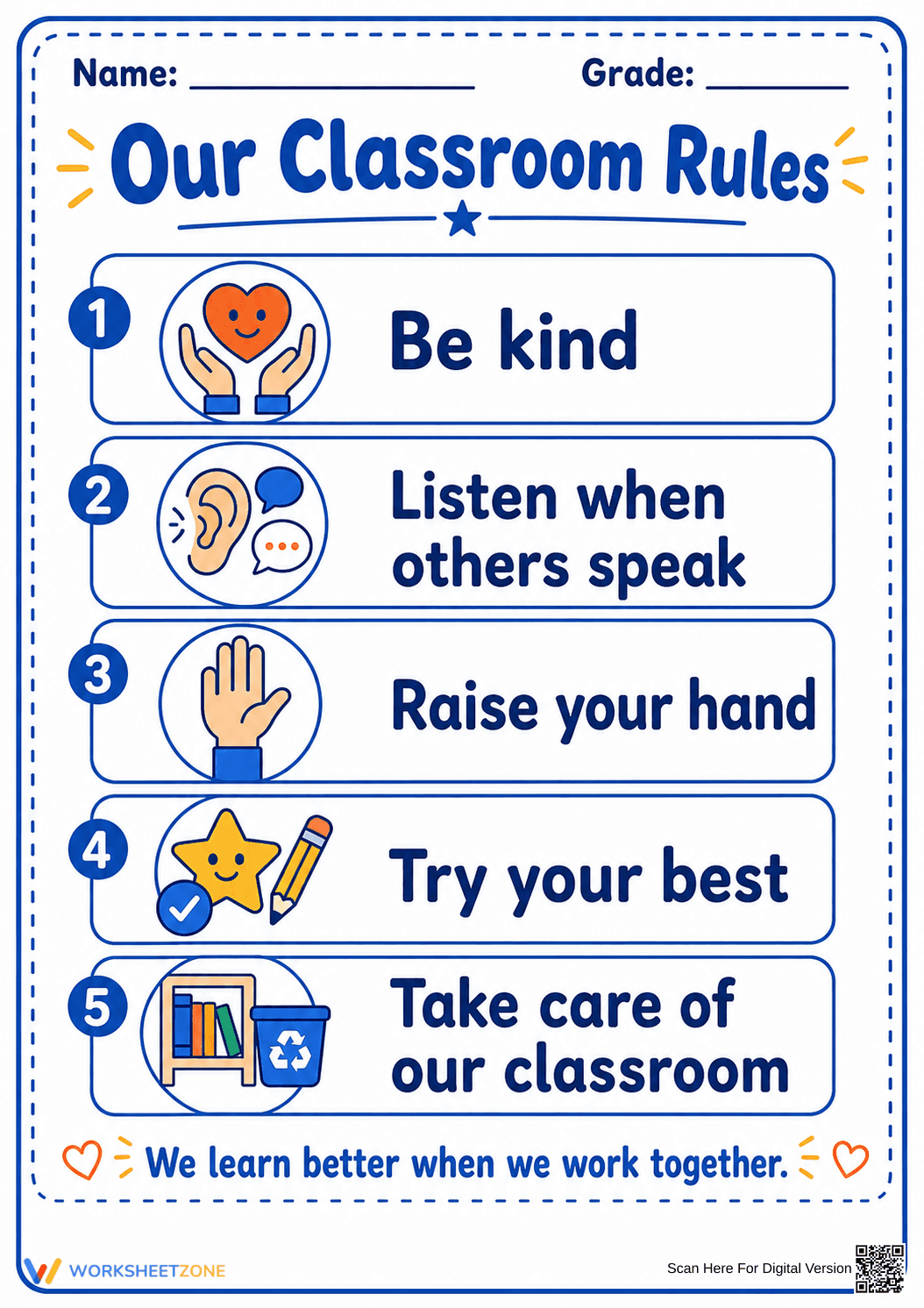
Establish a positive learning environment immediately with this visual classroom rules poster. Designed for elementary students, it clearly outlines five core behavioral expectations that promote kindness, active listening, and personal responsibility. By displaying these visual cues, teachers provide a consistent reference point for social-emotional growth and effective classroom management throughout the school year.
At a Glance
- Grade: K-5 · Subject: Classroom Management
- Standard:
CCSS.ELA-LITERACY.SL.K.1— Follow agreed-upon rules for discussions and participate in collaborative conversations- Skill Focus: Behavioral Expectations
- Format: 1 page · 5 rules · Visual icons included · PDF
- Best For: Classroom setup and daily behavior reminders
- Time: 5–10 minutes
This high-resolution PDF contains one printable A4 portrait poster featuring five distinct rule cards. Each card includes a bold number, a high-contrast icon (such as a heart for kindness or an ear for listening), and clear, large-print text. The design utilizes a professional blue and orange color palette with a dashed border, ensuring it remains visible from across the room. A collaborative message at the bottom reinforces the importance of teamwork.
- Print: Select the high-quality PDF and print on standard A4 paper or cardstock in under 30 seconds.
- Distribute: Laminate the sheet for durability and hang it at student eye level in a prominent location.
- Review: Spend 2 minutes during morning meeting pointing to each icon and modeling the expected behavior for the class.
This resource aligns with CCSS.ELA-LITERACY.SL.K.1, which requires students to follow agreed-upon rules for discussions, such as listening to others and taking turns speaking. By providing a visual anchor for these expectations, the poster supports the foundational social skills necessary for collaborative learning. This standard code can be copied directly into lesson plans, IEP goals, or district curriculum mapping tools.
Use this poster during the first week of school as a primary teaching tool for establishing routines. During direct instruction, walk through each rule and have students practice the "Raise your hand" and "Listen" expectations. As a formative assessment, observe student transitions; if the room becomes cluttered, point to rule five, "Take care of our classroom," to prompt a quick cleanup. Completion of the initial introduction takes 10-15 minutes.
This poster is ideal for general education teachers in grades K-5, special education providers needing visual supports, and substitute teachers looking for a quick reference guide. It pairs naturally with a social-emotional learning curriculum or a "First Week of School" anchor chart.
Effective classroom management relies on the clear communication of behavioral expectations, a principle supported by Fisher & Frey (2014) in their research on the gradual release of responsibility. This poster addresses CCSS.ELA-LITERACY.SL.K.1 by providing a permanent visual scaffold for collaborative conversation rules. Research indicates that visual cues significantly reduce cognitive load for young learners, allowing them to focus on academic content rather than trying to remember complex social procedures. By explicitly stating rules like "Listen when others speak" and "Raise your hand," educators create a predictable environment that fosters psychological safety. According to the Fisher & Frey framework, these visual anchors serve as essential environmental supports that bridge the gap between teacher modeling and independent student self-regulation. This resource ensures that the 5 core expectations are accessible to all students, including English Language Learners and those with executive functioning challenges, promoting a more inclusive and productive learning space.


