




























Views
Downloads
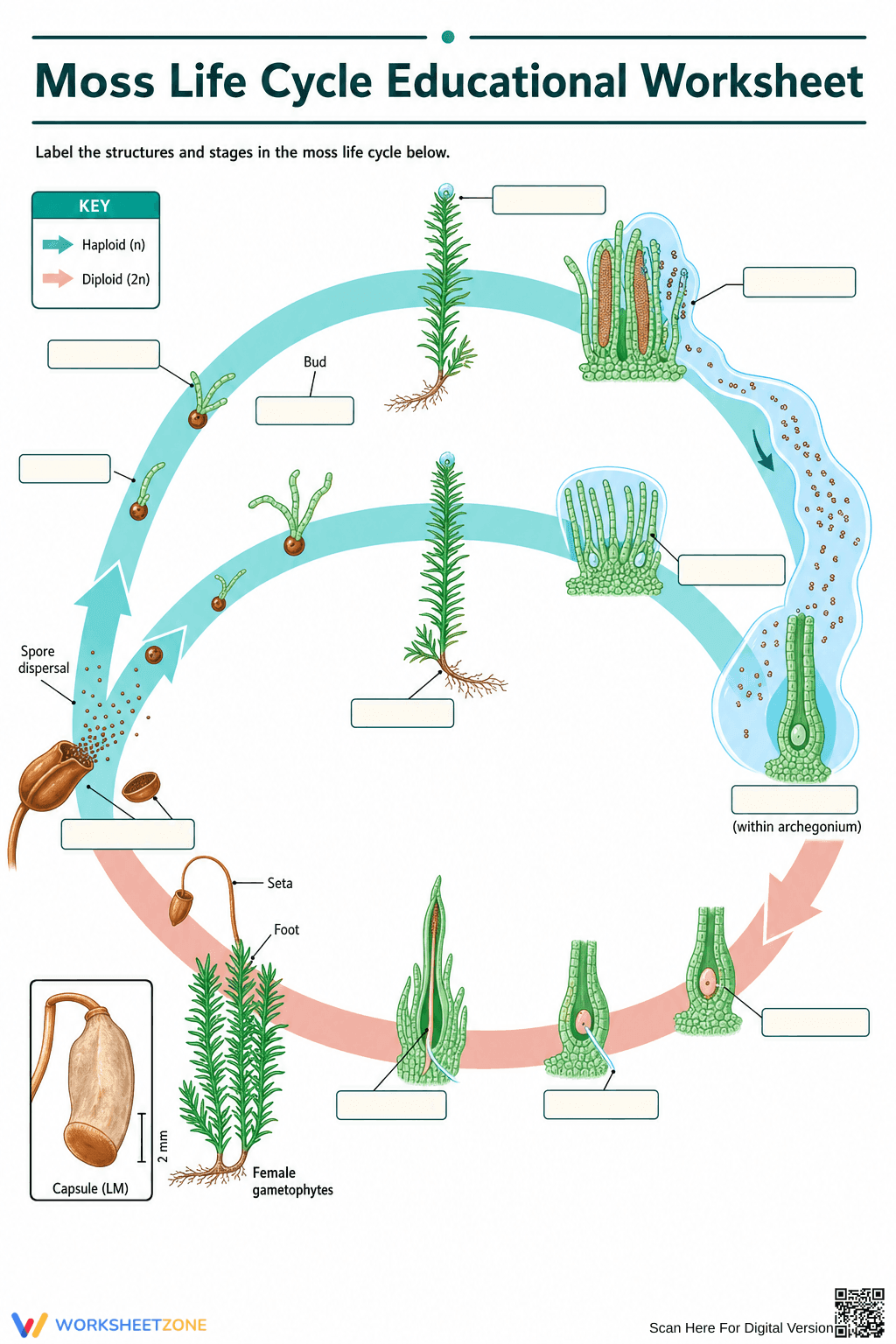

Grade 9 Moss Life Cycle — Printable No-Prep Worksheet

Paste this activity's link or code into your existing LMS (Google Classroom, Canvas, Teams, Schoology, Moodle, etc.).
Students can open and work on the activity right away, with no student login required.
You'll still be able to track student progress and results from your teacher account.
This printable biology worksheet helps students master the complex alternation of generations by labeling a detailed moss life cycle diagram. By identifying key structures like the gametophyte, sporophyte, and archegonium, learners will visualize how haploid and diploid phases interact during plant reproduction to ensure species survival.
At a Glance
- Grade: 9 · Subject: Biology
- Standard:
HS-LS1-4— Use a model to illustrate cellular division and differentiation- Skill Focus: Labeling the moss life cycle
- Format: 1 page · 11 problems · Answer key included · PDF
- Best For: Independent practice or review
- Time: 15–20 minutes
What's Inside
This single-page resource features a comprehensive diagram of the moss life cycle. Students complete 11 fill-in-the-blank boxes corresponding to specific reproductive stages and anatomical structures. The visual model distinguishes between haploid (n) and diploid (2n) phases using color-coded arrows. A complete teacher answer key is provided for accurate grading.
Zero-Prep Workflow
This resource ensures a zero-prep classroom experience.
- Print (1 minute): Simply download the PDF and print a class set. The clear diagrams render beautifully in both color and grayscale.
- Distribute (1 minute): Hand out the worksheets as a warm-up, in-class assignment, or homework task without any prior setup required.
- Review (3 minutes): Use the included answer key to quickly check student work or project it on the board for self-correction.
With under two minutes of prep time, this activity is an excellent option for emergency sub plans.
Standards Alignment
This activity aligns with HS-LS1-4, requiring students to use a model to illustrate the role of cellular division (mitosis and meiosis) and differentiation in producing and maintaining complex organisms. By mapping out the haploid and diploid stages, students connect microscopic cellular processes to macroscopic plant structures. Both standard codes can be copied directly into lesson plans, IEP goals, or district curriculum mapping tools.
How to Use It
Deploy this diagram during direct instruction as a guided note-taking tool, allowing students to fill in the blanks as you explain the alternation of generations. Alternatively, assign it as an independent review activity after completing a unit on plant reproduction. As a formative assessment tip, observe whether students correctly place the transition points between phases, which reveals their underlying comprehension of meiosis. Expected completion time is 15 to 20 minutes.
Who It's For
This worksheet is designed for high school biology students. For students needing extra support, provide a word bank containing the necessary terms (such as sporangium, zygote, and gametophyte) to reduce cognitive load. This diagram pairs perfectly with hands-on microscope labs observing live moss specimens or prepared slides of plant reproductive organs.
Integrating visual models into biology instruction significantly enhances student comprehension of abstract processes like the alternation of generations. Aligned with HS-LS1-4, this resource requires learners to use a model to illustrate cellular division and differentiation within the moss life cycle. According to a recent ScienceDirect TpT Analysis, students who actively label and interact with biological diagrams demonstrate a substantially higher retention rate of complex anatomical vocabulary compared to those who only read text descriptions. By requiring students to physically map the transition between haploid and diploid stages, this worksheet bridges the gap between rote memorization and deep conceptual understanding. The structured format reduces extraneous cognitive load, allowing learners to focus entirely on the sequential logic of plant reproduction and the specific functions of specialized structures like the archegonium and sporophyte.


