


























Views
Downloads
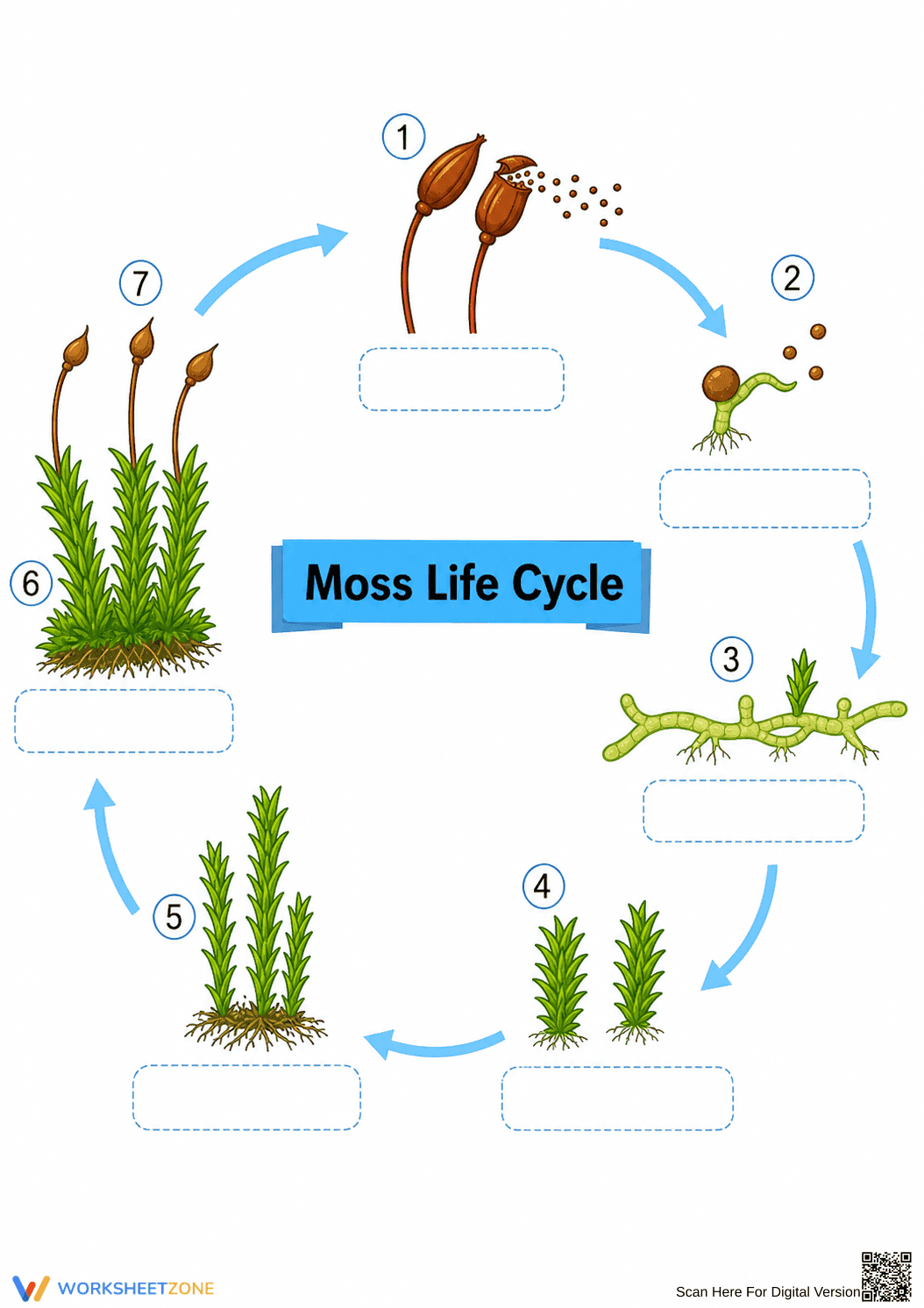

Grade 3 Moss Life Cycle — Printable No-Prep Worksheet
Paste this activity's link or code into your existing LMS (Google Classroom, Canvas, Teams, Schoology, Moodle, etc.).
Students can open and work on the activity right away, with no student login required.
You'll still be able to track student progress and results from your teacher account.
This visual science worksheet helps students master the stages of non-vascular plant reproduction by labeling a detailed moss life cycle diagram. By identifying each phase from spore release to mature gametophyte, learners build a concrete understanding of how these unique plants grow, reproduce, and thrive in their environments.
At a Glance
- Grade: 3 · Subject: Science
- Standard:
3-LS1-1— Develop models to describe organism life cycles- Skill Focus: Labeling moss life cycle stages
- Format: 1 page · 7 problems · Answer key included · PDF
- Best For: Independent practice and review
- Time: 10–15 minutes
This single-page resource features a high-quality, full-color illustration of the moss life cycle arranged in a continuous circular flow. Students are tasked with filling in seven blank text boxes corresponding to specific developmental stages, including the mature plant, spore capsules, and protonema. A complete answer key is provided to ensure accurate grading and allow for easy self-correction by students.
Designed for maximum efficiency, this resource requires virtually no teacher preparation:
- Print (1 minute): Simply print the PDF diagram and the accompanying answer key.
- Distribute (1 minute): Hand out the worksheets as a quick warm-up, science center activity, or independent assignment.
- Review (3 minutes): Display the answer key on your smartboard for rapid whole-class checking.
With a total prep time of under two minutes, this diagram is an excellent addition to any emergency sub plan or last-minute lesson adjustment.
This activity is directly aligned with the Next Generation Science Standard 3-LS1-1: Develop models to describe that organisms have unique and diverse life cycles but all have in common birth, growth, reproduction, and death. By mapping out the specific reproductive sequence of moss, students apply this core concept to non-vascular plants. Both standard codes can be copied directly into lesson plans, IEP goals, or district curriculum mapping tools.
Introduce this diagram during direct instruction as a guided note-taking tool, allowing students to fill in the blanks as you explain each phase of the moss life cycle. Alternatively, assign it as a formative assessment after a hands-on observation of real moss specimens. As students work, observe whether they correctly sequence the transition from spore germination to the leafy gametophyte stage. Most students will complete the labeling task within 10 to 15 minutes.
This worksheet is ideal for third-grade science students, though it easily scales up for upper elementary learners reviewing plant biology. For students who need extra support, provide a word bank containing the scientific terms for each stage. It pairs perfectly with an introductory reading passage on non-vascular plants or a nature walk to observe moss growing in its natural habitat.
Understanding the diverse reproductive strategies of plants is a foundational component of early science education. This resource supports standard 3-LS1-1 by having students develop models to describe organism life cycles, specifically focusing on the unique alternation of generations found in moss. According to a ScienceDirect TpT Analysis, providing students with clear, sequential visual models significantly improves their retention of complex biological processes compared to text-based instruction alone. By actively labeling the diagram, learners transition from passive observation to active cognitive engagement, reinforcing their grasp of how non-vascular plants reproduce without seeds. This targeted practice ensures that students can confidently articulate the continuous cycle of birth, growth, and reproduction in diverse ecosystems, laying the groundwork for more advanced botanical studies in middle and high school.


