




























Views
Downloads
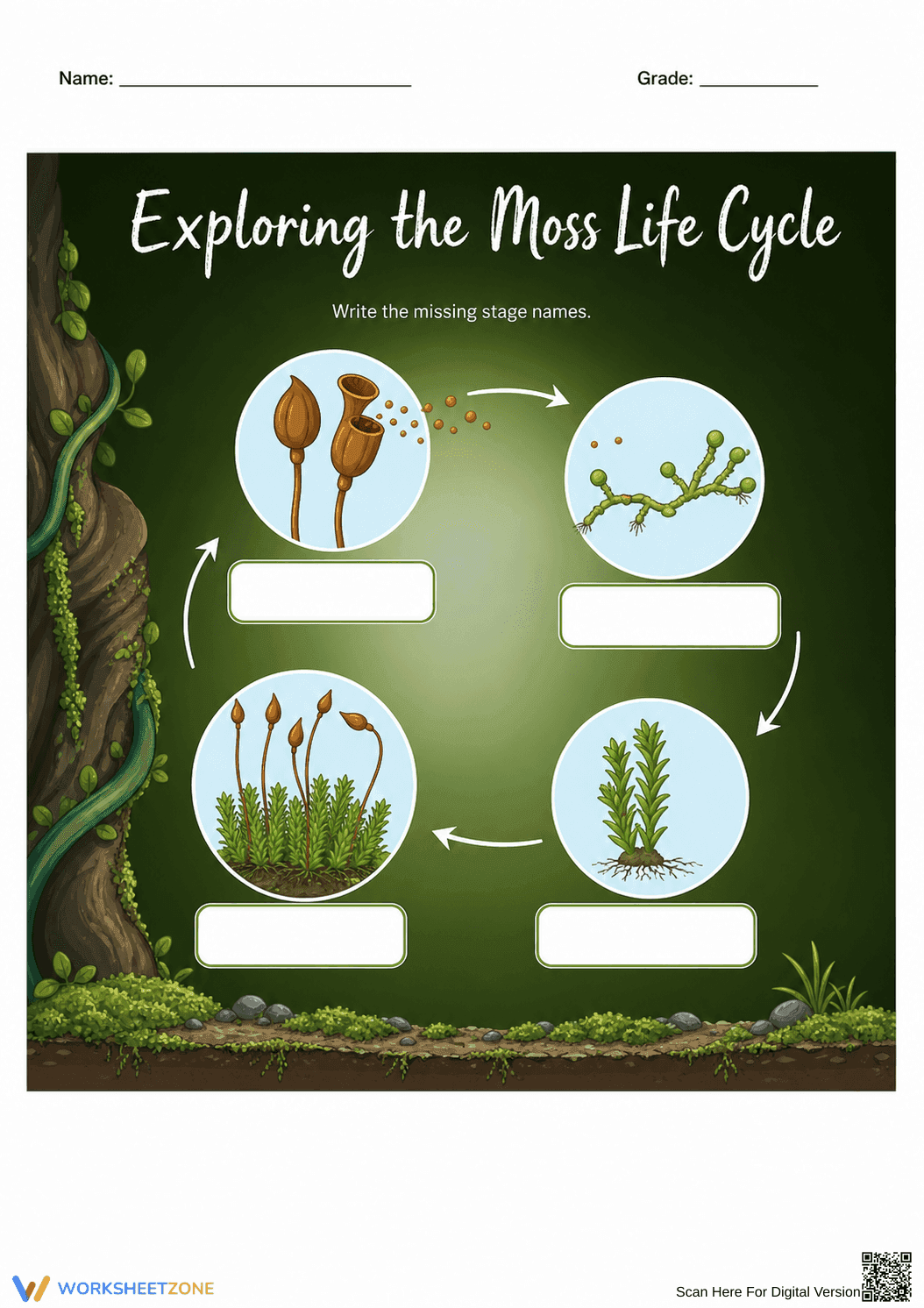

Grade 3 Moss Life Cycle — Printable No-Prep Worksheet

Paste this activity's link or code into your existing LMS (Google Classroom, Canvas, Teams, Schoology, Moodle, etc.).
Students can open and work on the activity right away, with no student login required.
You'll still be able to track student progress and results from your teacher account.
This printable moss life cycle worksheet helps students visually identify and sequence the reproductive stages of non-vascular plants. By labeling a clear, four-stage diagram, learners build foundational biology skills and understand how spores develop into mature plants. It provides an engaging, straightforward way to reinforce life science concepts.
At a Glance
- Grade: 3 · Subject: Science
- Standard:
3-LS1-1— Develop models to describe organism life cycles- Skill Focus: Identifying life cycle stages
- Format: 1 page · 4 problems · Answer key included · PDF
- Best For: Independent practice
- Time: 10–15 minutes
Inside this resource, educators will find a single-page diagram featuring four distinct, beautifully illustrated stages of moss development. Students write the missing stage names in the blank boxes, following the directional arrows. The straightforward layout makes it highly accessible. A complete answer key is provided for quick grading.
This resource is designed for a simple zero-prep workflow:
- Print (1 min): Download the PDF and print.
- Distribute (1 min): Hand out as a warm-up, center activity, or assignment.
- Review (2 mins): Use the answer key to check responses or project for class review.
With total teacher prep time under two minutes, this activity is an ideal, stress-free addition to any lesson and works perfectly as a sub plan.
This worksheet is closely aligned with the Next Generation Science Standards, specifically focusing on 3-LS1-1: Develop models to describe that organisms have unique and diverse life cycles but all have in common birth, growth, reproduction, and death. By completing the diagram, students actively model the specific reproductive cycle of a non-vascular plant. Both standard codes can be copied directly into lesson plans, IEP goals, or district curriculum mapping tools.
This versatile diagram can be utilized in multiple instructional moments. Introduce it during direct instruction by projecting the blank worksheet on a smartboard and filling it out collaboratively as you discuss spores and plant growth. Alternatively, assign it as an independent formative assessment after a lesson on non-vascular plants. As students work, observe whether they correctly sequence the stages from spore release to mature sporophyte, which indicates their grasp of the cyclical nature of plant reproduction. Expected completion time is a brief 10 to 15 minutes.
This activity is primarily designed for third through fifth-grade students exploring plant biology and life cycles. The strong visual scaffolds make it highly effective for English Language Learners and students who benefit from graphic organizers. It pairs perfectly with a hands-on nature walk to observe real moss or a direct instruction lesson comparing vascular and non-vascular plant reproduction.
Understanding biological processes through visual modeling is a critical component of early science education. This worksheet supports mastery of 3-LS1-1 by having students develop models to describe organism life cycles. According to a recent ScienceDirect TpT Analysis, integrating clear, sequenced diagrams into elementary science instruction significantly improves student retention of complex biological vocabulary and cyclical concepts. When learners actively label visual models rather than passively reading text, they build stronger cognitive connections regarding how organisms grow, reproduce, and sustain their species over time. This targeted practice ensures that foundational concepts regarding non-vascular plant reproduction are firmly established, paving the way for more advanced botanical studies in middle school and beyond. By utilizing this structured diagram, educators provide a reliable, research-backed method for reinforcing essential life science standards in a highly accessible format.


