Students hear the word atmosphere long before they understand what it actually describes. Layers of the atmosphere worksheets give upper elementary and middle school classes a concrete way to organize that idea, turning an invisible column of gas above their heads into something they can label, sequence, and measure. Whether you are opening a weather unit, building background for a space science lesson, or reviewing before a district assessment, a well-designed worksheet set lets students practice recalling altitude ranges, temperature patterns, and the phenomena tied to each layer without needing a lecture every time.
These worksheets also travel well across a school year. The same core content supports a first introduction in fifth or sixth grade and a more detailed review in seventh or eighth grade physical science, which makes this topic a reliable building block for vertical planning across grade levels.
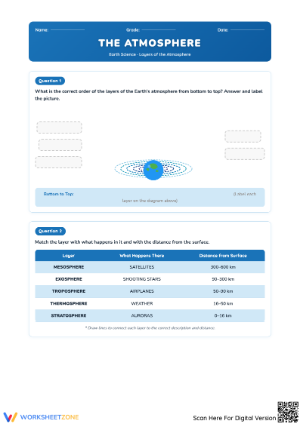
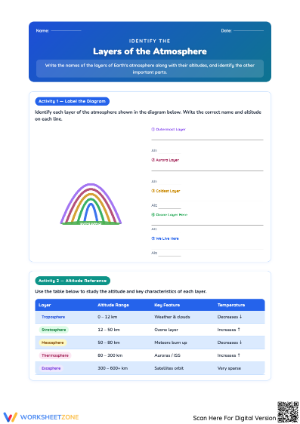
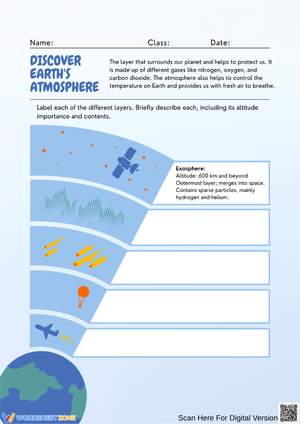
The Five Layers at a Glance: Altitude, Temperature, and Function
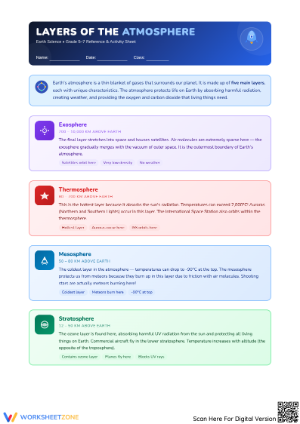
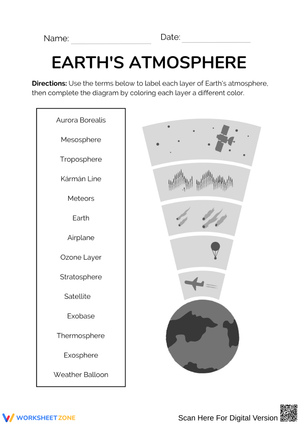
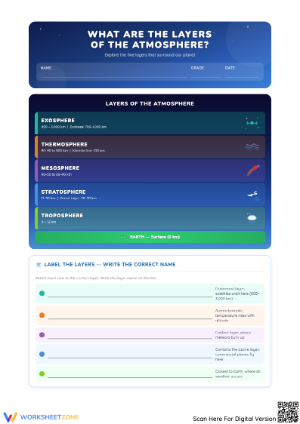
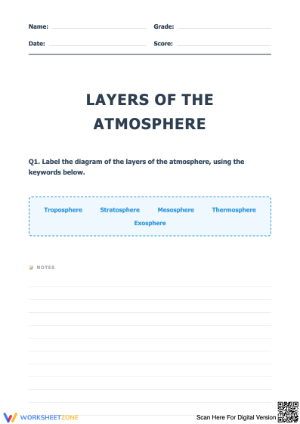
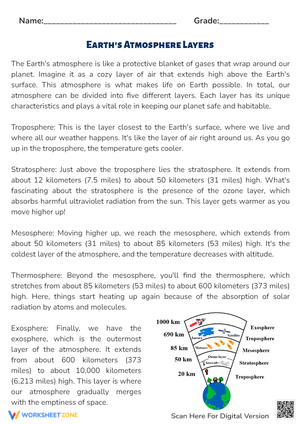
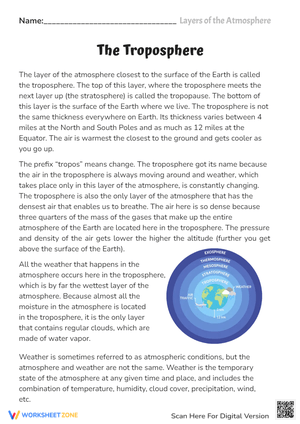
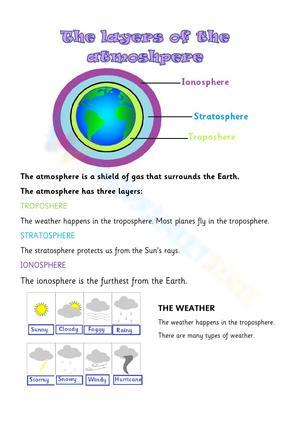
Most atmosphere worksheets organize the five layers from the ground up: troposphere, stratosphere, mesosphere, thermosphere, and exosphere. Presenting them in this order matches how students naturally think about height, and it mirrors the sequence used in most published Earth science curricula.
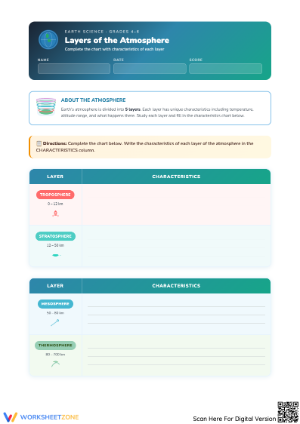
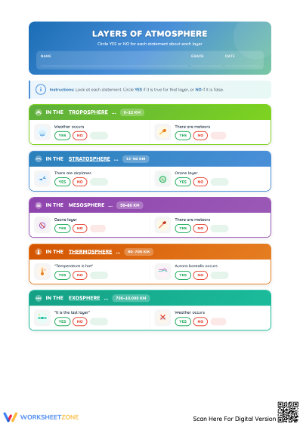
- Troposphere: surface to about 7.5 miles (12 km), home to nearly all weather
- Stratosphere: about 6 to 12 miles up to roughly 31 miles (50 km), contains the ozone layer
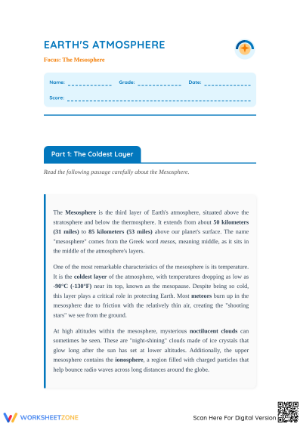
- Mesosphere: about 31 to 53 miles (50-85 km), coldest layer, where most meteors burn up
- Thermosphere: about 53 to 375 miles (85-600 km), extremely hot, home to the International Space Station
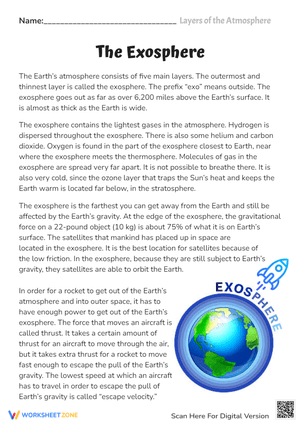
- Exosphere: roughly 440 to 6,200 miles (700-10,000 km), thinnest layer, blends into space
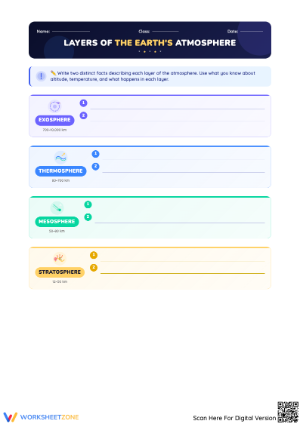
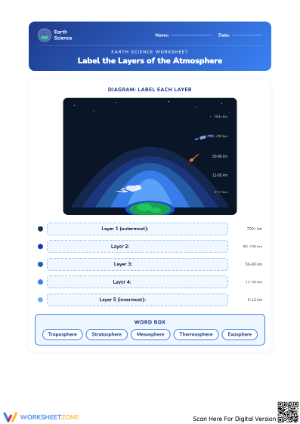
A simple label-the-diagram worksheet using this list gives students a reference they can return to across the unit, especially when later questions ask them to compare two layers directly.
Troposphere and Stratosphere: Where Weather and Ozone Live
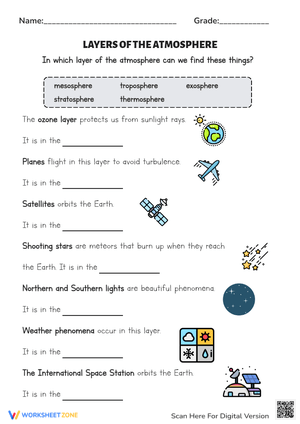
The troposphere is the layer students already experience every day, since it holds roughly 99% of the atmosphere's water vapor and virtually all weather, from cloud formation to storms. Worksheet questions here work well when they ask students to connect altitude to a familiar experience, such as why mountain climbers need oxygen tanks or why airplanes fly above most turbulence.
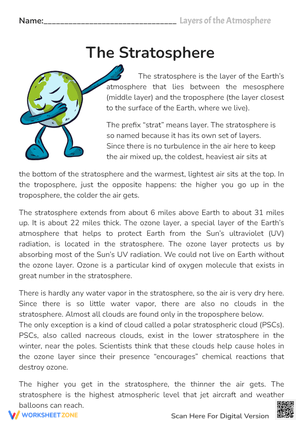
One detail that consistently improves student understanding is the ozone layer's specific location within the stratosphere rather than at ground level. Many students assume ozone is something they breathe near the surface, so a worksheet item asking them to place the ozone layer on a diagram between roughly 6 and 31 miles up directly corrects that misconception while reinforcing altitude sequencing.
Mesosphere, Thermosphere, and Exosphere: The Upper Layers
The upper three layers tend to generate the most classroom interest because they connect to phenomena students have seen in movies or the night sky. The mesosphere holds the atmosphere's coldest recorded temperatures, near -90degC (-130degF), and it is the layer where friction burns up most meteors before they reach the ground, which is why worksheet prompts about shooting stars belong here rather than in the stratosphere.
The thermosphere runs counter to intuition because, despite its name, temperatures there can climb above 2000degC (3632degF) even though it would not feel hot to a person, since the air is too thin to transfer much heat. This is also the layer where the International Space Station orbits, a fact that gives students a real, trackable object to anchor their understanding of altitude at that scale.
The exosphere is the hardest layer for students to picture because particles are spread so far apart that it gradually merges with solar wind rather than ending at a clear boundary. Worksheet questions here work best as compare-and-contrast items, asking students to explain how the exosphere differs from the thermosphere in density rather than expecting them to memorize an exact edge.
Labeling and Cut-and-Paste Activities for Visual and Kinesthetic Learners
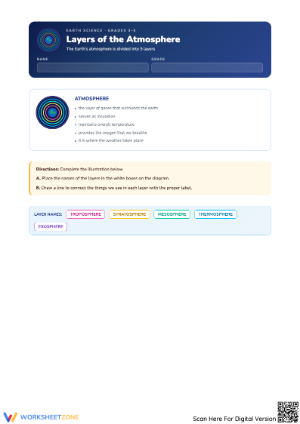
Diagram-based worksheets suit this topic particularly well because the content is inherently spatial. A blank vertical cross-section of the atmosphere, paired with a word bank of layer names, altitude ranges, and key facts, asks students to do more than recall a definition; it asks them to place information correctly relative to everything around it.
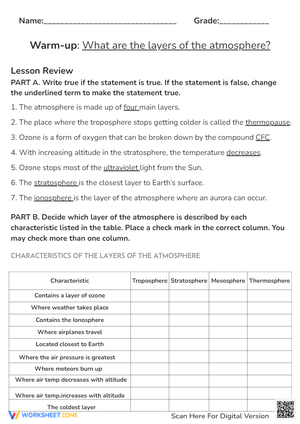
Cut-and-paste versions extend this further for younger or striving learners. Sorting altitude ranges, temperature descriptions, and notable features into the correct layer column builds the same sequencing skill without requiring independent writing, which makes this format useful for small-group stations or an intervention block.
Teacher Tips
Layers of the atmosphere worksheets work best when they are not treated as a single standalone assignment. A few practical ways to build them into instruction:
- Use a labeling worksheet as a bell-ringer at the start of a weather or space unit, then repeat it as an exit ticket at the end to measure growth
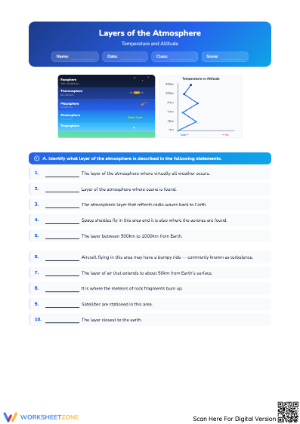
- Pair a data-rich version with a short small-group discussion where students defend why they ranked layers by temperature the way they did
- Use cut-and-paste sorting activities at a review station for students who need a lower-stakes, hands-on formative check before a quiz
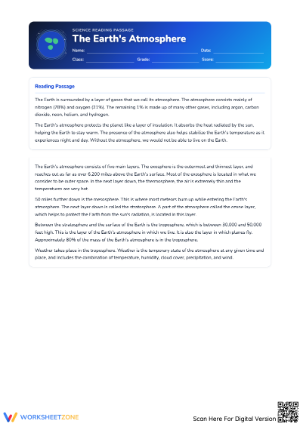
- Save one open-ended worksheet, such as an explanation of why the thermosphere is both extremely hot and where satellites orbit, for early finishers or enrichment
Because the content is factual and sequential, these worksheets also grade quickly, which makes them practical for a formative checkpoint even in a tightly packed unit.
Frequently Asked Questions
1. How many layers does Earth's atmosphere have and what are they called?
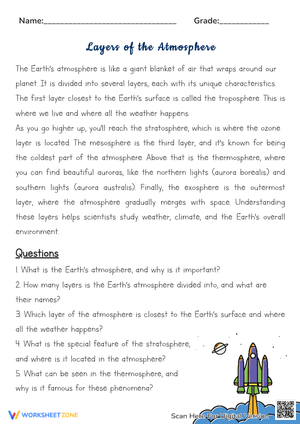
Earth's atmosphere has five main layers, listed from the surface upward: the troposphere, stratosphere, mesosphere, thermosphere, and exosphere. Most worksheets teach them in this order so altitude and sequence reinforce each other.
2. What grade level is best suited to atmospheric layers worksheets?
This topic fits upper elementary through middle school Earth science, roughly grades 4 through 8. Younger students typically use a simplified overview, while middle school students can handle altitude ranges and temperature comparisons.
3. How can teachers use atmosphere worksheets for formative assessment or review?
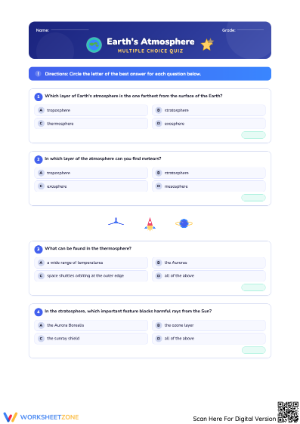
A labeling or cut-and-paste worksheet works well as a bell-ringer, exit ticket, or small-group station, since it gives a quick, gradable snapshot of whether students can sequence the layers correctly and recall one key fact about each.
4. What is the difference between the troposphere and stratosphere for classroom purposes?
The troposphere is the lowest layer and holds nearly all weather and water vapor, while the stratosphere sits above it and contains the ozone layer that absorbs ultraviolet radiation. Worksheet questions often ask students to sort weather-related facts into the troposphere and ozone-related facts into the stratosphere.
5. How do these worksheets tie into broader weather and climate units?
Since the troposphere is where all weather forms, atmosphere worksheets make a natural entry point before a weather or climate unit, giving students the vertical context they need before studying fronts, storms, or long-term climate patterns.












 Interactive Worksheet Maker
 Quiz Maker
 Word Search Maker
 Crossword Puzzle Maker
 Word Scramble Generator
 Sentence Scramble Generator
 Handwriting Worksheet Generator
 Name Tracing Generator
 Fill In The Blank Generator