Why Soil Formation Deserves Its Own Worksheet Set
Soil formation is one of those earth science topics students walk past every day without noticing. A focused set of soil formation worksheets turns the ground under the playground into a teachable system of weathering, parent material, and layered horizons. For grades 3-8, these printables give teachers a structured path from the everyday word dirt to the scientific story of how solid rock slowly becomes fertile topsoil.
Strong worksheets do more than ask students to color a diagram. They pair vocabulary with cause-and-effect reasoning, connect the process to grade-level standards, and leave room for a short hands-on demonstration. This guide breaks down how to choose and use soil formation worksheets so each page supports real instruction, whether you're teaching a full earth science unit or a single review lesson before a quiz.
How Soil Formation Worksheets Support NGSS Instruction
Soil formation lives inside the Next Generation Science Standards' treatment of Earth's systems, weathering, and erosion. Worksheets that ask students to gather and interpret evidence of how rock breaks down map cleanly onto the science practices of making observations and analyzing data, rather than simply memorizing terms.
Middle school teachers can anchor these printables to standard MS-ESS2-2, which examines how water's movement on land and underground drives the weathering and erosion that reshape surface features. A worksheet that asks students to trace what happens to a hillside after repeated rain gives them a concrete case for that standard.
According to the Next Generation Science Standards, standard MS-ESS2-2 asks students to construct explanations for how water moving across and beneath the land reshapes Earth's surface, driving weathering and erosion at scales that range from a single slope to whole continents over millions of years.
Elementary teachers can lean on the same standards family with simpler evidence. A worksheet that has fourth graders observe and describe signs of weathering, cracked sidewalks, rounded pebbles, rusting metal, builds the observation skills those standards reward without demanding the full vocabulary load.
Building a CLORPT Sorting Activity
One of the most useful frameworks for soil formation worksheets is the CLORPT acronym: Climate, Organisms, Relief or topography, Parent material, and Time. Each letter names a factor that shapes what kind of soil ends up in a given place, and each one gives you a category students can sort evidence into.
A simple sorting worksheet lists a dozen scenario cards, such as a thick blanket of fallen leaves or a steep, south-facing slope, and asks students to file each under the correct CLORPT factor. Because most real soils are shaped by several factors at once, the activity naturally sparks debate, which is exactly where the learning happens.
For younger grades, trim the acronym to three factors, organisms, climate, and time, and expand to the full five as students build confidence. The point is not to have students recite CLORPT but to reason about why a forest floor and a desert surface hold such different soil.
Comparing Physical and Chemical Weathering
Soil begins when weathering breaks down parent material, and worksheets should keep the two weathering types distinct. Physical weathering changes rock through temperature swings, freezing water, and friction, while chemical weathering alters the actual minerals through chemical reactions. A two-column sorting page is an easy way to check that students can tell them apart.
Here is the detail that reframes the whole unit for students: it takes roughly 500 to 1,000 years for natural processes to build a single inch of topsoil. When a worksheet places that number next to a photo of an eroded field, students grasp in one glance why soil is treated as a nearly nonrenewable resource, and a routine sorting task turns into a conversation about conservation and stewardship.
Cause-and-effect prompts work well here. Ask students to predict whether a crack in a boulder on a freezing mountain is physical or chemical weathering, then explain their reasoning in a sentence. That short written justification is worth more than a matched pair of terms.
Labeling Soil Horizons Layer by Layer
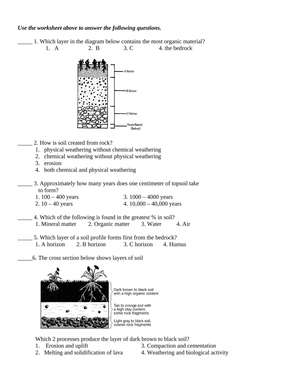
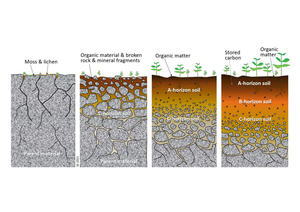
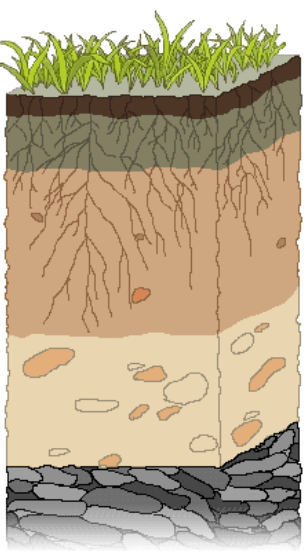
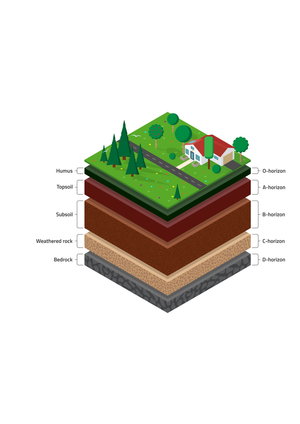
Diagram-labeling worksheets are the backbone of most soil formation units because horizons make the abstract process visible. Students label the layers from the surface down: the organic-rich topsoil, the subsoil below it, and the parent material and bedrock underneath.
The A horizon, or topsoil, deserves special attention. It is the darkest, most organic-rich, and most fertile layer, the zone where decomposition and root growth concentrate. A worksheet that asks students to explain why the A horizon looks darker than the layers beneath it pushes them past labeling into genuine understanding of where organic matter comes from.
Color coding helps the layers stick. Have students shade the A horizon dark brown, the subsoil a lighter reddish tan, and the parent material gray, then write one sentence explaining each choice. The act of justifying a color forces them to connect appearance to the science of organic content and mineral weathering.
Pair the diagram with a build-a-layer activity where students sketch and color each horizon based on a written description. Reversing the task, going from words to a labeled drawing, reveals misconceptions a fill-in-the-blank page would hide.
Turning Soil's Slow Timescale into a Hook
The centuries-per-inch pace of soil formation is the most memorable number in the unit, and it earns its own worksheet moment. Ask students to calculate how long the topsoil in a schoolyard garden bed might have taken to form, then compare that span to how quickly a single storm can strip an unprotected field.
That contrast, slow to build and fast to lose, gives the topic real stakes. A short worksheet that connects soil formation to farming, gardening, or local land use helps students see why soil scientists and conservation programs treat topsoil as something to protect rather than assume. It also sets up naturally for a writing prompt on stewardship.
Classroom Implementation
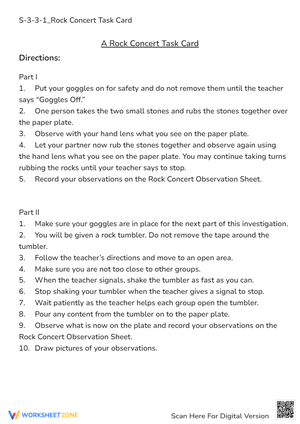
Soil formation worksheets work best when they bracket a hands-on demonstration rather than replace it. Open with a short prediction page, run a quick model, then return to a worksheet that asks students to explain what they observed.
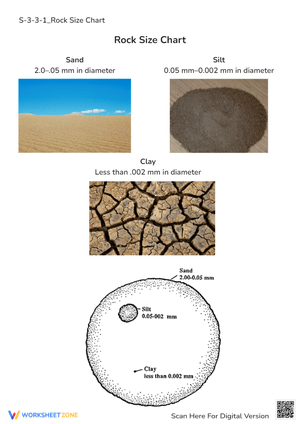
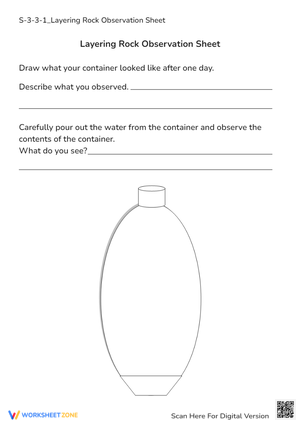
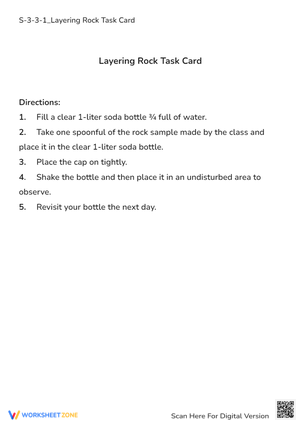
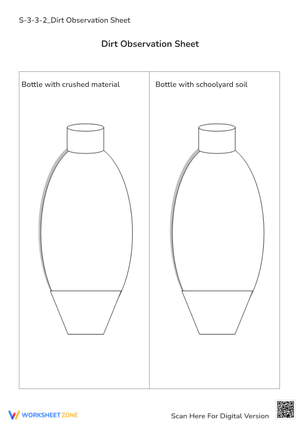
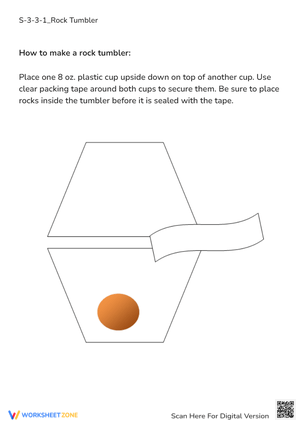
A weathering jar is a reliable station: seal sugar cubes or soft rock fragments in a jar of water and shake to model how friction and moving water round and break down particles. A layering demonstration, pouring sand, soil, and gravel into a clear cup, mirrors the horizon diagrams students just labeled. Keep groups to three or four so everyone handles the materials.
For pacing, a single worksheet page per station keeps small groups accountable without burying them in paper. Reserve a reflection page for the end, when students can pull the vocabulary, the CLORPT factors, and the horizon diagram into one summary. Fast finishers can research a local soil type or design their own weathering test.
Frequently Asked Questions
1. What grade levels are soil formation worksheets appropriate for?
They fit grades 3 through 8 with adjustments. Younger students focus on observing weathering and naming soil layers, while middle school students analyze the CLORPT factors and connect the process to erosion and Earth's systems. Scaling the vocabulary load lets one topic stretch across several grade bands.
2. How do soil formation worksheets align with NGSS earth science standards?
They support the Next Generation Science Standards' focus on weathering and erosion, including MS-ESS2-2, which looks at how water reshapes land surfaces. Worksheets that ask students to gather evidence and explain cause and effect match the science practices those standards emphasize.
3. What is the difference between weathering and erosion?
Weathering breaks rock and minerals down in place, while erosion moves the resulting particles somewhere else. Worksheets should keep the two separate, because students often blur them. A clear prompt is to ask whether a process is breaking material apart or carrying it away.
4. How can teachers pair these worksheets with hands-on demonstrations?
Use worksheets to bookend an activity. A prediction page before a weathering jar or a soil-layering cup primes students to look for specific results, and a follow-up page asks them to explain what they saw. The pairing keeps hands-on time focused on the science rather than the mess.
5. What key vocabulary should soil formation worksheets reinforce?
Core terms include parent material, weathering, horizon, topsoil, and the five CLORPT factors: climate, organisms, relief, parent material, and time. Reinforcing these words across sorting, labeling, and writing tasks helps students use them accurately instead of just recognizing them on a matching page.












 Interactive Worksheet Maker
 Quiz Maker
 Word Search Maker
 Crossword Puzzle Maker
 Word Scramble Generator
 Sentence Scramble Generator
 Handwriting Worksheet Generator
 Name Tracing Generator
 Fill In The Blank Generator