Invasive Species printable worksheets for Science Class
These invasive species printable worksheets resources give science teachers a focused way to address one of the trickiest conceptual tangles in ecosystems instruction: students routinely treat "non-native" and "invasive" as synonyms, and that assumption undermines everything that follows in a unit on environmental change. Each worksheet pairs short informational reading with sorting tasks, cause-and-effect charts, and vocabulary work — building the reasoning skills students need to explain ecosystem disruption in specific, evidence-based terms.
The Specific Skills Targeted in Each Worksheet
The conceptual core of this topic is the three-way distinction between native, non-native, and invasive organisms. That separation is more difficult in practice than it appears on a vocabulary list. Students often skim a reading passage and move directly to labeling, which means their sorted answers reflect pattern-matching rather than actual category understanding. The worksheets address this by pairing every sorted answer with a written justification line, making the reasoning visible before teachers evaluate anything.
- Vocabulary precision: students match, define, and apply terms including native, non-native, invasive, competition, habitat disruption, and ecological harm — terms that must be distinguished from one another, not treated as rough synonyms.
- Cause-and-effect mapping: students trace how a single species introduction cascades through a food web, affecting food access, shelter, water conditions, and native population sizes in sequence rather than in isolation.
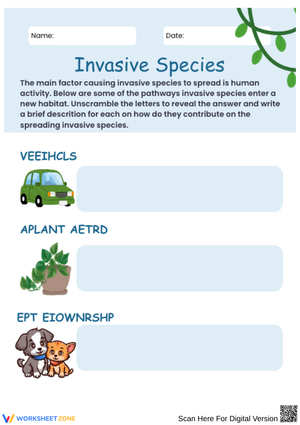
- Human pathway identification: students record how recreational boating, firewood transport, the ornamental plant trade, and pet release all function as channels for species spread — placing human behavior inside the ecological story.
- Text-based evidence writing: students pull specific details from a reading passage to support a written claim, rather than restating general impressions from prior knowledge.
- Prevention reasoning: students identify realistic individual and community actions and explain how each one interrupts a specific spread pathway.
Student Mistakes That Surface During This Unit
The most persistent error is the non-native/invasive conflation. Ask students to classify the domesticated honeybee — a European import with several centuries of North American presence — and many immediately mark it invasive because it "came from somewhere else." That response shows they are applying geographic origin as a proxy for harm, which is the wrong criterion. The sorting task includes non-native species with no documented harm record specifically to force students to apply the harm standard rather than the origin standard.
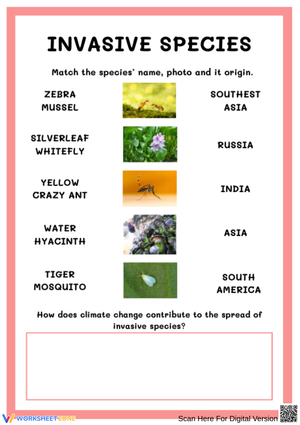
A second pattern appears in cause-and-effect tasks: students correctly identify direct competition — "zebra mussels filter the same food source as native mussels" — and stop there. Extending the chain to secondary effects does not happen without an explicit prompt. A follow-up step built into the chart ("now trace what happens to the fish species that depend on those native mussels") catches this reasoning gap before it disappears into a summative assessment. Students also define harm too narrowly, limiting it to direct animal death and missing the economic and habitat dimensions of the definition. A brief whole-class review of the harm criterion, run before students open any worksheet, prevents that narrowing reliably.
Fitting These Worksheets Into the Flow of Your Lesson
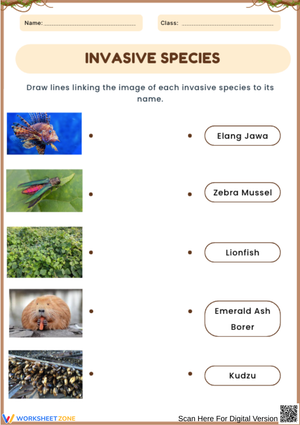
A practical 35-minute sequence begins with a brief whole-class discussion of one locally relevant example — spotted lanternfly in the Mid-Atlantic, kudzu in the Southeast, emerald ash borer across the Midwest — before students touch any materials. That three-minute anchor conversation activates prior knowledge and gives students a reference point when they encounter unfamiliar species on the page. From there, the reading passage leads into the sorting task, which works best as a partner activity so students verbalize their reasoning before committing it to writing. The cause-and-effect chart follows naturally as individual work.
Station rotations are equally effective. One station handles vocabulary matching, a second runs the reading and comprehension questions, and a third presents a paired comparison — one terrestrial example and one aquatic example — asking students to identify the pattern they share. That third station is where the most instructive reasoning happens, and positioning yourself there during rotation surfaces misconceptions early. These invasive species printable worksheets sets also work well as Monday warm-up sequences run across three consecutive days — one worksheet per day covers vocabulary, reading, and cause-and-effect without cutting into core instruction time.
Standard Alignment
These invasive species printable worksheets materials connect directly to NGSS MS-LS2-1, which asks students to analyze and interpret data on how resource availability affects organism populations in an ecosystem. The invasive species context is well-suited for this standard: students have a clear before-and-after scenario, a resource variable (food, space, light, water), and observable population effects to trace. MS-LS2-4 extends that work by requiring students to construct evidence-based arguments about how changes to biological components of an ecosystem affect native populations — exactly what the cause-and-effect chart and written justification tasks demand.
For upper elementary teachers working with NGSS 3-LS4-3, the sorting task maps onto the standard's focus on habitat fit: students evaluate why some organisms thrive in a given habitat while others decline, using invasive species as the evidence base. The vocabulary work also reinforces the broader life science progression's disciplinary core ideas on interdependence and ecosystem dynamics running from grade 3 through middle school, making these worksheets useful across multiple grade-level placements within a single building.
Tailoring the Worksheets for Different Student Readiness Levels
Students who struggle with extended reading benefit from completing the vocabulary-match worksheet before they encounter those terms in the passage. Having definitions on a separate worksheet — rather than embedded in a glossary at the back of a textbook — keeps attention on the science reasoning instead of constant page-hunting. On the sorting task, limiting those students to three carefully chosen examples rather than the full set preserves the conceptual challenge without demanding sustained focus across too many simultaneous cases.
Advanced students typically finish sorting tasks quickly and correctly, but their written explanations are thin. The most productive extension is not more examples — it is requiring a cause-and-effect chain of at least three steps, or asking students to argue in writing whether a specific borderline case qualifies as invasive based only on evidence provided in the passage. That constraint surfaces the difference between students who understand the ecosystem logic and those who have learned to pattern-match from familiar species names. Using these invasive species printable worksheets resources with a mixed-readiness class works best when differentiation targets the required depth of explanation, not the number of tasks completed.
Frequently Asked Questions
What is the actual difference between non-native and invasive, and how do I explain it clearly to students?
A non-native species is any organism living outside its original geographic range. An invasive species is a non-native organism whose introduction causes — or is likely to cause — measurable harm to the environment, the economy, or human health. The key teaching move is showing students examples of non-native species that are not invasive, so they cannot use geographic origin as a shortcut. The sorting task is built around this: it includes examples that fail the origin test but lack evidence of harm alongside examples that are clearly non-native with documented ecosystem effects.
Which grade levels fit these worksheets best?
The reading passages and tasks are written for grades 4 through 8, with the strongest alignment at grades 5 through 7 where NGSS ecosystem standards are concentrated. Adjusting the amount of vocabulary pre-teaching and the required depth of written justification brings individual worksheets up or down within that range. Sorting and cause-and-effect tasks work at the lower end of the band; evidence-based written argument tasks are most appropriate starting at grade 6.
Which species examples appear in the worksheets?
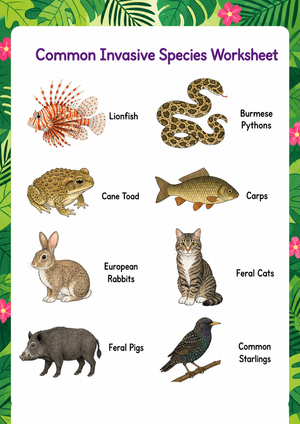
The worksheets draw on species with well-documented classroom use and clear ecosystem effects: zebra mussels (aquatic habitat disruption across the Great Lakes region), kudzu (displacement of native vegetation across the Southeast), spotted lanternfly (agricultural and hardwood forest damage), Burmese python (apex predator effects in the Everglades), and emerald ash borer (ash tree mortality and forest composition change). Using both aquatic and terrestrial examples is intentional — it prevents students from treating invasive species as exclusively a water problem or exclusively a plant problem, an assumption that appears in student work more often than expected.
Do these worksheets work inside an ecosystems unit that already uses a textbook?
Yes, and that pairing is the most effective placement. These worksheets function as application and practice materials within a unit, not as primary instruction replacing a text. The reading passages introduce invasive species vocabulary and concepts, but they assume students have already encountered basic ecosystem terms — producer, consumer, food web, habitat — through direct instruction. Teachers who use these worksheets as the first introduction to all ecosystem vocabulary find that students spend more time decoding unfamiliar terms than reasoning about ecological relationships, which inverts the purpose of the activity.
Clear All