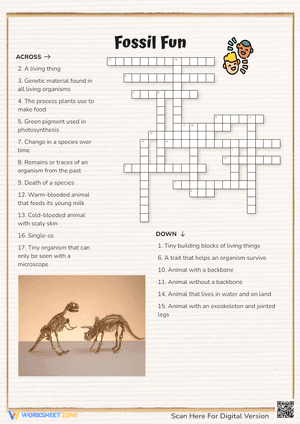
If you teach grade 3 or grade 4 earth science, you already know that fossils are one of the few topics where students can practice real evidence-based reasoning without a lab kit. Fossils worksheets give you a low-prep way to turn a fossil photo or data table into a reasoning task: what does this evidence tell us about an organism and the place it once lived. That is exactly the skill NGSS 3-LS4-1 asks students to build, and it is why fossil-based tasks show up so often in earth and life science pacing guides for this age group.
Instead of starting with a broad claim about worksheets being useful, it helps to start from what a grade 3-4 classroom actually needs: short, focused tasks that fit into a 30-45 minute science block, work as a whole-class mini-lesson, and can also be reused at a small-group station later in the unit.
How Fossils Worksheets Support NGSS 3-LS4-1
NGSS 3-LS4-1 requires students to analyze and interpret fossil data as evidence of organisms and the environments they lived in long ago. That means a worksheet is doing its job only if it asks students to move beyond naming a fossil and into interpreting it. Strong tasks ask students to look at a fossil image or simple dataset and answer questions such as what body part is preserved, what that body part suggests about how the organism moved or fed, and what the surrounding rock layer suggests about the environment at the time.
A useful classroom pattern is a two-column evidence organizer, where one column lists what students observe directly in the fossil and the other column lists what they can reasonably infer. This mirrors the claim-evidence structure used in NGSS performance expectations and gives you a clean formative check on whether students can separate observation from inference, which is often the actual gap in early evidence-based reasoning.
Teaching the Fossil Formation Process Step by Step
Before students can interpret fossil evidence, they need a working model of how a fossil forms in the first place. Fossils worksheets built around a sequencing task are effective here: students order steps such as an organism dying and being buried by sediment, layers of sediment building up over time, minerals gradually replacing the original material, and the surrounding rock eventually being exposed or excavated.
A sequencing worksheet also works well as a review task before a fossil dig simulation or a rock-layer activity, since it gives every student the same shared vocabulary for sedimentation, molds, casts, and mineral replacement before you move into more open-ended analysis.
Pairing Fossil Worksheets With Rock Layer Analysis
NGSS 4-ESS1-1 requires students to use patterns in rock layers and fossils to explain changes in a landscape over time, which makes it a natural extension once your grade 3 students already understand basic fossil formation. A cross-grade earth science unit can pair a grade 3 fossil-evidence worksheet with a grade 4 rock-layer worksheet, so students first practice reading a single fossil as evidence and then practice reading a stack of rock layers as a timeline.
This pairing is especially useful in mixed-grade schools or in schools that loop teachers across grades 3 and 4, since it lets you scaffold the same core skill, using evidence to explain the past, across two connected standards instead of teaching them as unrelated topics.
Classroom Implementation
For whole-class instruction, a single fossil-analysis worksheet works well as a shared mini-lesson: project one fossil image, model the observation-versus-inference thinking on the board, then release students to complete a second fossil independently. For small-group science stations, rotate three or four different fossil worksheets, one on formation sequencing, one on comparative anatomy, one on footprint inference, and one on rock-layer connections, so each station reinforces a different piece of the same standard.
For intervention groups, simplify the task by reducing the number of inference questions and adding a word bank for key vocabulary like sediment, mold, cast, and petrified. For enrichment groups, add an open-ended prompt asking students to write their own claim about the fossils environment and support it with two pieces of evidence from the worksheet, which pushes them toward the full claim-evidence-reasoning structure used in later grades.
Fossil worksheets also work well as formative checkpoints. A short fossil-interpretation task makes an effective exit ticket at the end of a lesson on fossil formation, and a quick footprint or comparative-anatomy task can serve as a warm-up to check retention before you move into rock-layer analysis. Because these tasks are short and focused, you get a clear read on which students can reason from evidence to a conclusion and which students need another pass at the vocabulary before they can do that reasoning independently.
Frequently Asked Questions
1. What grade levels are fossils worksheets best suited for?
Fossils worksheets are most commonly used in grades 3-4, since this is where NGSS 3-LS4-1 and 4-ESS1-1 place fossil evidence and rock-layer reasoning as core science expectations. Grade 3 tasks tend to focus on individual fossils as evidence, while grade 4 tasks extend that reasoning into rock-layer patterns over time.
2. How do fossils worksheets align with NGSS standards like 3-LS4-1 and 4-ESS1-1?
NGSS 3-LS4-1 asks students to analyze and interpret fossil data as evidence of organisms and past environments, and 4-ESS1-1 asks students to use rock layer and fossil patterns to explain landscape change over time. Fossils worksheets built around observation, inference, and sequencing tasks give students direct, repeated practice with both expectations.
3. What skills do fossil worksheets build beyond science content?
Beyond earth science content, fossil worksheets build evidence-based reasoning, since students must separate what they directly observe from what they can reasonably infer. They also build comparative thinking through tasks like trilobite versus horseshoe crab analysis, and sequencing skills through fossil-formation ordering tasks.
4. How can teachers use fossils worksheets in small-group or station-based instruction?
Fossil worksheets work well as rotating station tasks, with each station focused on a different skill such as formation sequencing, comparative anatomy, footprint inference, or rock-layer connections. This lets you reinforce the same standard through several short, focused tasks rather than one long worksheet, which fits naturally into a station-based science block.















 Interactive Worksheet Maker
 Quiz Maker
 Word Search Maker
 Crossword Puzzle Maker
 Word Scramble Generator
 Sentence Scramble Generator
 Handwriting Worksheet Generator
 Name Tracing Generator
 Fill In The Blank Generator