


























Views
Downloads


Printable Mesosphere Worksheet | Grade 6-8 Science
Paste this activity's link or code into your existing LMS (Google Classroom, Canvas, Teams, Schoology, Moodle, etc.).
Students can open and work on the activity right away, with no student login required.
You'll still be able to track student progress and results from your teacher account.
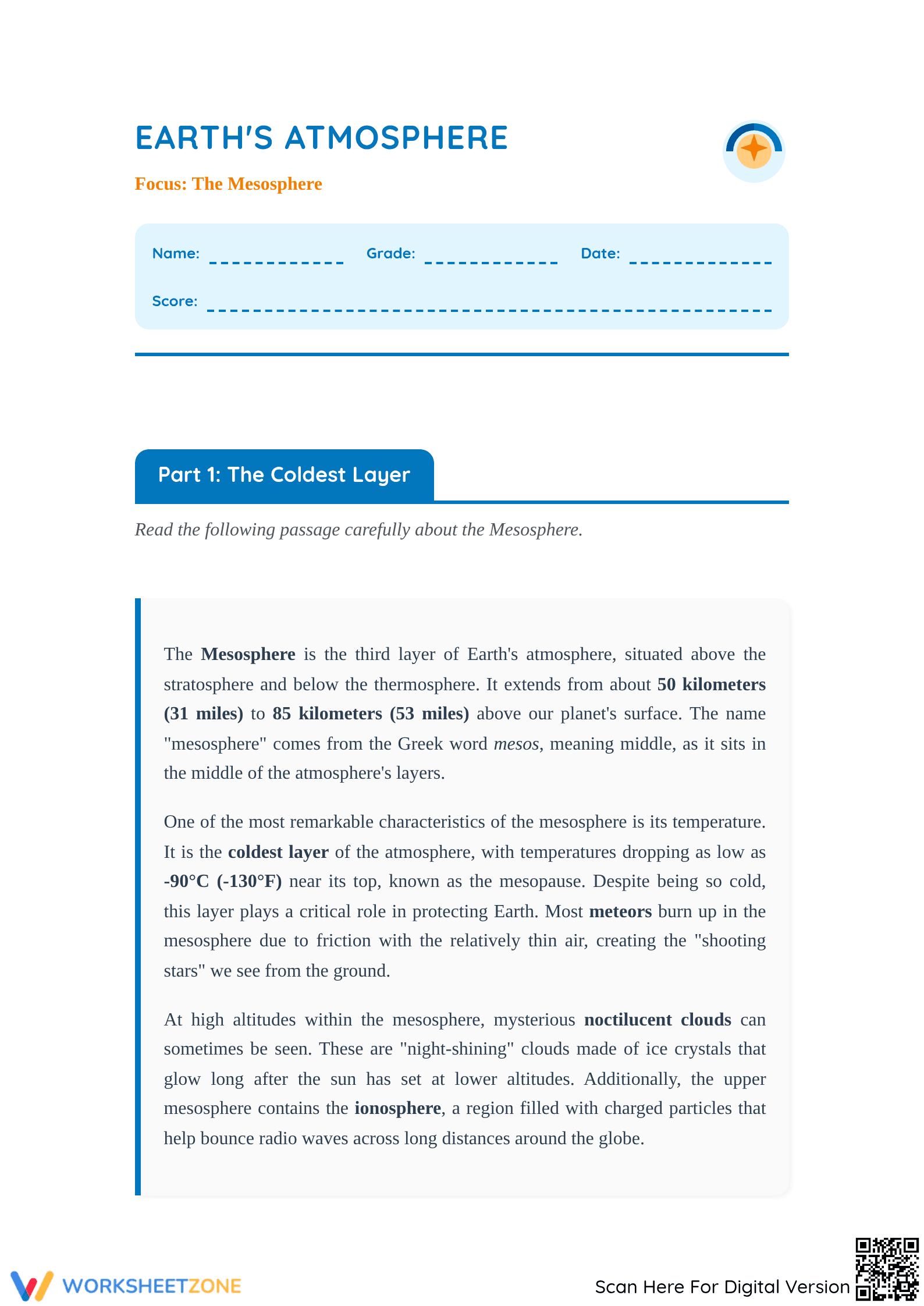
This comprehensive reading and practice packet helps middle school students master Earth's atmospheric layers, focusing specifically on the mesosphere. By combining an informational text with targeted vocabulary and comprehension questions, learners will build essential science literacy skills while discovering the unique characteristics of our planet's coldest layer.
At a Glance
- Grade: 6-8 · Subject: Science
- Standard:
CCSS.ELA-LITERACY.RST.6-8.4— Determine the meaning of domain-specific science words- Skill Focus: Reading Comprehension & Vocabulary
- Format: 4 pages · 24 problems · Answer key included · PDF
- Best For: Independent practice or sub plans
- Time: 30–45 minutes
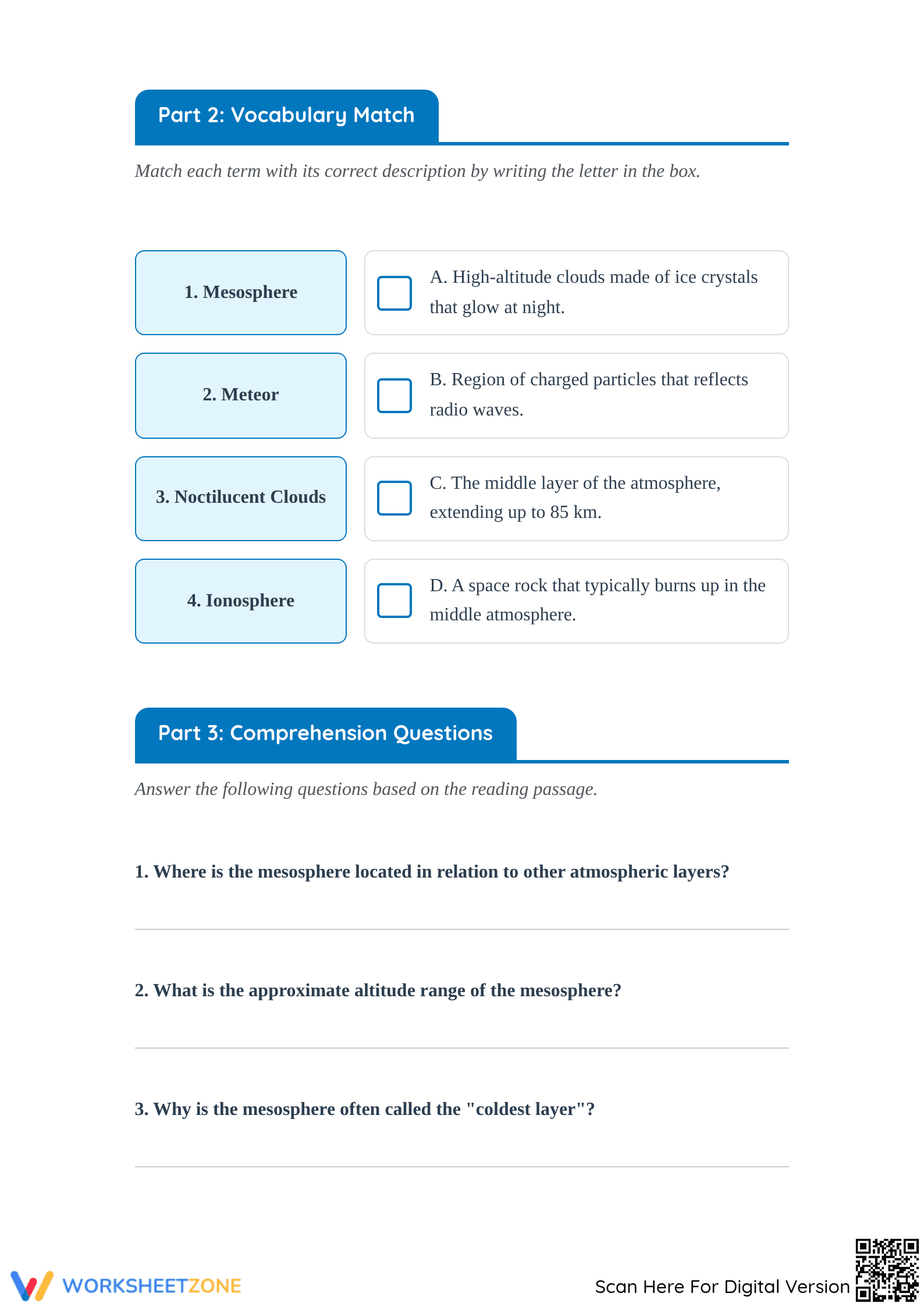
This four-page resource provides a complete, self-contained lesson on the mesosphere. It begins with an engaging informational passage detailing the layer's temperature, meteor activity, and noctilucent clouds. Following the text, students will complete a four-term vocabulary match, answer five short-response comprehension questions, label a five-part atmospheric diagram, and finish with a ten-word thematic word search. A complete answer key is provided for quick grading.
- Guided practice: Students begin by reading the provided informational text, which highlights key terms in bold to support vocabulary acquisition and reading comprehension.
- Supported practice: The vocabulary matching and diagram labeling sections provide structured, low-stakes opportunities to apply new knowledge directly from the text.
- Independent practice: Five short-answer questions require students to synthesize information and explain concepts in their own words, demonstrating true mastery of the material.
This gradual-release approach ensures students build confidence as they move from basic recall to deeper conceptual understanding.
Aligned to CCSS.ELA-LITERACY.RST.6-8.4, this resource requires students to "determine the meaning of symbols, key terms, and other domain-specific words and phrases as they are used in a scientific or technical context." It also supports cross-curricular literacy goals by reinforcing informational text reading strategies. Both standard codes can be copied directly into lesson plans, IEP goals, or district curriculum mapping tools.
This worksheet is highly versatile for middle school science classrooms. Use it as an independent reading assignment during a broader Earth Science unit on the atmosphere, or keep it on hand as a reliable, zero-prep substitute teacher plan. As a formative assessment tip, review students' answers to the short-response questions to gauge their ability to pull specific textual evidence. Most students will complete the packet within 30 to 45 minutes.
Designed primarily for 6th through 8th-grade science students, this packet is ideal for mixed-ability classrooms. The bolded vocabulary words and clear diagram labeling offer built-in scaffolds for English Language Learners and students needing reading support. It pairs perfectly with a broader unit on weather, climate, or Earth's systems, serving as a focused exploration of one specific atmospheric layer.
Integrating literacy into science instruction is critical for developing students' ability to process complex technical information. According to a recent ScienceDirect TpT Analysis, resources that combine domain-specific reading passages with targeted vocabulary exercises significantly improve student retention of scientific concepts and overall academic achievement. This worksheet directly supports CCSS.ELA-LITERACY.RST.6-8.4 by challenging students to determine the meaning of domain-specific science words in context. By engaging with the text to define terms like "ionosphere" and "noctilucent clouds," learners practice the exact analytical skills required for advanced STEM coursework. Providing structured opportunities to read, write, and interact with scientific vocabulary ensures that students do not just memorize isolated facts, but actually comprehend the underlying systems that govern Earth's atmosphere. This approach builds a strong foundation for future scientific inquiry and environmental literacy.


