


























Views
Downloads


Atmosphere Layers Printable Worksheet | Grade 6 Science
Paste this activity's link or code into your existing LMS (Google Classroom, Canvas, Teams, Schoology, Moodle, etc.).
Students can open and work on the activity right away, with no student login required.
You'll still be able to track student progress and results from your teacher account.
This comprehensive science worksheet helps students master the layers of Earth's atmosphere by identifying key characteristics of the troposphere, stratosphere, mesosphere, thermosphere, and exosphere. Through a variety of engaging question formats, learners will build a strong foundational understanding of how our atmosphere is structured and why each layer is vital to our planet.
At a Glance
- Grade: 6 · Subject: Science
- Standard:
5-ESS2-1— Describe ways the atmosphere interacts with Earth's systems- Skill Focus: Identifying atmospheric layers
- Format: 3 pages · 39 problems · Answer key included · PDF
- Best For: Independent practice or review
- Time: 25–35 minutes
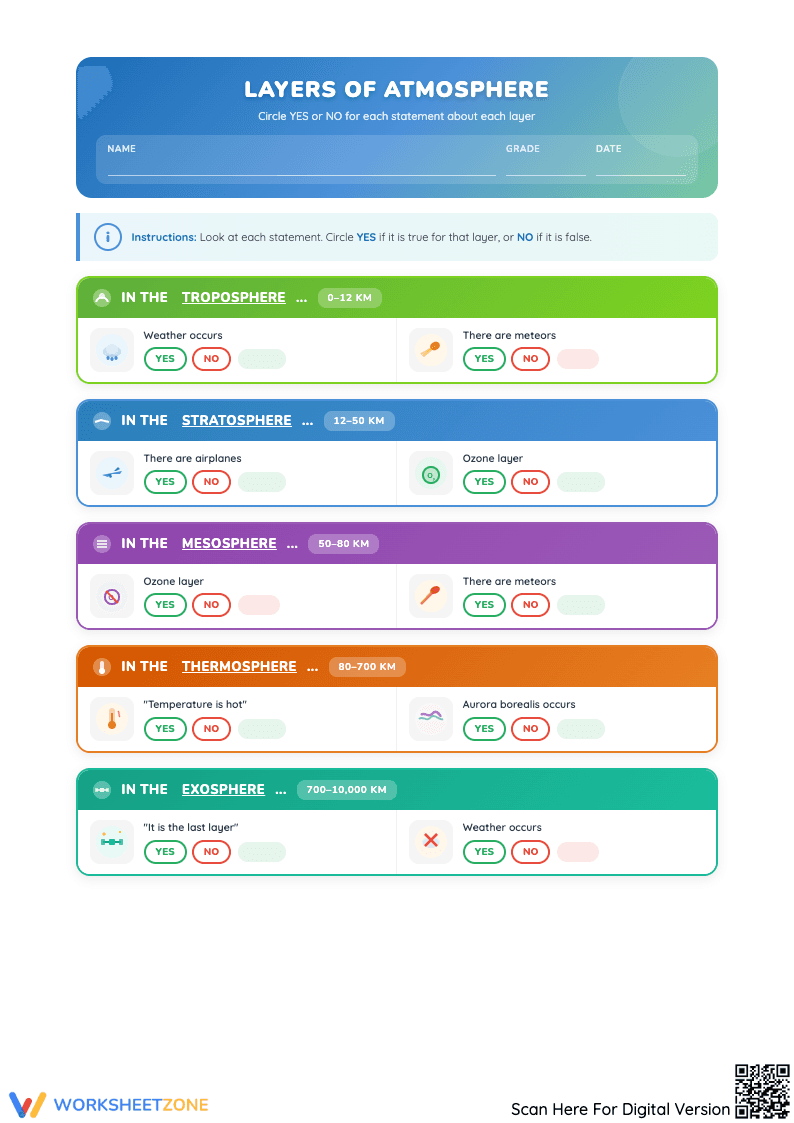
This three-page packet features a diverse mix of 39 tasks designed to keep students engaged. It includes a yes/no characteristic sorting activity, a matching section, true/false questions, a visual labeling diagram, and a fill-in-the-blank exercise with a provided word bank. The final page also features a bonus challenge and a quick-write reflection to encourage higher-order thinking, along with a handy "Fun Facts" reference box. A complete answer key is included for easy grading.
- Guided practice: The first page introduces the five layers with straightforward yes/no questions (10 tasks) that help students associate specific phenomena, like weather or meteors, with the correct layer.
- Supported practice: The second page transitions into matching, true/false, and diagram labeling (15 tasks), requiring students to recall and apply their knowledge with visual and textual cues.
- Independent practice: The final page challenges students with fill-in-the-blanks, short answer questions, and a reflective writing prompt (14 tasks) to solidify their understanding.
This gradual-release approach ensures students build confidence as they move from basic identification to independent application.
Aligned to 5-ESS2-1, this resource supports students as they "develop a model using an example to describe ways the geosphere, biosphere, hydrosphere, and/or atmosphere interact." It also builds essential background knowledge for middle school Earth Systems standards. Both standard codes can be copied directly into lesson plans, IEP goals, or district curriculum mapping tools.
This worksheet is highly versatile and can be deployed during direct instruction as a guided notes companion or assigned afterward as independent practice. For a formative assessment observation tip, monitor students as they complete the visual labeling diagram to quickly gauge their spatial understanding of the layers' order. Expected completion time is 25 to 35 minutes, making it an ideal length for a standard class period or a comprehensive homework assignment.
Designed primarily for 5th and 6th-grade science students, this resource includes built-in scaffolds like word banks and visual diagrams to support diverse learners. It pairs perfectly with an introductory lesson on Earth's systems or a hands-on atmosphere model-building activity.
Integrating structured practice on identifying atmospheric layers is crucial for developing scientific literacy in Earth sciences. According to EdReports 2024, high-quality instructional materials that provide varied, repeated exposures to core scientific concepts significantly improve student retention and conceptual understanding. By aligning with 5-ESS2-1, this resource ensures students can accurately describe ways the atmosphere interacts with Earth's systems. Providing multiple modalities of practice—from visual labeling to reflective writing—supports deeper cognitive processing and helps students transition from rote memorization to meaningful application of Earth science principles.


