


























Views
Downloads
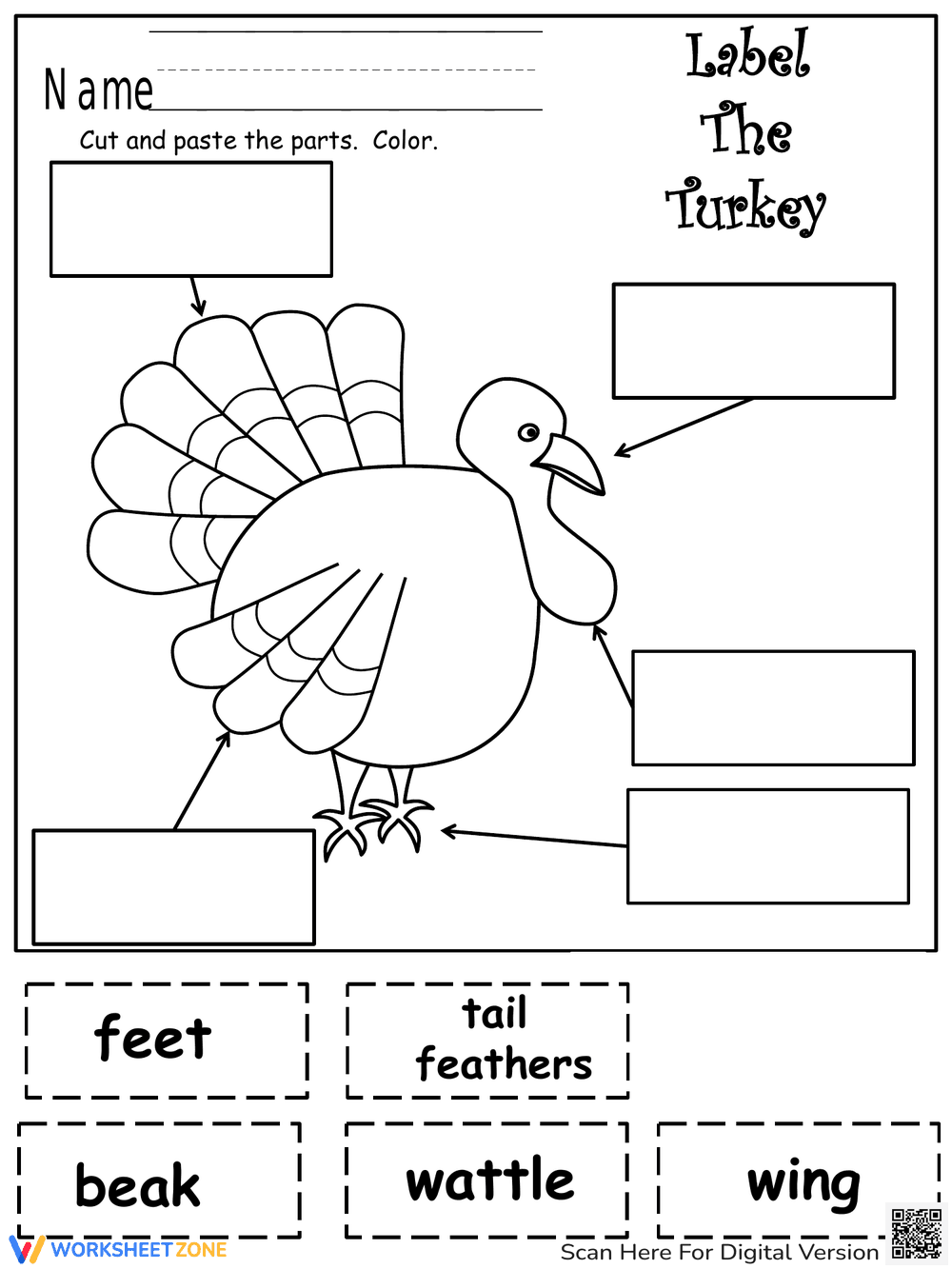

Label The Turkey Parts Worksheet | Grade 3 Essential
Paste this activity's link or code into your existing LMS (Google Classroom, Canvas, Teams, Schoology, Moodle, etc.).
Students can open and work on the activity right away, with no student login required.
You'll still be able to track student progress and results from your teacher account.
This Grade 3 turkey anatomy worksheet helps students identify and label external structures of a common bird. By engaging in a hands-on cut-and-paste activity, learners develop essential vocabulary and observational skills. This resource provides a clear visual representation of a turkey, ensuring students can accurately locate and name specific physical features during Thanksgiving-themed science lessons.
At a Glance
- Grade: 3 · Subject: Science
- Standard:
3-LS1-1— Identify external structures that help organisms survive and grow- Skill Focus: Identifying external animal structures
- Format: 1 page · 5 problems · Answer key included · PDF
- Best For: Thanksgiving science centers or sub plans
- Time: 15–20 minutes
The worksheet features a large, clear illustration of a turkey with five distinct boxes pointing to specific anatomical parts. At the bottom of the page, students find a cut-and-paste word bank containing the terms: feet, tail feathers, beak, wattle, and wing. The layout is designed for high-contrast printing, and the line-art style allows for an optional coloring activity once the labeling is complete.
This resource follows a streamlined zero-prep workflow designed for busy educators. First, print the single-page PDF (30 seconds). Second, distribute the sheets along with scissors and glue sticks to your students (1 minute). Third, review the completed labels as a whole group to check for accuracy (5 minutes). The total teacher preparation time is under two minutes, making it an ideal choice for emergency sub plans or last-minute holiday activities.
This activity aligns with `3-LS1-1`, focusing on the external structures that support an organism's survival and growth. While the standard often emphasizes life cycles, understanding the physical components of the organism is a foundational prerequisite. Additionally, it supports CCSS.ELA-LITERACY.RI.3.7 by requiring students to use information gained from illustrations to demonstrate understanding of the text. Both standard codes can be copied directly into lesson plans, IEP goals, or district curriculum mapping tools.
Use this worksheet during a life science unit on animal adaptations or as a thematic Thanksgiving activity. It works best after a brief direct instruction session where you display a real image of a turkey. For a formative assessment, observe students as they match the "wattle" and "beak" labels; this reveals their ability to distinguish between specific facial features. Expect completion within 15 to 20 minutes depending on fine motor speed.
This worksheet is designed for Grade 3 students but is accessible for English Language Learners (ELL) due to the heavy visual support and word bank. It serves as an excellent differentiation tool for students who struggle with handwriting, as the cut-and-paste format removes that barrier. Pair this resource with a non-fiction passage about wild turkeys or an anchor chart detailing bird anatomy for a comprehensive lesson.
Research from the RAND AIRS 2024 report indicates that high-quality, visually-supported materials significantly improve vocabulary retention in elementary science. By using the 3-LS1-1 standard to frame the identification of external structures, this worksheet provides a concrete entry point into biological modeling. The plain-English skill of identifying animal parts like the wattle and tail feathers allows students to build a schema for more complex anatomical studies. Fisher & Frey (2014) emphasize that the gradual release of responsibility is most effective when students have clear, scaffolded tasks like this cut-and-paste activity. This resource ensures that 100% of students can participate in the labeling process regardless of their writing proficiency. By integrating holiday themes with rigorous scientific observation, educators can maintain high engagement levels while meeting district curriculum requirements for life science and informational text analysis.


