


























Views
Downloads
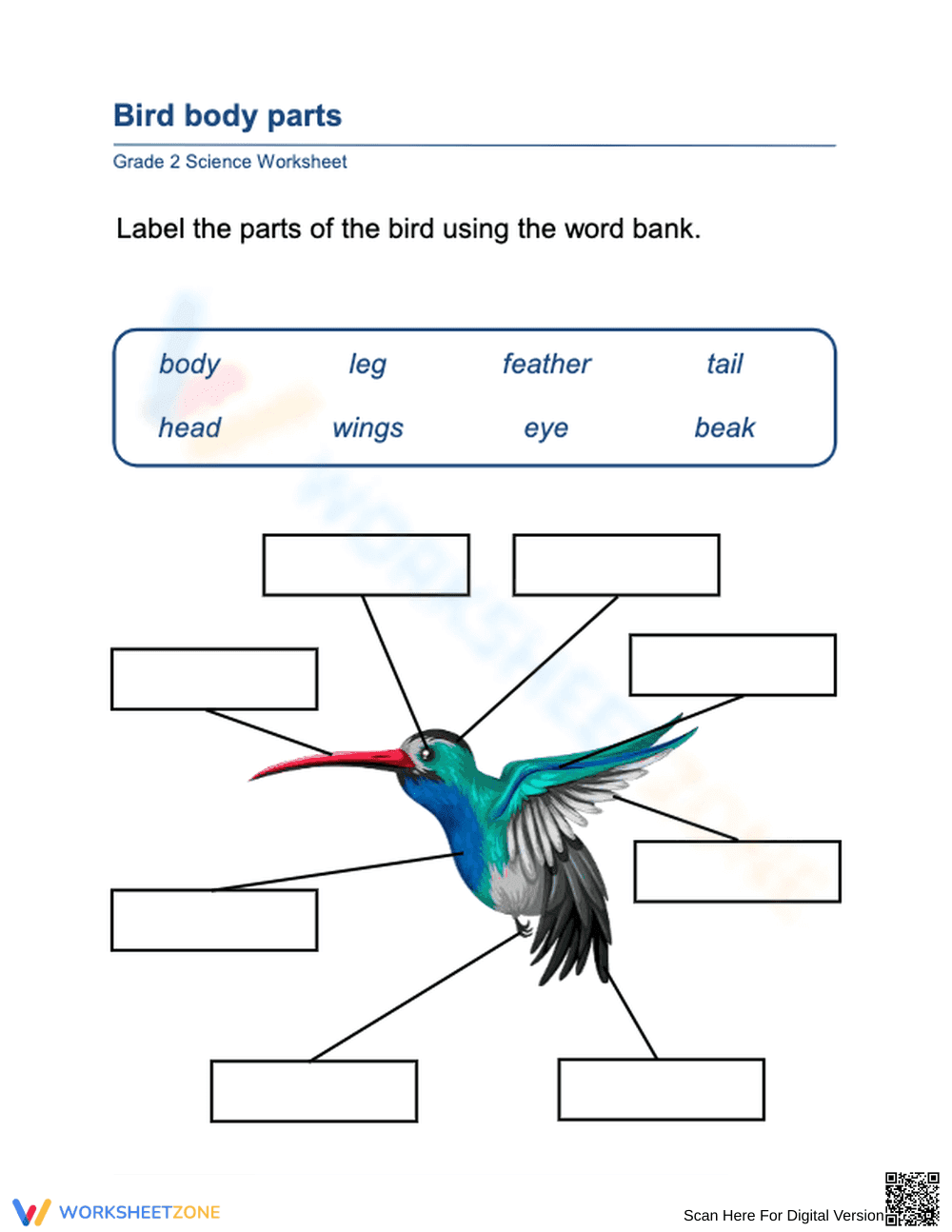

Essential Bird Body Parts Worksheet | Grade 2 Science
Paste this activity's link or code into your existing LMS (Google Classroom, Canvas, Teams, Schoology, Moodle, etc.).
Students can open and work on the activity right away, with no student login required.
You'll still be able to track student progress and results from your teacher account.
This Grade 2 Science worksheet helps students master the identification of bird anatomy by labeling key structures using a provided word bank. Students observe a detailed hummingbird illustration to connect terms like beak, wings, and feathers to their physical locations, fostering essential observation skills in life science.
At a Glance
- Grade: 2 · Subject: Science
- Standard:
2-LS4-1— Make observations of animals to compare the diversity of life- Skill Focus: Bird anatomy and external body parts identification
- Format: 2 pages · 8 problems · Answer key included · PDF
- Best For: Introduction to animal structures or assessment
- Time: 10–15 minutes
What's Inside
This two-page PDF includes a student worksheet and a corresponding answer key for easy grading. The worksheet features a clear hummingbird diagram with eight leader lines pointing to specific anatomical features. A structured word bank containing eight essential vocabulary terms—body, leg, feather, tail, head, wings, eye, and beak—supports learners as they complete the labeling task.
Zero-Prep Workflow
The workflow for this resource is designed for maximum efficiency in the classroom. Total teacher preparation time is under two minutes, making it ideal for busy mornings or sub plans. Follow these three steps:
- Print (30 seconds): Print the single-page student worksheet for the class.
- Distribute (1 minute): Hand out the sheets for a quick warm-up or center activity.
- Review (2 minutes): Check the answers using the provided key for immediate feedback.
Standards Alignment
This resource is primary aligned to 2-LS4-1, which focuses on making observations of animals to understand the diversity and structures of life. By identifying specific external parts, students build the foundational knowledge required to compare how different animals are adapted to their environments. Both standard codes can be copied directly into lesson plans, IEP goals, or district curriculum mapping tools.
How to Use It
Use this worksheet during the "Explain" phase of a lesson on animal characteristics to solidify vocabulary. It works exceptionally well as a formative-assessment tool; observe if students correctly distinguish between the beak and the head or the tail and the wings to gauge anatomical understanding. The activity typically takes 10 to 15 minutes to complete during a science center rotation.
Who It's For
This activity is designed for second-grade students beginning their exploration of life science and living organisms. It provides necessary scaffolding for English Language Learners and students needing fine motor practice through labeling. This worksheet pairs naturally with a bird-themed non-fiction reading passage or a classroom anchor chart displaying various animal structures.
Aligned to 2-LS4-1, this bird anatomy worksheet facilitates the direct observation of external structures, a critical component of early life science literacy. By connecting visual diagrams with specific terminology such as "beak" and "feather," students develop the schema necessary for later comparisons of animal diversity and habitat adaptation. As noted in RAND AIRS 2024, the use of structured visual labeling tasks significantly improves vocabulary retention and conceptual mapping in elementary science learners. This printable resource provides exactly 8 targeted identification opportunities, ensuring that students reach a high level of accuracy within a single instructional session. A hummingbird model allows for the discussion of specialized structures like the long beak, which supports standard-aligned inquiries into how animal parts help them survive and meet their needs within their specific ecological niches.


