


























Views
Downloads
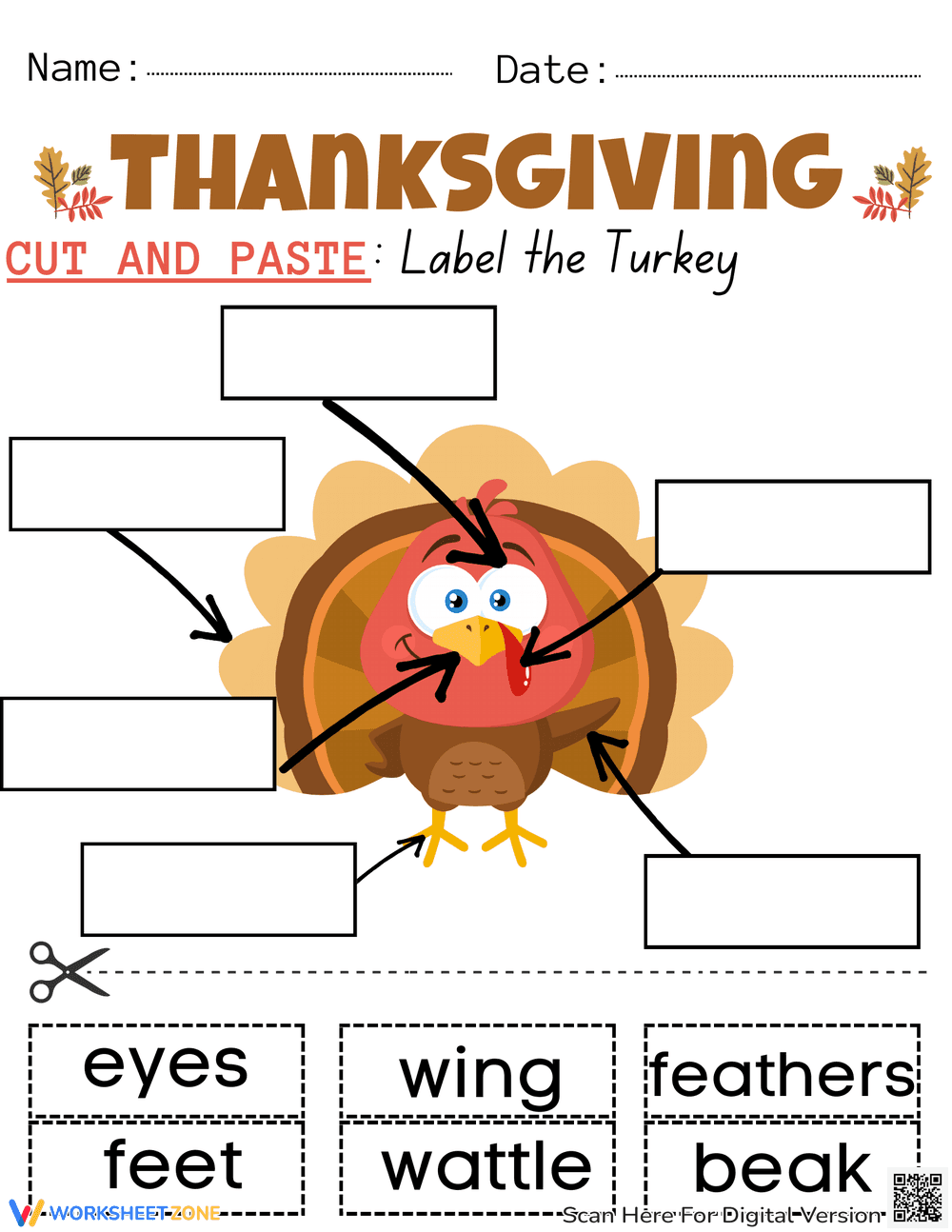

Label the Turkey Worksheet | Grade K-2 Essential
Paste this activity's link or code into your existing LMS (Google Classroom, Canvas, Teams, Schoology, Moodle, etc.).
Students can open and work on the activity right away, with no student login required.
You'll still be able to track student progress and results from your teacher account.
This Label the Turkey worksheet helps early learners master basic animal anatomy through a hands-on cut-and-paste activity. Students identify and place labels for six key turkey parts, reinforcing vocabulary and fine motor coordination. It provides a clear, visual way for children to demonstrate their understanding of biological structures during Thanksgiving-themed lessons.
At a Glance
- Grade: K-2 · Subject: ELA & Science
- Standard:
CCSS.ELA-LITERACY.L.K.1— Use frequently occurring nouns to label objects and identify parts- Skill Focus: Vocabulary and Diagram Labeling
- Format: 1 page · 6 tasks · Answer key included · PDF
- Best For: Thanksgiving centers or morning work
- Time: 15–20 minutes
This single-page PDF features a high-quality illustration of a turkey with six distinct arrows pointing to its physical features. At the bottom of the page, students find a dashed-line cutting zone containing six vocabulary words: eyes, wing, feathers, feet, wattle, and beak. The layout is clean and spacious, making it accessible for students still developing scissor skills.
This resource is designed for immediate classroom implementation. First, print the required number of copies (30 seconds). Next, distribute the sheets along with scissors and glue sticks (1 minute). Finally, review the completed diagrams as a whole group to check for accuracy (5 minutes). This workflow requires less than two minutes of teacher preparation, making it an ideal choice for emergency sub plans or seasonal transition times.
The primary standard addressed is `CCSS.ELA-LITERACY.L.K.1`, which focuses on the use of frequently occurring nouns. By matching the printed word to the correct anatomical feature, students practice word recognition and categorization. Both standard codes can be copied directly into lesson plans, IEP goals, or district curriculum mapping tools.
Use this worksheet as a formative assessment after a read-aloud about farm animals or Thanksgiving traditions. It works best during independent work blocks where teachers can observe students' scissor control and word-to-image association. Expect students to complete the task in approximately 15 to 20 minutes, depending on their manual dexterity.
This activity is tailored for Kindergarten through 2nd-grade students, including English Language Learners who benefit from visual aids. It pairs naturally with a non-fiction text about turkeys or a seasonal anchor chart displaying animal body parts.
This Label the Turkey worksheet aligns with CCSS.ELA-LITERACY.L.K.1 by requiring students to identify and apply specific nouns to a visual diagram. According to the RAND AIRS 2024 report, integrating tactile activities like cut-and-paste labeling significantly improves vocabulary retention in early childhood settings compared to passive observation. By engaging multiple senses—visual, motor, and cognitive—students build stronger neural pathways for new terminology. The 6 specific tasks included in this resource provide sufficient repetition for mastery without overwhelming young learners. This instructional design follows the Fisher & Frey (2014) model of scaffolded literacy, where visual cues support the transition from oral language to printed word recognition. Educators can utilize this tool to gather evidence of student progress in both fine motor development and life science vocabulary, ensuring that foundational literacy goals are met through engaging, seasonal content.


