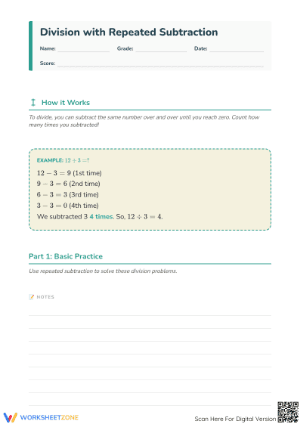
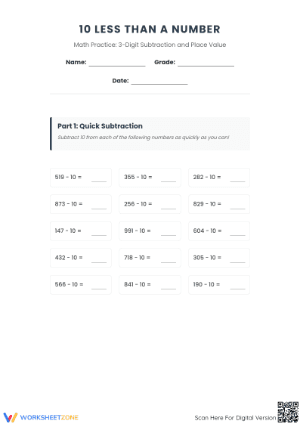
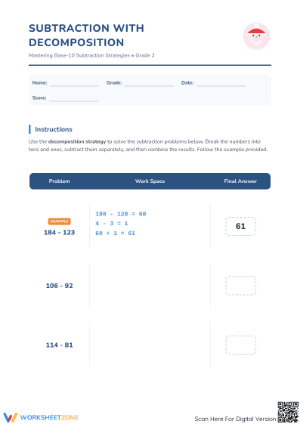
These subtraction strategies printable worksheets give K–3 teachers structured, reusable practice for the four methods students need before multi-digit operations arrive: counting back, open number line movement, making ten through decomposition, and fact family reasoning. Each worksheet isolates a single strategy so students build genuine fluency with one approach before encountering the next. The set runs from kindergarten, where counting back is the entry point, through second grade, where fact families and making ten become the dominant tools for working within 20.
The Specific Skills Each Worksheet Targets
Counting-back worksheets ask students to mark their starting number and record each backward step — making the process visible rather than purely mental, which matters most for students who are still internalizing the relationship between counting sequences and removal. Number line worksheets include pre-labeled intervals so students spend their attention drawing jumps rather than constructing the tool from scratch; a child who builds a number line from nothing is doing a fundamentally different task than one who uses an existing line to reason about subtraction. Making-ten worksheets pair ten-frame grids with equations like 13 − 6, walking students through breaking the subtrahend into two parts — first reaching 10, then subtracting what remains. Fact family worksheets use a triangle format with the three related numbers at each corner, allowing students to read both the addition and subtraction relationships from one figure without switching between separate problems.
The sequencing of these strategies is deliberate. Counting back requires no new representation — students already count, and subtracting as removal maps directly onto that skill. The number line follows as a spatial record of the same movement. Making ten and fact families arrive later, when students are working within 20 and need approaches that don't rely on counting individual steps.
Why Showing the Strategy Matters More Than Showing the Answer
Worksheets that require students to draw their reasoning generate diagnostic information that answer-only formats cannot. When a student draws hops on a number line to solve 7 − 3 and lands on 3 instead of 4, the error is visible and correctable in real time. That same student writing "3" in a blank box tells the teacher nothing about whether they miscounted, misread the problem, or have a deeper gap in number order. The ten-frame format works similarly — a student who crosses out six dots on a frame of thirteen leaves a record that shows whether they decomposed correctly or simply removed dots at random. These worksheets build formative checkpoints into the practice itself rather than requiring a separate assessment moment.
Common Misconceptions to Watch For and Correct
The error students make most reliably on counting-back worksheets is including the minuend in the count. For 8 − 3, they count "8, 7, 6" and record 6. This fencepost error is almost universal in first grade regardless of how clearly the strategy was modeled whole-group. A quick correction: ask the student to place a finger on the starting number, then move the finger only when counting begins — separating the starting position from the first backward step usually resolves it within one session.
On making-ten worksheets, the typical breakdown happens after the first subtraction step. A student rewrites 13 − 6 correctly as (13 − 3) − 3, reaches 10, and stops. They have done the harder conceptual work of hitting the benchmark but don't complete the second part. Including a dedicated line for each step — one for reaching 10, one for the remaining subtraction — keeps that second step from disappearing. Fact family worksheets surface a different problem: students write the same subtraction equation twice (7 − 3 = 4 and 7 − 3 = 4) rather than generating the inverse (7 − 4 = 3). They haven't yet internalized that swapping the two smaller numbers produces a valid, different equation — a conceptual gap worth addressing directly before moving on.
Fitting These Worksheets Into Your Instructional Week
The eight minutes between morning meeting and the first formal lesson is a reliable slot for a counting-back or number line worksheet as a low-stakes warm-up. The brevity matters — a focused worksheet activates mathematical thinking without consuming the time needed for new content. For reteaching, pull three to five students and work through a number line worksheet together, asking each student to narrate their jumps aloud before marking them. That verbal step surfaces confusion that written work alone sometimes masks.
These subtraction strategies printable worksheets rotate naturally through math centers. A ten-frame worksheet at one station, a fact family triangle sheet at another, and a counting-back sequence at a third gives students distributed practice across all four methods over the course of a week. Scanning a class set of completed worksheets after independent work takes about three minutes and reveals immediately which strategy needs whole-group reteaching before the unit moves forward.
Standard Alignment
CCSS.MATH.CONTENT.1.OA.C.6 requires first graders to add and subtract within 20 using strategies including making ten and the relationship between addition and subtraction — the exact approaches these worksheets address. CCSS.MATH.CONTENT.2.OA.B.2 raises the expectation to fluency within 20, which means second grade is where students consolidate and automate strategies rather than encounter new ones. Instructionally, that distinction matters: in first grade, these worksheets are tools for strategy introduction; in second grade, they function as fluency-building repetition. Using a number line worksheet at the start of second grade also serves as a quick screen — students who still need the line to solve basic facts within 10 need targeted intervention before the class moves into two-digit addition and subtraction.
Adjusting the Worksheets for Students at Different Points
For students who are shaky on number order, limit counting-back worksheets to minuends of 10 or below and keep the subtracted value at 1 or 2. The goal isn't easier math — it's isolating the strategy so number knowledge doesn't interfere with practicing the procedure. Students who have counting back under control move to number line worksheets with two-digit numbers, where the same underlying strategy demands more careful tracking and becomes a genuine challenge without introducing any new concept.
Fact family worksheets extend further than they initially appear. Students who move through the triangle format quickly can work with these subtraction strategies printable worksheets by covering the top corner — the sum hidden — turning a fluency drill into a reasoning task that asks them to find a missing whole rather than a missing part. That modification requires no additional materials, just a verbal instruction before the worksheet begins. On the other end, students who struggle with the triangle layout benefit from first seeing the three numbers written as a list and identifying which is largest before moving to the spatial arrangement of the triangle.
Frequently Asked Questions
Which strategy should I introduce first?
Start with counting back. It requires no new representation and connects directly to counting skills students already have. Once students count back accurately by 1s and 2s, introduce the number line as a visual record of the same process. Making ten and fact families follow when students are working confidently within 20 and need strategies that don't depend on counting individual steps backward.
Are number line worksheets appropriate to send home?
Not during initial instruction. A student who misreads the format at home spends the evening reinforcing an error. Once a strategy has been modeled and practiced in class and the student can navigate a worksheet without prompting, sending it home as review is reasonable — but the classroom practice phase needs to come first. Counting-back worksheets travel home more safely because the format is simpler and errors are easier for parents to catch.
How many times should students practice a strategy before moving on?
A practical benchmark: students are ready to move on when they complete a strategy worksheet accurately without referencing the worked example at the top. Most students reach that point after three to five exposures. A student who still needs the model after six sessions is signaling something about their number sense that warrants closer investigation — strategy practice alone won't resolve a gap in counting fluency or number order.
Do these worksheets work alongside Eureka Math or similar core programs?
These subtraction strategies printable worksheets address the same methods those programs introduce, so they function well as supplemental practice alongside any standards-aligned curriculum. They are not a replacement for initial conceptual instruction with manipulatives or whole-group modeling — they work best after a strategy has been introduced concretely, when students need repetition to move from understanding to fluency.
















 Interactive Worksheet Maker
 Quiz Maker
 Word Search Maker
 Crossword Puzzle Maker
 Word Scramble Generator
 Sentence Scramble Generator
 Handwriting Worksheet Generator
 Name Tracing Generator
 Fill In The Blank Generator