These subtraction on a number line printable worksheets resources give K–3 teachers four distinct practice formats — pre-marked lines with hops already drawn, blank labeled lines, open number lines, and missing-number problems — each one matched to a different point in students' conceptual development. The set spans subtraction within 5 all the way to three-digit work, so one teacher can reach for the same resource from the first number unit in kindergarten through the mental math strategies of third grade. What holds every format together is consistent visual logic: the minuend starts on the right, and students always move left.
The Four Worksheet Formats and What Each One Builds
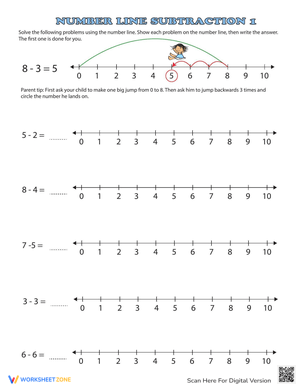
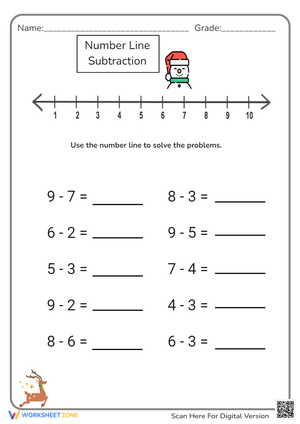
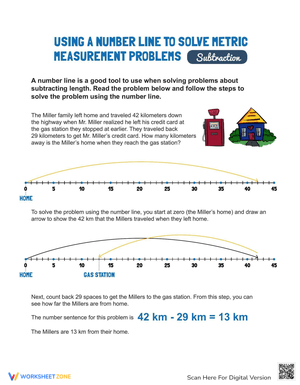
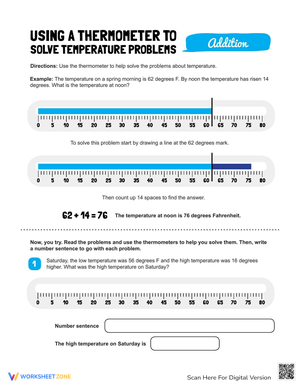
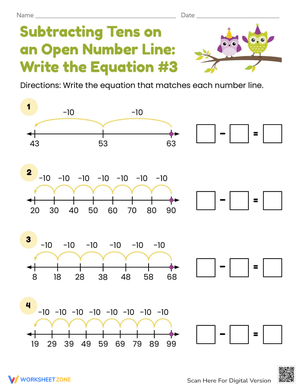
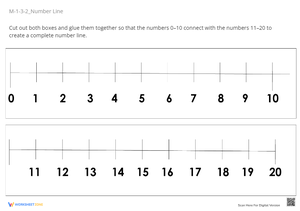
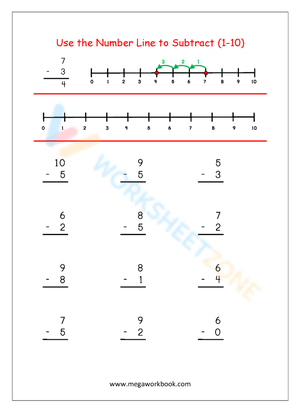
The pre-marked format is the entry point. Arcs are already drawn above the number line, and students count the hops, record the equation, and identify the difference. Removing the drawing demand lets students focus entirely on directional concept without managing two tasks at once. Once that direction is secure, the blank labeled format shifts responsibility — tick marks and numbers are printed, but students draw every arc themselves, locating the minuend, counting backward, and writing the landing point as the answer. Both appear throughout the subtraction on a number line printable worksheets collection in ranges from 0–10 to 0–20.
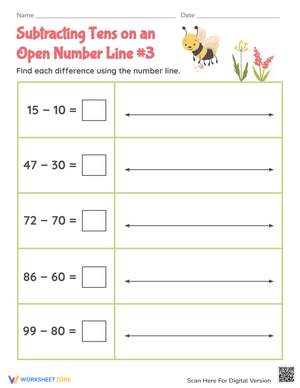
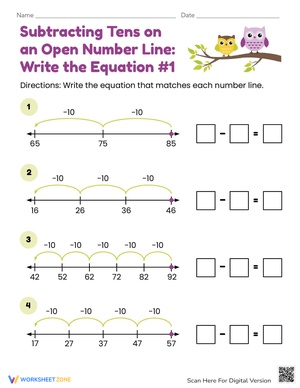
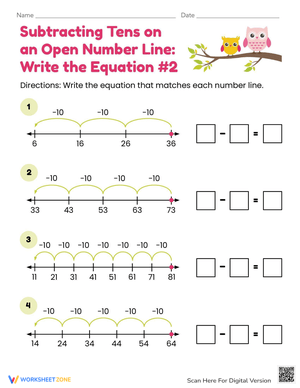
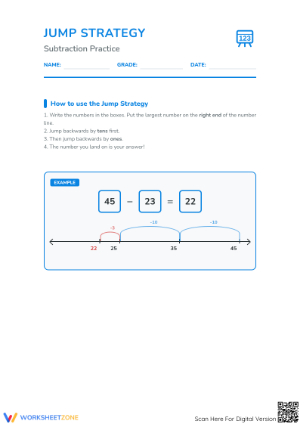
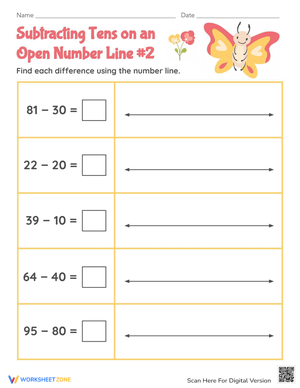
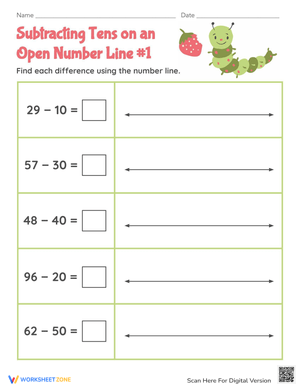
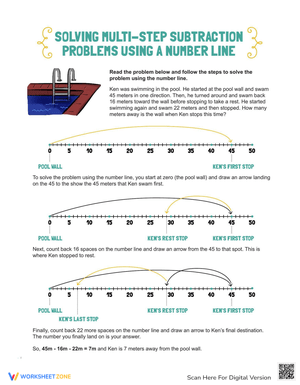
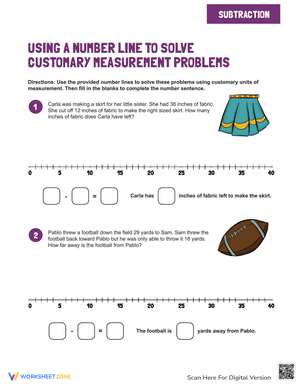
The open number line format has no pre-printed tick marks or values. Students write only the numbers they need, then make jumps of tens and ones, recording each landmark as they land. For 62 − 25, a student might mark 62, jump back 20 to reach 42, then back 5 to reach 37 — a decomposition strategy that shows reasoning rather than just a circled answer. Missing-number worksheets round out the set: a fully drawn number line with hops is shown, but one value in the equation is blank. Students read the model to find what is missing, which is a different cognitive demand from producing the model — and a reliable tool for formative assessment.
Why This Visual Model Works at This Stage
First graders are making a specific cognitive transition — from counting discrete objects to reasoning about intervals and distance. A pile of counters keeps attention on individual units; a number line shifts attention to the gap between values. That gap is what measurement, elapsed time, fractions, and eventually the coordinate plane all depend on. No other early arithmetic model transfers across that many later topics with the same structural consistency.
There is a directionality benefit that often goes unnoticed in lesson planning. When students draw backward arcs to the left, they physically enact what subtraction means — a reduction in distance from a starting point. Students who internalize that leftward movement in first grade carry a spatial intuition that makes negative integers feel less arbitrary two years later. The concept of "below zero" on a thermometer maps directly onto movement they have already practiced hundreds of times on paper.
Mistakes Students Make That These Worksheets Help You Catch
The most persistent error is starting at zero rather than the minuend. A student solving 9 − 4 will place their pencil at 0, count forward four tick marks to land on 4, and write "4" — arriving at the right answer entirely by accident, with a completely wrong model. Because the final number happens to be correct, this error can hide for weeks if teachers check only circled answers. Looking at the drawn arcs reveals it immediately: four arcs moving right from zero rather than left from nine.
A second pattern is counting tick marks instead of spaces. A student drawing four hops left from 9 lands on 6 instead of 5 because each arc covers a tick mark rather than an interval. This is worth demonstrating slowly during guided practice — drawing one arc, pausing, and asking "Did I travel one unit, or did I land on the number 1?" — before students work independently. On open number lines, a different problem surfaces: students place the minuend on the left side of the line because that is where reading begins. When a student runs off the left edge, that placement error is almost always why.
How to Build These Worksheets Into Your Lesson Plans
Before students put pencil to paper, put a number line on the floor. Painter's tape from 0 to 20 along a row of desks takes about eight minutes to set up and survives weeks of foot traffic. Have a student stand on 7 and take three physical steps backward. That kinesthetic experience — body weight shifting left, landing on 4 — makes the paper worksheet feel like a record of something already understood rather than a new abstract task. Two or three turns per introduction lesson is enough to anchor the concept before moving to seats.
During guided practice, project a worksheet under a document camera and use the same language every time: "I start at the big number. One hop left. Two hops left. Three hops left. I land on four." Consistent verbal framing reduces cognitive load during the learning stage — students who hear that exact sentence sequence daily build an inner voice they use during independent work. For small-group reteaching, laminated copies with dry-erase markers let students erase and retry without the anxiety that comes from pencil corrections. That freedom to fix mistakes without consequences is especially important in the first two weeks.
The subtraction on a number line printable worksheets format also works well as homework once students have completed at least two class sessions with guided practice. Because the number line is embedded directly in each problem and the layout is self-explanatory, families can support practice without needing to decode unfamiliar notation. Encouraging a child to count each arc aloud and say the landing number is sufficient support for most home practice situations.
Adjusting the Worksheets Across a Range of Learners
For kindergarteners or anyone who needs more support, start with 0–10 pre-marked worksheets and set a physical number line card at the top of the desk. Narrowing the range removes one layer of complexity while keeping the directional concept intact. If a student freezes in front of a blank line, the open number line format is not the right entry point — return to labeled lines and add the drawing requirement incrementally once the directional habit is automatic.
For students working at grade level in first or second grade, the blank labeled line in the 0–20 range is where most of the developmental work happens. Pairing each worksheet with a brief, focused independent practice block — not a timed test, but a short structured window — builds the automaticity that mental math depends on later. For students ready for a challenge, the open number line format with two-digit and three-digit problems offers genuine complexity. Push them further by asking them to solve each problem in two different jump sequences, then explain in writing which approach required fewer steps and why.
Standard Alignment
CCSS.MATH.CONTENT.1.OA.C.6 asks first graders to add and subtract within 20 using strategies that include counting on and counting back. The labeled-line worksheets in this set directly support the count-back strategy and give students a paper record of their process — important for a standard that asks students to demonstrate the strategy, not just produce an answer. CCSS.MATH.CONTENT.2.NBT.B.7 extends to three-digit subtraction and calls for flexible strategies based on place value; the open number line format supports the decomposition thinking that standard requires. In most first-grade pacing guides, labeled number line work enters the rotation in the second quarter; open number line work follows in late second grade once students are fluent within 100.
Frequently Asked Questions
What number ranges do these worksheets cover?
The set includes subtraction within 10, within 20, within 100, and three-digit problems. The labeled formats — pre-marked and blank — focus on the 0–10 and 0–20 ranges and are built for kindergarten through early second grade. The open number line worksheets address two-digit and three-digit subtraction and suit students in late second and third grade who are ready to design their own jump sequences.
When should students move from labeled number lines to open ones?
The shift makes sense in late first grade or early second grade, once students reliably draw hops on a labeled 0–20 line without prompting and consistently land on the correct value. The clearest signal is accurate arc placement — each arc covering one unit without slipping onto a tick mark. Pushing students to open number lines before that accuracy is in place creates confusion rather than flexibility, and most of the diagnostic value of the open format is lost.
Can parents help with these worksheets at home without any training?
Yes. The subtraction on a number line printable worksheets pages are laid out so the number line is printed directly inside each problem, and the direction of movement is implied by the layout. Parents do not need to know formal vocabulary. Asking a child to point to each hop and count aloud, then say the number they land on, is enough support for standard homework practice.
How does this model connect to mental math over time?
Students who practice drawing backward hops on paper gradually begin running the same spatial image mentally when working without a written line. The open number line format accelerates that transfer because students must choose their own jump sizes — a decision that mirrors the flexible decomposition strategies used in mental arithmetic. Linear spatial models of number are among the most reliable predictors of mental computation accuracy in the research on early number sense, precisely because they build an internalized distance model rather than a memorized sequence of isolated facts.













 Interactive Worksheet Maker
 Quiz Maker
 Word Search Maker
 Crossword Puzzle Maker
 Word Scramble Generator
 Sentence Scramble Generator
 Handwriting Worksheet Generator
 Name Tracing Generator
 Fill In The Blank Generator