


























Views
Downloads


Printable Jump Strategy Subtraction Worksheet | Grade 2 Math
Paste this activity's link or code into your existing LMS (Google Classroom, Canvas, Teams, Schoology, Moodle, etc.).
Students can open and work on the activity right away, with no student login required.
You'll still be able to track student progress and results from your teacher account.
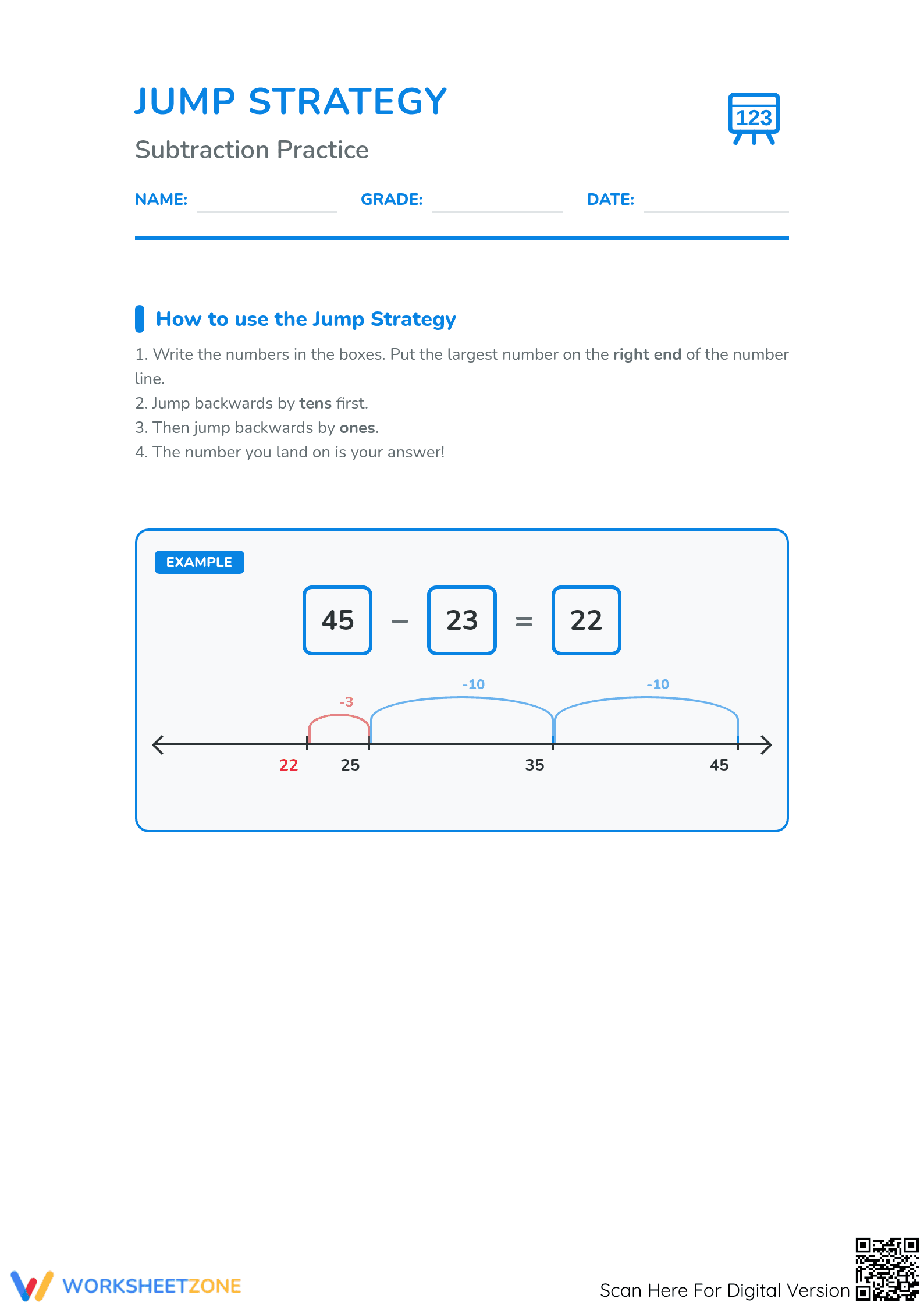
Strengthen student subtraction fluency with this comprehensive instructional resource designed to bridge the gap between concrete and abstract mental math. This worksheet guides learners through the Jump Strategy, a visual method that uses number lines to decompose numbers and simplify complex two-digit subtractions. By the end of these exercises, students will demonstrate increased accuracy and confidence in their subtraction outcomes.
At a Glance
- Grade: 2 · Subject: Mathematics
- Standard:
2.MD.B.6— Represent whole-number differences within 100 on a number line diagram- Skill Focus: Subtraction Jump Strategy
- Format: 4 pages · 9 problems · Answer key included · PDF
- Best For: Small group instruction and independent practice
- Time: 20–30 minutes
Inside this 4-page PDF, you will find a clear, step-by-step instructional guide that defines the Jump Strategy for students and teachers alike. The resource begins with a fully worked example to model the procedure of jumping back by tens and then by ones. Following the instruction, nine carefully curated practice problems are distributed across three distinct sections, accompanied by pre-formatted number lines and a complete answer key for rapid checking.
Skill Progression: This worksheet employs a structured approach to skill acquisition. Section 1 provides Guided Practice with three problems focused on basic two-digit subtraction to establish the rhythm of jumping by tens. Section 2 moves to Supported Practice, introducing "Challenge Yourself" problems that require larger or more frequent jumps. Finally, Section 3 offers Independent Practice with mastery problems designed to confirm the student has internalized the strategy without further scaffolding. This gradual-release model ensures every learner achieves competence.
The content is strictly aligned with CCSS.MATH.CONTENT.2.MD.B.6, which requires students to represent whole-number sums and differences within 100 on a number line diagram. It also supports 2.NBT.B.5 by fostering fluency through the use of strategies based on place value. Both standard codes can be copied directly into lesson plans, IEP goals, or district curriculum mapping tools to document rigorous alignment with state and national frameworks.
For optimal results, use this worksheet during the "guided practice" phase of a direct instruction lesson. Teachers should observe students during Section 2 to ensure they are jumping backward from the right end of the number line correctly. This serves as an excellent formative assessment tool; if a student struggles to partition the subtrahend into tens and ones, it indicates a need for additional place-value intervention. Expect most Grade 2 students to complete the full set in approximately 25 minutes.
This resource is specifically tailored for Grade 2 students but serves as an effective intervention for Grade 3 learners who lack a visual model for mental subtraction. It pairs naturally with physical number lines or desk-taped hundreds charts. For advanced learners, the "Mastery Problems" in the final section provide enough complexity to keep them engaged while their peers finish the introductory sections.
According to research by Fisher & Frey (2014) on the gradual release of responsibility, the transition from modeled examples to independent mastery is critical for long-term retention of mathematical strategies. This Jump Strategy worksheet facilitates that transition by providing a clear visual scaffold (the number line) that students can eventually replicate on blank paper. By focusing on 2.MD.B.6, the resource ensures that students are not just memorizing procedures but are building a robust spatial understanding of how numbers interact within the base-ten system. The inclusion of nine targeted problems provides sufficient repetitions to move the strategy from short-term working memory into long-term procedural knowledge, a key requirement for achieving the fluency standards set by modern educational benchmarks. This tool provides the precise structural support needed for classroom success.


