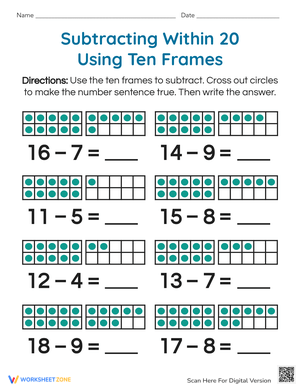
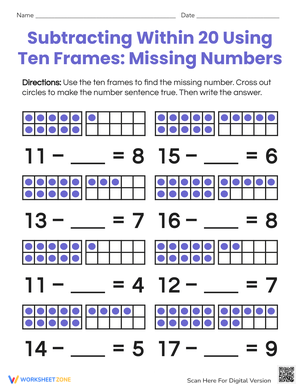
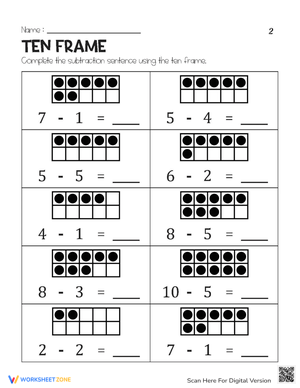
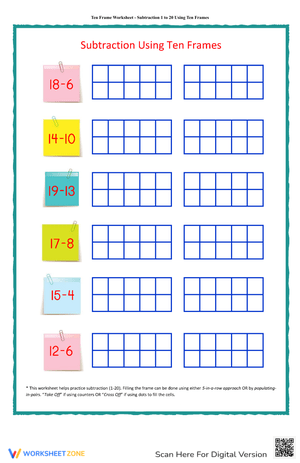
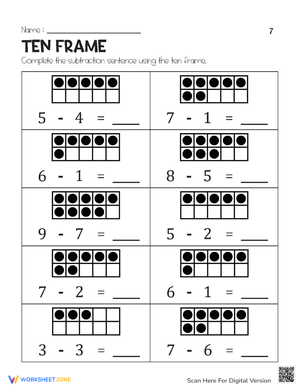
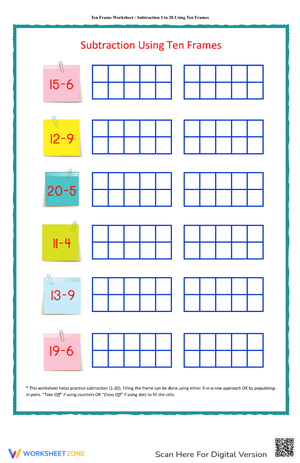
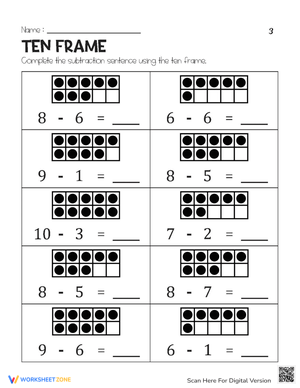
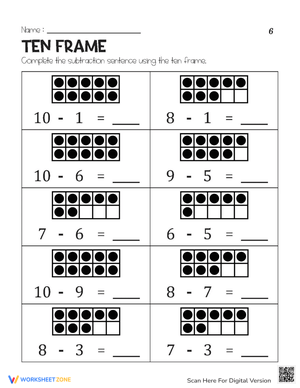
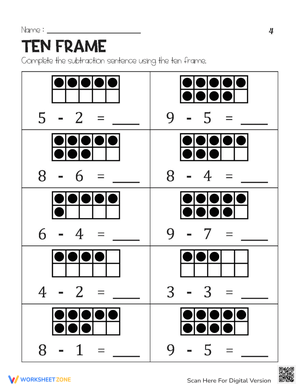
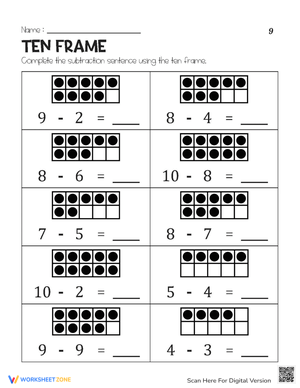
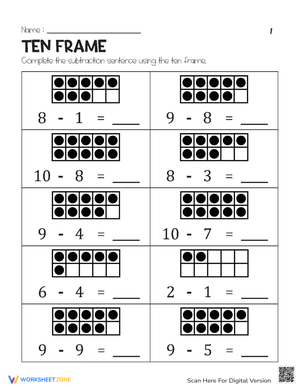
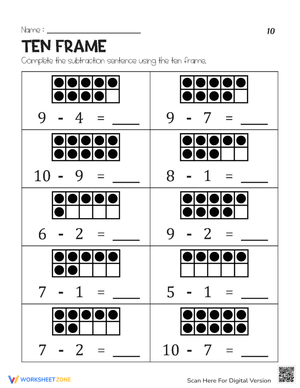
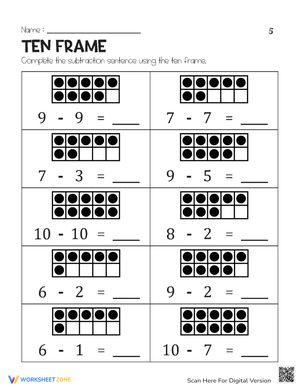
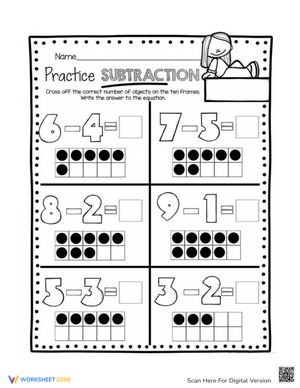
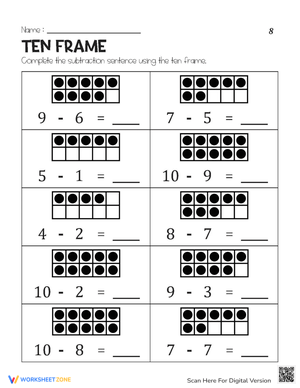
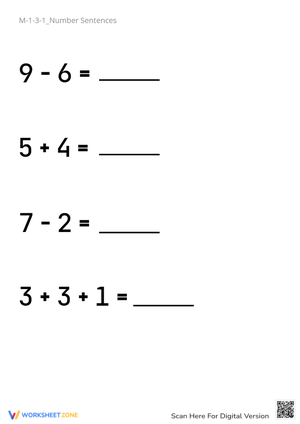
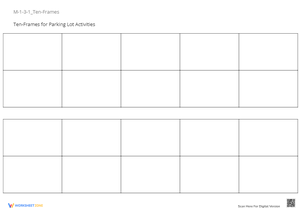
These subtraction and ten frames printable worksheets give K–2 teachers a reliable bridge between hands-on counter work and independent pencil-and-paper practice. Each worksheet presents a visual ten-frame model alongside the symbolic equation, so students cross out dots, count what remains, and record the difference in one continuous sequence — without losing the concrete logic that made the concept click during manipulative work. The set spans subtraction within 5, 10, and 20, covering the full progression from kindergarten introduction through first-grade fluency.
What Students Practice Across the Set
The core action is crossing out. A student sees a ten frame pre-filled with dots representing the starting number, marks an X over the quantity being removed, counts the unmarked dots, and writes the difference in the equation below the frame. That sequence — visual removal, count, record — mirrors exactly what students do with physical counters, which makes the print format feel like a natural continuation of prior hands-on work rather than a separate task.
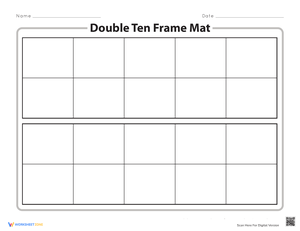
Double ten frame worksheets extend this into the making-ten strategy. When a student works on 14 − 6, the worksheet shows one full frame and a second frame holding four dots. The student crosses out four from the partial frame first, arrives at ten, then crosses out two more from the full frame. Watching the subtraction span across frames makes decomposing visible: "breaking apart the subtrahend" shifts from a verbal instruction to something students can trace and verify with a crayon.
- Crossing out counters to represent the take-away action, then counting what remains
- Recording matching equations after completing the visual model, connecting the grid directly to symbolic notation
- Decomposing the subtrahend across double ten frames to subtract within 20
- Identifying missing parts on worksheets where the difference is given and students determine what was removed
How Ten Frames Reduce Cognitive Load in Early Subtraction
Subtraction is harder for young learners than addition because it requires holding the starting quantity in working memory while simultaneously removing a second number. Ten frames reduce that demand by externalizing the starting quantity: when nine dots appear on the page, the child does not have to maintain "9" in their head while counting backwards. The grid does the memory work, freeing the child's attention for the operation itself.
The 2×5 structure also exploits subitizing — the perceptual ability to recognize small quantities without counting individual items. A full row of five is instantly recognizable; seven dots read as "a full row plus two more" without any individual counting. That grouping perception is the foundation of number sense at this stage, and ten frames are built entirely around it. Students practicing on these worksheets are not just completing a format — they are developing a mental habit about how quantities are organized and related.
Student Error Patterns These Worksheets Make Visible
The most common mistake: students count the crossed-out dots along with the remaining ones. A child solving 8 − 3 marks X over three dots, then counts all eight marks on the page — including the X's — and writes 8 as the answer. The visual action was correct; the interpretation was not. Catching this during a small-group session before students practice independently prevents the error from calcifying into habit.
Double ten frame work generates a distinct second error. When solving 14 − 6 on a worksheet showing one full frame and a partial frame holding four dots, many students cross out the four available dots, write 14 − 4 = 10, and stop — treating the partial frame as if it contained the entire subtrahend. A practical fix: have students use a red crayon for the first round of crossed-out dots and switch colors for the remainder. The color change forces them to track the subtraction across both frames rather than treating the convenient "10" as a stopping point.
A third pattern appears in equation writing. Students who complete the visual model correctly sometimes write the equation with the difference first — 5 = 8 − 3 — because they count the remaining dots immediately and put that number down before anything else. This is a notation habit rather than a conceptual error, but it needs a brief, explicit lesson on where each term belongs in a subtraction sentence.
Fitting These Worksheets Into Your Instructional Routine
The most effective placement for subtraction and ten frames printable worksheets is immediately after a whole-group lesson on a projected frame. Model two or three problems on the board — removing magnetic counters or crossing out digital dots — then distribute the corresponding worksheet for independent work. The step from "watching removal on the projected frame" to "marking X's on my own printed frame" is short enough that most students move into the worksheet with confidence rather than hesitation.
Math centers benefit from pairing printed worksheets with a physical ten frame and a container of counters set alongside. Students build the problem in three dimensions first, then record it on the page. This two-step approach surfaces the students who pattern-match from the printed image without actually modeling removal — a gap that is completely invisible when worksheets are used without manipulatives.
A high-value formative routine is the ten-frame journal check: after completing a worksheet, each student selects one problem, rebuilds it on a blank paper frame using real counters, and explains the subtraction to a partner step by step. Those two minutes of verbal retell reveal whether a child understands the operation or has been following the visual template mechanically — and produce immediate classroom data without requiring a separate assessment.
Meeting Different Readiness Levels With the Same Set
Kindergartners encountering subtraction for the first time work best with within-5 worksheets. Problems like 5 − 2 and 4 − 1 keep quantities small enough that students focus on the procedure — crossing out, counting, writing — rather than on managing numbers they cannot yet reliably subitize. Beginning each new tier with frames that start nearly full gives students a satisfying, clear experience of removal before introducing partially filled frames.
First graders working within 10 use the full single frame, which is where number-sense patterns begin to emerge. A student who sees 10 − 7 and immediately identifies three remaining dots without counting — not because they recalled a memorized fact, but because the frame made the relationship structurally obvious — is showing genuine number sense. Small groups doing targeted review of within-10 facts often show the clearest gains at this tier because the visual model makes relationships apparent in a way that a bare equation does not.
For students ready for larger numbers, double ten frames introduce subtraction within 20 alongside the decomposing strategy. Students who rush through by guessing rather than modeling benefit from switching to a blank-frame format — drawing their own dots before crossing them out slows the process productively. Students who freeze when they encounter a partially filled frame with no clear entry point can work alongside a completed physical model without removing the cognitive work required to record the equation.
Subtraction and ten frames printable worksheets also serve as effective intervention tools for second and third graders with gaps in within-20 fluency. The visual model is not age-inappropriate at those grade levels when framed as a strategy for verifying answers rather than as remediation — older students accept it readily when the teacher presents it as a checking tool rather than a step backward.
Standard Alignment
Kindergarten standard K.OA.A.1 (Common Core State Standards — Operations and Algebraic Thinking) requires students to represent addition and subtraction with objects, drawings, and equations. Ten frame worksheets fulfill the drawings requirement directly: the printed dots are the representation, and the crossing-out action stands in for physical removal. Teachers working through the K.OA.A.1 instructional sequence can use completed worksheets as concrete evidence of this standard during documentation or observation cycles.
First-grade standard 1.OA.C.6 expects students to add and subtract within 20 using strategies including making ten, decomposing a number, and applying the relationship between addition and subtraction. Double ten frame worksheets address all three within the same format. The making-ten approach appears directly when students decompose the subtrahend across two frames; the inverse relationship appears on worksheets where students record both the subtraction fact and its related addition sentence from the same visual model.
Frequently Asked Questions
How do ten frames help young students understand subtraction?
The frame holds the starting number visually so the child does not have to hold it mentally. When eight dots appear on the grid, the student sees the starting quantity rather than remembering it while counting backwards. Crossing out a portion of those dots makes the removal action concrete, and counting the unmarked dots produces the answer before the student writes a single digit. The visual record and the symbolic equation develop side by side rather than in isolation from each other.
Can these worksheets be used with students above second grade?
Subtraction and ten frames printable worksheets work well as intervention materials for third graders who lack fluency with within-20 subtraction facts. The double ten frame format gives older students a visual strategy for verifying answers that mental math alone cannot always confirm. When a teacher frames the tool as a checking method rather than a remediation step, the resistance that sometimes accompanies simpler materials tends to disappear.
How does the double ten frame introduce the making-ten strategy?
The layout makes the strategy structurally obvious. With two frames side by side, students see that the left frame holds a full ten and the right frame holds the remainder. When subtraction requires crossing out dots from both frames — emptying the partial frame first and continuing into the full frame — students are physically performing the decompose-to-ten move. A few repetitions of that physical crossing-out process produce internalization that a verbal explanation of the strategy rarely achieves on its own.
What is the best setup for using these worksheets at a math center?
Place printed worksheets alongside a physical ten frame and a small container of counters. Students model the problem with real objects first, then record it on the worksheet. The physical modeling step exposes students who are guessing from the printed image without actually subtracting — something the worksheet alone cannot catch. Any small counter works: beans, cubes, pennies, or even torn paper squares.













 Interactive Worksheet Maker
 Quiz Maker
 Word Search Maker
 Crossword Puzzle Maker
 Word Scramble Generator
 Sentence Scramble Generator
 Handwriting Worksheet Generator
 Name Tracing Generator
 Fill In The Blank Generator