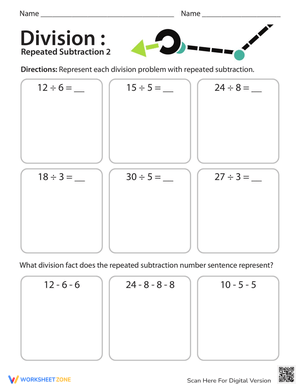
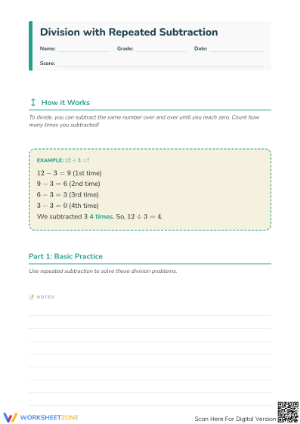
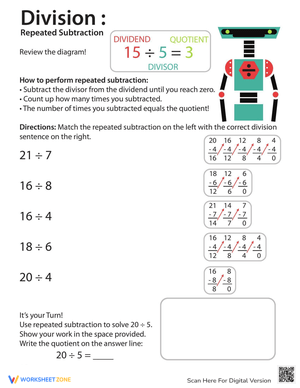
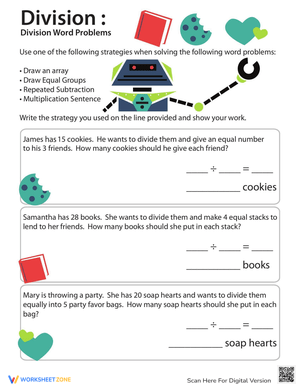
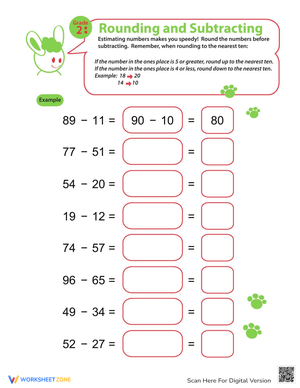
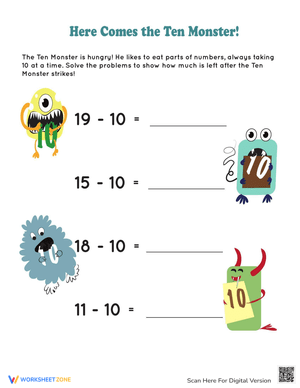
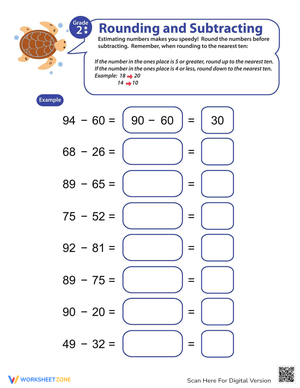
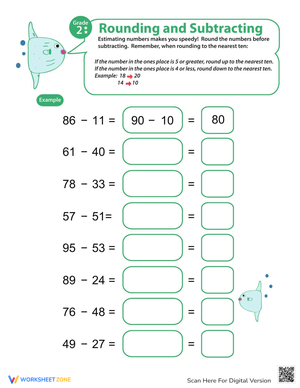
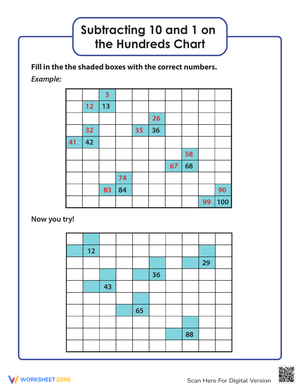
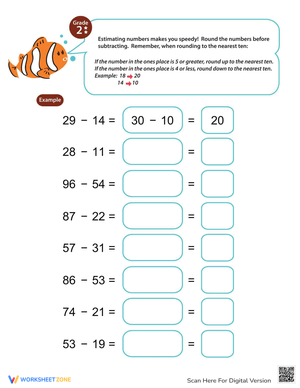
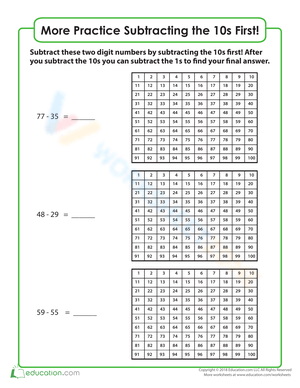
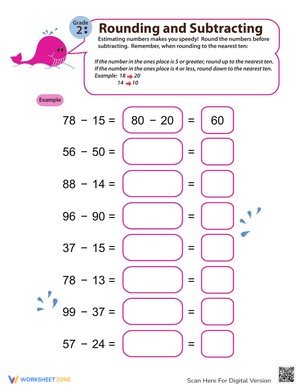
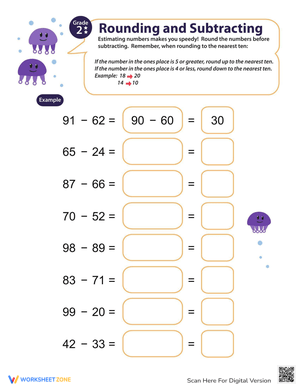
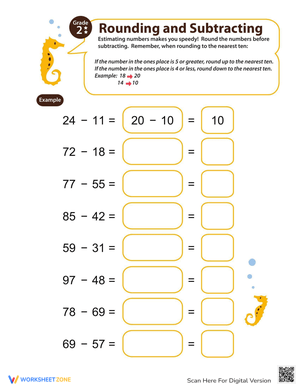
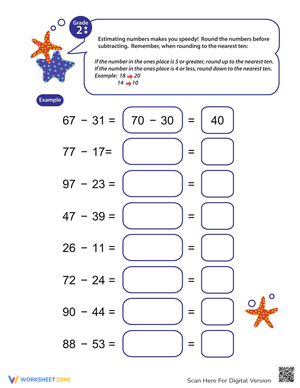
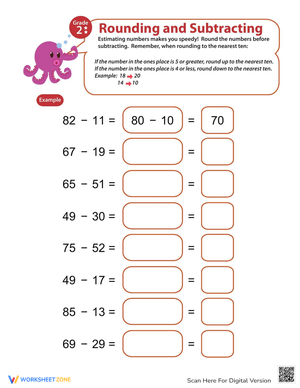
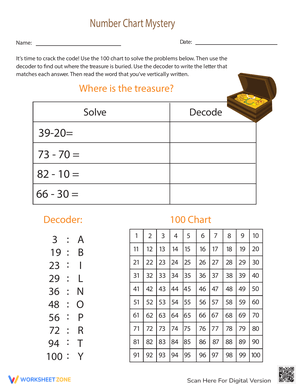
These repeated subtraction printable worksheets give grades 2–4 teachers a concrete entry point into division — one that works because it draws on subtraction fluency students already have, before they encounter the abstract notation of a division sentence. The set includes equation-based practice, number line activities, and word problems, and every worksheet closes with a step asking students to write the matching division equation. That final step is not optional busywork; it is where the conceptual link forms.
What Students Practice Across the Set
The core task on every worksheet is the same: start with a dividend, subtract a fixed value repeatedly, record each intermediate result, and count the total subtractions. That count is the quotient. Starting dividends run from small values in the foundational worksheets up through larger numbers on the extension problems, with subtrahends drawn from the multiplication facts students are typically building alongside this work — 2s, 3s, 4s, 5s, and 10s in the introductory worksheets, and 6s through 9s in the more demanding ones.
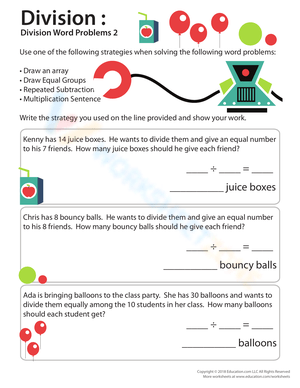
Number line worksheets ask students to draw backward hops, which makes the counting visible and helps students who lose track of their place in a long subtraction chain. Word problem worksheets frame the same math in grouping scenarios — distributing 36 crayons equally into groups of 4, splitting 45 minutes across three equal tasks — so students practice identifying which number is the total and which is the group size before computing. That identification step is division reasoning, even before students write a division symbol.
Frequent Errors Worth Catching Before They Calcify
The most persistent mistake in repeated subtraction is an off-by-one counting error that happens at the very start of the process. When working through 20 ÷ 4, students sometimes count the starting position as step one: "one (20), two (16), three (12), four (8), five (4), six (0)" — arriving at 6 subtractions instead of the correct 5. The arithmetic at every step is right; the error lives entirely in how they number the moves. Asking students to circle hops rather than positions on the number line resolves this faster than re-explaining the procedure.
A separate pattern appears when students write the final division sentence. They know all three numbers — 20, 4, and 5 — but frequently write 4 ÷ 20 = 5 or 20 ÷ 5 = 4. They haven't yet sorted out which role each number plays. A brief verbal anchor ("what did we start with? that goes first") handles most of these, but students who make this error consistently usually need more time working with grouping stories before the notation clicks into place.
Fitting These Worksheets Into Your Lesson Plans
The most reliable placement for repeated subtraction printable worksheets is the opening 8–10 minutes of a math block, before new instruction begins. Students arrive with subtraction facts still active from prior units, and a short run of repeated subtraction problems primes them to see the division content that follows as a continuation of known work rather than a brand-new topic. That transfer of prior knowledge is the instructional reason for teaching this concept before introducing the standard algorithm — not just sequence for its own sake.
For small-group rotations, three stations work cleanly:
- Equation worksheets where students record each step in a subtraction chain and count total subtractions
- Number line worksheets where students draw backward hops and count them
- A matching activity pairing completed subtraction chains to their equivalent division sentences
Twelve-minute rotations give students enough time to work through a meaningful portion of each format. At the end of the block, a brief whole-group share — one student explains how many times they subtracted and why that number equals the quotient — consolidates understanding without extending the lesson past its window.
Standard Alignment
These worksheets align most directly to CCSS 3.OA.A.2, which asks students to interpret whole-number quotients — specifically as the number of times a value can be subtracted from a total. That standard's language maps nearly word-for-word onto what repeated subtraction practice requires, making this set a natural fit at the opening of a Grade 3 division unit before students move toward more abstract strategies. Grade 2 teachers introducing the concept as a preview will find natural connections to 2.NBT.B.7, since repeated subtraction requires students to apply multi-digit subtraction fluency across several steps within a single problem.
Adjusting the Work for a Range of Learners
For students who are still building subtraction fluency, keep dividends at or below 20 and limit subtrahends to 2, 5, and 10. Pair the equation worksheets with a physical set of counters so students can remove groups rather than compute abstractly — the worksheet then serves as a recording sheet for what they are doing with their hands, which keeps working memory demand low enough that the counting step stays accurate.
Students working at grade level with dividends through 50 can move between equation and number line formats within a single session. Asking them to complete one format and then verify the answer using the other builds a self-checking habit and reinforces that both representations describe the same operation.
Students who have already internalized basic division facts benefit from repeated subtraction printable worksheets that extend into two-digit subtrahends or that introduce the remainder concept — stopping when the remaining value falls below the subtrahend and recording both the quotient and the leftover. That extension connects directly to what formal remainder work looks like later and gives these students something genuinely new to reason through rather than repeated execution of a procedure they have already mastered.
Frequently Asked Questions
What grade levels do these worksheets target?
The set spans grades 2 through 4. Grade 2 teachers use the foundational equation worksheets to extend subtraction work into early grouping concepts. Grade 3 is the primary target, aligned to 3.OA.A.2. Grade 4 teachers draw on the more demanding worksheets for students who need a concrete re-entry point into division before tackling multi-digit problems.
Do students need multiplication fact fluency before using these worksheets?
No — and that is the point. Repeated subtraction gives students access to division using only subtraction, which most grade 2 and early grade 3 students already handle reliably. A student who can subtract 3 from 18 repeatedly can solve 18 ÷ 3 before they have memorized 3 × 6 = 18. The worksheets build toward multiplication fact recognition rather than depending on it.
How can these worksheets serve as a formative tool?
A repeated subtraction printable worksheets set used as a pre-assessment at the start of a division unit tells you immediately which students connect the subtraction process to the division sentence and which students treat each subtraction step as an isolated calculation with no broader meaning. That distinction is actionable the next day — you know whether students need more time with the procedure, more time with the notation, or more time connecting the two — in a way that a broad unit pre-test rarely reveals.
What is the relationship between repeated subtraction and skip counting, and should I teach both?
Skip counting moves forward by a fixed number — 4, 8, 12, 16, 20. Repeated subtraction moves backward from the total — 20, 16, 12, 8, 4, 0. They are inverse processes, and students who practice both develop a clearer sense of the relationship between multiplication and division than students who learn only one direction. Once students can move confidently in both directions, the fact family — 4 × 5 = 20, 20 ÷ 4 = 5, 20 ÷ 5 = 4 — becomes visible as a single connected structure rather than three separate facts to memorize.













 Interactive Worksheet Maker
 Quiz Maker
 Word Search Maker
 Crossword Puzzle Maker
 Word Scramble Generator
 Sentence Scramble Generator
 Handwriting Worksheet Generator
 Name Tracing Generator
 Fill In The Blank Generator