Subtraction and Patterns of One Less worksheets
Subtraction and patterns of one less worksheets give kindergarten and first-grade teachers a focused, print-ready toolkit for building the number sense that early subtraction depends on. The core idea is precise: subtracting one always lands on the number directly before, without recounting from zero. These worksheets make that pattern explicit and repeatable across enough formats to move it from recognition into reflex.
The Specific Skills These Worksheets Target
Each worksheet addresses a distinct slice of the one-less concept rather than treating it as a single undifferentiated task. These subtraction and patterns of one less worksheets present the skill across five formats that move gradually from concrete to abstract, giving students the repeated encounters they need before the pattern becomes automatic.
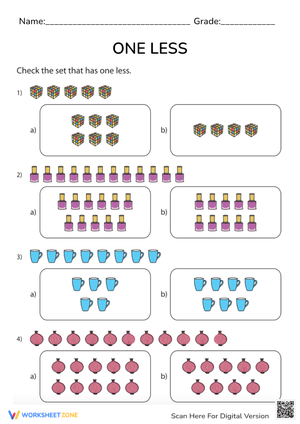
- Picture-based subtraction: Students examine a small group of illustrated objects, cross one out, and write the resulting equation. The crossing-out step matters — it makes the removal visible before any number sentence appears.
- Ten-frame work: Worksheets display a ten-frame with one counter already removed and ask students to record what remains. This grounds the one-less relationship inside the ten structure students encounter throughout K–1 math.
- Number line backward jumps: Students mark a starting number and draw a single jump left, landing on the answer. The spatial left-is-less relationship reinforces directionality that causes confusion when it isn't made explicit early.
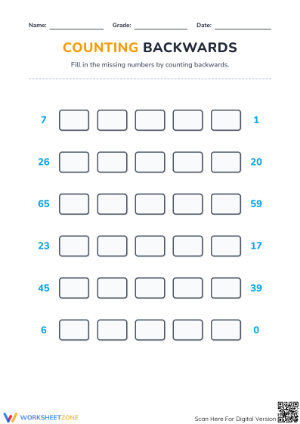
- Fill-in-the-blank tables: A number is given; students write the number that is one less. Tables run from 1–10 for early practice and extend to 1–20 for students ready to apply the pattern across a wider range.
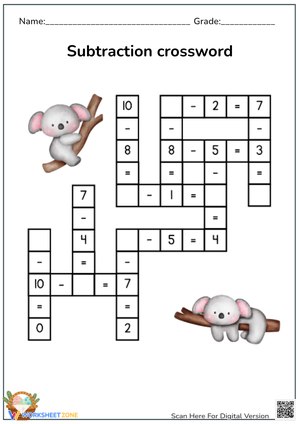
- Missing-number equations: Problems of the form 9 − 1 = ___ and ___ − 1 = 8 appear together, requiring students to apply the pattern in both directions rather than memorizing a single response format.
Error Patterns Worth Catching Early
The most persistent error is recounting from one. A student who can recite the counting sequence to 20 without hesitation will still restart at one when asked what is one less than 14. The pause before they write is the tell — they've gone to their fingers rather than recognizing the positional relationship. This happens because forward recitation and backward retrieval are separate skills; fluency in one does not transfer automatically to the other. Watching for that hesitation during independent practice identifies students who have memorized the sequence without internalizing its structure.
A second error appears when one-more and one-less are introduced in the same instructional week, which they often are. A meaningful subset of students will write 8 as the number one less than 7 — they've reversed direction. The counting sequence hasn't yet locked in a reliable sense of which way is less, and placing two opposite concepts in close proximity creates interference. Seeing this in student work is a signal to slow down and return to the number line, keeping the spatial reference visible until directionality stabilizes.
Why This Pattern Belongs at This Grade Level
The one-less pattern is taught in kindergarten because it bridges two competencies students are building simultaneously: knowledge of the counting sequence and understanding of subtraction as removal. CCSS K.CC.B.4c establishes that students should recognize each number as one more than the previous; the inverse — each number as one less than the one after — is the same knowledge applied in the other direction. Making that inverse explicit through repeated practice is what allows students to stop reconstructing the relationship each time they see a minus-one problem and start recognizing it on sight.
Reducing cognitive load at this stage matters more than it might initially appear. When a student has to count down from 11 using fingers to solve 11 − 1, working memory is consumed entirely by the counting procedure, leaving nothing available for checking reasonableness or noticing the equation's structure. Once the one-less response becomes automatic, students can direct that working memory toward the form of equations — which is precisely where K–1 instruction needs them to focus next.
Building These Worksheets Into Daily Math Routines
The most effective placement is not a standalone worksheet session but the brief, high-frequency practice slots that K–1 schedules already contain. Three minutes of morning meeting — call out a number, students write the number one less on a whiteboard, flash and check — followed by one worksheet as independent confirmation gives students the oral repetition and the written record they need simultaneously. The worksheet then functions as a formative snapshot: who has it, who's still recounting, who reversed direction.
These subtraction and patterns of one less worksheets also fit naturally as a Monday re-entry task after a weekend gap, when short retrieval practice prevents the forgetting that accumulates over two days away from structured math. Using the fill-in-the-blank tables as a five-minute opener before the week's first math lesson costs almost no instructional time and tells teachers immediately which students need a concrete review before moving forward.
Adjusting the Set Across a Range of Student Readiness
Students who are still building one-to-one correspondence need the picture-based worksheets first — and they need counters or snap cubes beside them. The physical act of removing one object (placing it on a separate part of the desk rather than just pointing at it) makes the subtraction concrete before any written number sentence is required. For these students, skip the equation-writing step entirely until the removal action is fluent.
Students who have already mastered the pattern within 1–10 move to the 1–20 tables and to the missing-number equation format. A useful extension: after completing each one-less equation, students write the corresponding one-more fact beside it — 9 − 1 = 8 alongside 8 + 1 = 9. That pairing previews the inverse relationship between addition and subtraction that becomes a central focus in first grade. For these students, the subtraction and patterns of one less worksheets function less as initial instruction and more as a vehicle for connecting two operations they are beginning to understand as related rather than separate.
Standard Alignment
These worksheets address CCSS K.CC.B.4c, which requires students to understand that each successive number in the counting sequence represents a quantity one greater — and by direct inverse, one less — than the one before. They also connect to CCSS K.OA.A.1, which calls for students to represent addition and subtraction using objects, drawings, and equations. In classroom terms, this positions the worksheets squarely inside the operations-and-algebraic-thinking unit that typically runs mid-kindergarten, after students count reliably to 20 but before instruction moves to sums greater than 10.
Frequently Asked Questions
Do students need prior subtraction experience before using these worksheets?
Not prior subtraction experience specifically, but they need to count reliably forward to 10 — ideally to 20 — before the one-less pattern will feel grounded. Students who cannot yet produce the counting sequence consistently will struggle to recognize that the answer to 7 − 1 is simply the number they say before 7. Use the picture-based worksheets first with any student still building counting fluency; the visual removal of one object keeps the concept accessible even when the sequence isn't fully automatic.
How should teachers handle students who recount all objects instead of using the pattern?
The number-line worksheets address this habit directly. When a student draws a single jump left and lands on the answer, the operation becomes directional movement rather than a problem requiring a full recount from one. Pairing the number-line worksheet with a brief verbal prompt — "you moved one space left; what number did you land on?" — redirects the student from counting all to recognizing position, which is the underlying conceptual shift this entire set addresses.
Are the 1–20 tables appropriate for first grade, or is this primarily a kindergarten resource?
Both grade levels use these materials, just at different entry points. The 1–10 tables typically appear mid-kindergarten, once students have a stable forward counting sequence. The 1–20 tables work well as review and extension at the start of first grade and connect directly to first-grade number line work. Many first-grade teachers use the abstract fill-in-the-blank format as a fluency check at the opening of a subtraction unit rather than as initial instruction.
Clear All