


























Views
Downloads
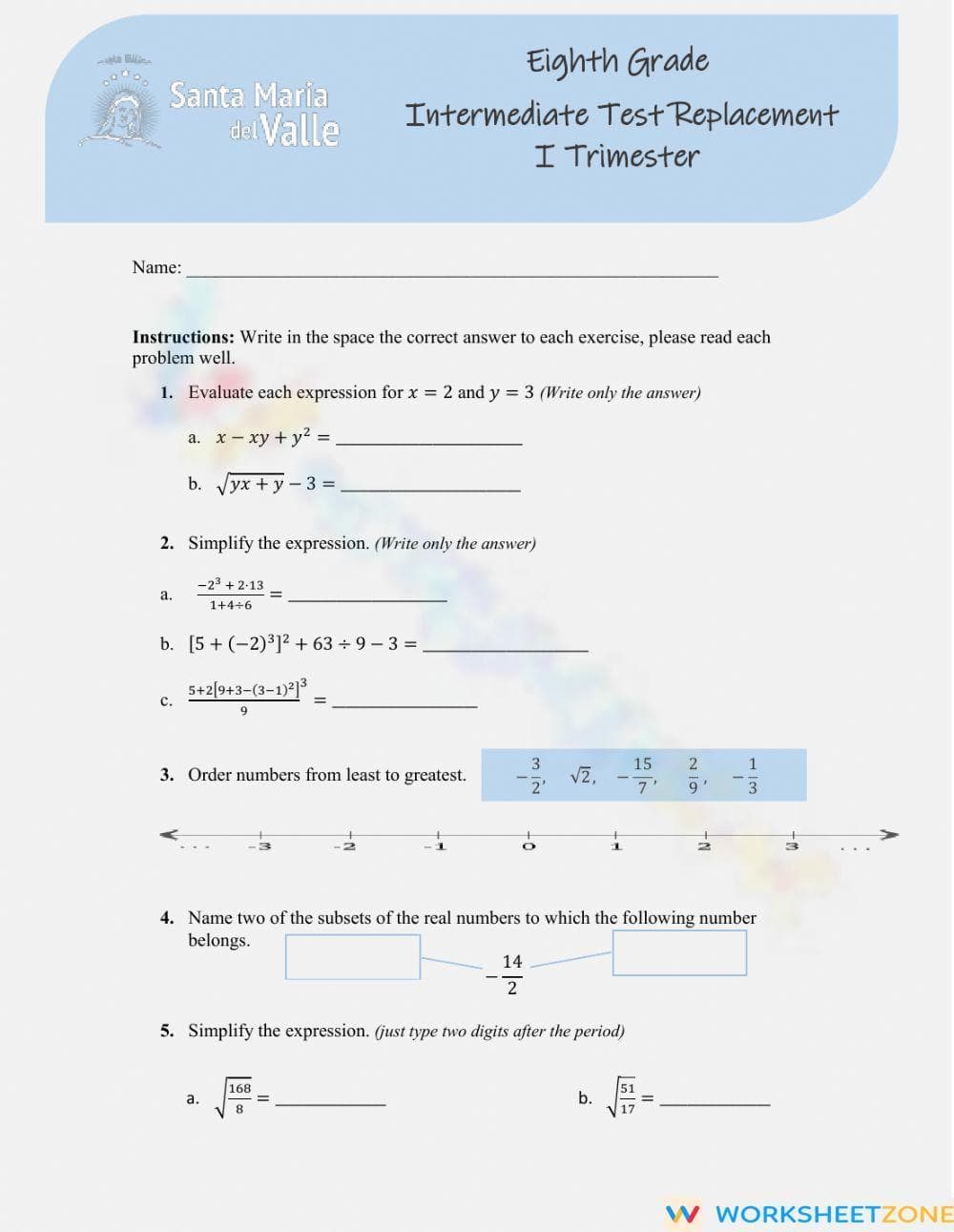

Grade 8 Real Numbers — Printable No-Prep Worksheet
Paste this activity's link or code into your existing LMS (Google Classroom, Canvas, Teams, Schoology, Moodle, etc.).
Students can open and work on the activity right away, with no student login required.
You'll still be able to track student progress and results from your teacher account.
This Grade 8 math worksheet provides students with targeted practice on evaluating expressions and classifying real numbers. By working through these structured problems, learners will strengthen their ability to simplify complex equations and accurately place irrational numbers on a number line, ensuring a solid foundation for advanced algebra.
At a Glance
- Grade: 8 · Subject: Math
- Standard:
CCSS.MATH.CONTENT.8.NS.A.2— Compare and locate irrational numbers on a number line- Skill Focus: Real numbers and expressions
- Format: 1 page · 9 problems · Answer key included · PDF
- Best For: Formative assessment or review
- Time: 20–30 minutes
Inside this resource, educators will find a single-page assessment featuring nine tasks. Problem types range from evaluating algebraic expressions to simplifying complex fractions with exponents and square roots. It includes a number line activity where students order rational and irrational numbers, alongside a classification exercise for the real number system. A complete answer key is provided.
Zero-Prep Workflow
- Print (1 minute): Download the PDF and print a class set. The clean layout minimizes paper waste.
- Distribute (1 minute): Hand out the worksheets as a warm-up or standalone quiz. Instructions are self-explanatory.
- Review (5 minutes): Use the included answer key to quickly grade submissions or project it for whole-class review.
Total teacher preparation time is under two minutes, making this ideal for emergency sub plans.
Standards Alignment
This resource is directly aligned to CCSS.MATH.CONTENT.8.NS.A.2: Use rational approximations of irrational numbers to compare the size of irrational numbers, locate them approximately on a number line diagram, and estimate the value of expressions. It also supports evaluating expressions with integer exponents and radicals. Both standard codes can be copied directly into lesson plans, IEP goals, or district curriculum mapping tools.
How to Use It
This worksheet functions perfectly as an end-of-unit review or formative assessment. Assign it after direct instruction on the real number system. As students work, observe how they handle the number line placement of square roots; this is an excellent formative-assessment observation tip to identify who needs a reteach on estimating irrational numbers. Expected completion time is 20 to 30 minutes.
Who It's For
This material is designed primarily for eighth-grade general education math students, though it serves as an excellent review for ninth-grade algebra learners. For students requiring accommodations, teachers can allow the use of a basic calculator for the square root estimations or provide a reference sheet detailing the order of operations. It pairs naturally with an anchor chart displaying the subsets of the real number system.
Mastering the classification and estimation of values within the real number system is a critical stepping stone for high school mathematics. According to a recent EdReports 2024 analysis, students who frequently engage with mixed-practice formative assessments demonstrate significantly higher retention rates in algebraic reasoning and problem-solving. This specific resource targets CCSS.MATH.CONTENT.8.NS.A.2, requiring learners to compare and locate irrational numbers on a number line accurately. By integrating algebraic expression evaluation with foundational number system classification, the worksheet reinforces multiple cognitive pathways simultaneously. Regular exposure to these combined skill sets reduces cognitive load during standardized testing and builds long-term mathematical confidence. Educators can utilize this targeted practice to ensure learners are not just memorizing isolated procedures, but actively understanding the complex relationships between different numerical formats, ultimately preparing them for rigorous future coursework.


