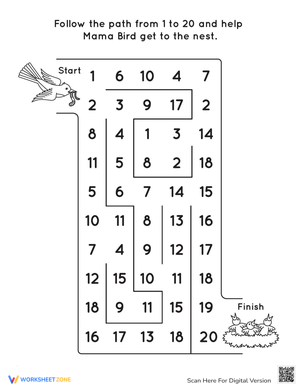
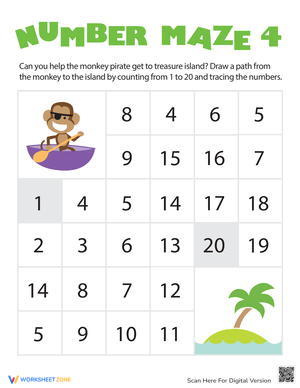
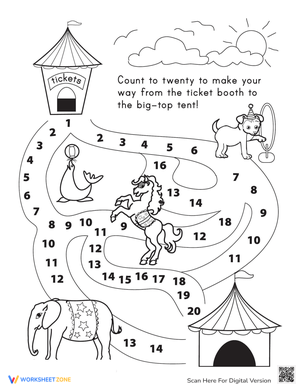
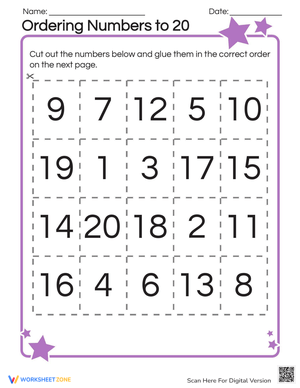
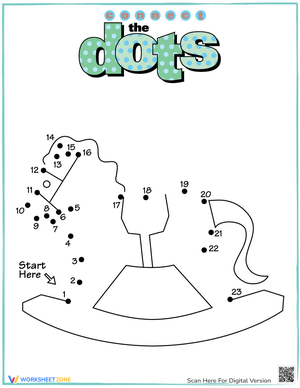
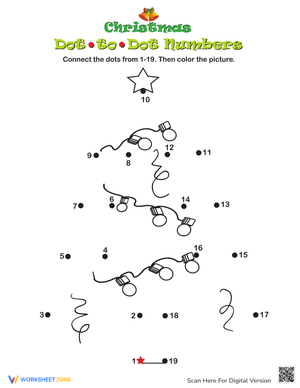
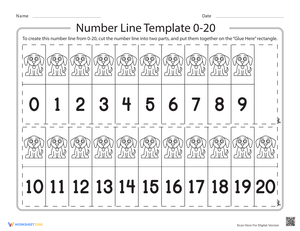
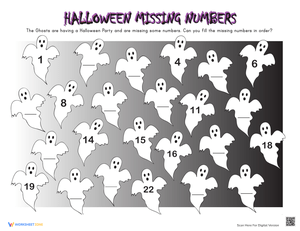
These ordering numbers 11 20 worksheets give Kindergarten and 1st-grade teachers a targeted, ready-to-use set for one of the trickiest number ranges young learners encounter. Teen numbers sit in an awkward place linguistically — "eleven" and "twelve" sound nothing like the place-value logic that governs everything from twenty-one onward — and these worksheets address that challenge directly through varied formats and visual scaffolding.
What Students Practice Across the Set
The worksheets target sequencing, number recognition, and comparative reasoning within the 11–20 range. Students read numerals and place them in order from least to greatest or greatest to least, identify which number comes before or after a given value, and locate missing numbers within a partial sequence. Several worksheets incorporate ten frames so students can see, for instance, that 16 is one complete group of ten with six remaining — a representation that makes the ones digit meaningful rather than arbitrary. One-to-one correspondence is reinforced throughout, because the real issue with teen numbers is rarely the counting itself; it's the connection between the spoken name, the written numeral, and the position in a sequence.
Worksheet Formats Included in the Set
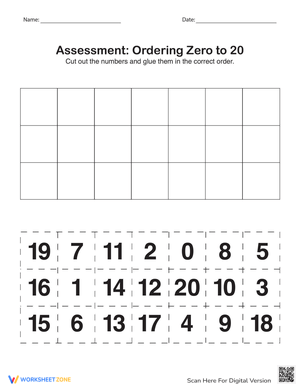
- Cut-and-paste sequencing: Students cut a strip of numerals and glue them onto a number line or ordering mat in the correct sequence. Removing the writing component lets students concentrate entirely on order rather than splitting attention between numeral formation and placement.
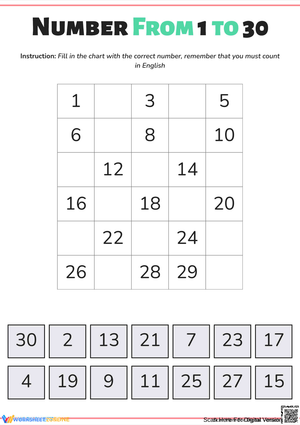
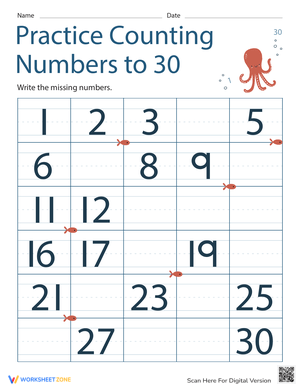
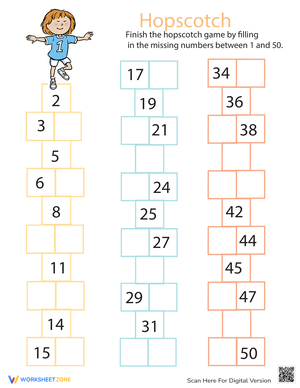
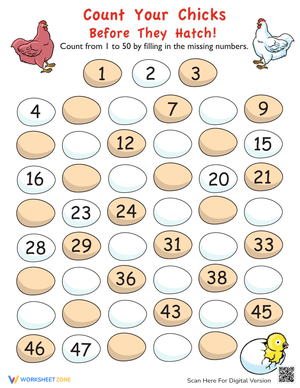
- Missing-number sequences: A partial sequence appears with one, two, or three blanks. Students write the missing values. This format distinguishes between students who can recite numbers in order and those who genuinely understand where each teen number sits.
- Before-and-after practice: A single numeral is shown; students write the number immediately before it, after it, or both. This targeted format builds the positional awareness that later underpins mental addition and subtraction strategies.
- Number line and ten-frame combination pages: Visual anchors accompany the ordering task, giving students a concrete reference while they work through the sequence.
Standard Alignment
These worksheets address K.CC.A (Kindergarten Counting and Cardinality), specifically the expectation that students know number names and the count sequence, and 1.NBT.A.1, which asks first-graders to count to 120 starting from any number less than 120. In classroom terms, sequencing teen numbers is the work that happens after students can rote-count to 20 but before they're ready to operate on those numbers — it's the bridge between counting and number sense, and it's where many students need more structured practice than daily calendar routines alone provide.
How to Work These Worksheets Into Your Lesson Plans
The most reliable entry point is the math warm-up. A missing-number worksheet at the start of the math block takes most students four to six minutes, activates prior knowledge before instruction, and surfaces gaps immediately — if three or four students stall on the same blank, that's your small-group pull for the day. Cut-and-paste pages belong at a math center alongside scissors, glue sticks, and a set of base-ten blocks so students can build each teen number before they order it. The physical construction reinforces what the ten frame shows on the page.
Before-and-after sheets work well as independent seatwork while you run guided math groups. They're short enough that early finishers aren't waiting and focused enough that students don't need much redirection. One classroom practice worth adopting: before students begin any ordering task, have them circle the ones digit in each teen number with a colored crayon. Every numeral from 11 to 19 shares the same tens digit, so the ones digit is the only thing determining its position — making that visible shifts students from rote sequencing toward actual place-value thinking faster than most whole-group lessons do.
Frequently Asked Questions
Why are teen numbers harder to sequence than numbers 1–10?
English number names from 11 through 19 don't follow a transparent tens-and-ones structure. "Fourteen" gives a learner some phonetic help, but "eleven" and "twelve" offer none. Students can't rely on the word to reconstruct the numeral the way they eventually can with "twenty-three." The sequence has to be learned as a series of distinct facts before the underlying place-value pattern becomes visible, which is why repeated, varied practice with these specific numbers matters.
At what point in the year should these worksheets be introduced?
In Kindergarten, most teachers introduce the 11–20 range after students have solid fluency with 1–10 — typically mid-year, though intervention students may need earlier exposure with a narrower range. In 1st grade, these worksheets serve as review and consolidation work in the first quarter before instruction moves toward counting and comparing within larger ranges.
Do these worksheets work for small-group intervention?
They do, and the missing-number format is especially useful in that setting because errors are visible and immediate. Sitting alongside a student and watching which blanks they skip or which reversals they produce gives more diagnostic information than a completed page returned the next morning. The before-and-after worksheet also generates focused conversation — asking a student to explain why 17 comes after 16 reveals whether the answer came from understanding or from pattern-matching alone.
Can these be sent home for additional practice?
The number-line and before-and-after pages travel well because they don't require materials beyond a pencil. Cut-and-paste worksheets are better kept in the classroom where scissors and glue are available, unless you send materials home with them. A brief note to families explaining that the ones digit in teen numbers determines order — and that spending two minutes pointing to each numeral and saying its name aloud helps — makes home practice more productive than the worksheet alone.













 Interactive Worksheet Maker
 Quiz Maker
 Word Search Maker
 Crossword Puzzle Maker
 Word Scramble Generator
 Sentence Scramble Generator
 Handwriting Worksheet Generator
 Name Tracing Generator
 Fill In The Blank Generator