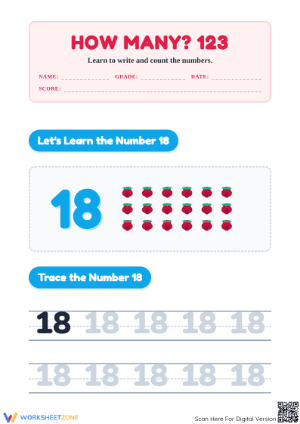
Learning to count beyond ten marks an important leap for young children, and number 18 worksheets give them a friendly stepping stone in that journey. At this stage, students are starting to understand place value, group objects into tens and ones, and connect spoken number names with written numerals. A focused practice page that centers on a single teen number gives them the time and space to truly internalize what eighteen looks like, sounds like, and represents on paper.
From a developmental standpoint, isolating the number 18 helps reinforce both fine motor coordination and number sense at the same time. When children trace the curves of the digits, they build the same hand control they will later rely on for writing complete equations. Pairing tracing with counting tasks, such as circling groups of eighteen objects, supports the cognitive bridge between symbolic numerals and concrete quantities, a foundation highlighted in many early math counting activities for preschoolers.
Teachers in kindergarten and first grade classrooms can layer these printable practice sheets into small-group rotations, morning warm-ups, or homework folders. The repetition of one teen number across multiple formats, including ten-frames, dot patterns, and missing-number lines, lets students approach the concept from several angles. This kind of varied repetition is exactly what helps the value of eighteen become automatic rather than something a child has to recompute each time.
Parents working with children at home will appreciate how straightforward these worksheets are to use. There is no special prep, no extra materials, and no complicated lesson plan required. A child can sit down with a pencil and crayons and immediately begin meaningful work, while a caregiver listens for confident counting, watches the pencil grip, and offers gentle encouragement. Learners who want to keep building momentum can move on to number 17 practice pages or other teen-number sets within the same sequence.
By the time a student finishes a thoughtful round of practice, the number 18 stops feeling like a tricky combination of one and eight and starts feeling like a trusted friend. That quiet shift, from hesitation to recognition, is the real goal of well-designed early math materials, and Worksheetzone is here to support every step of that progression with classroom-ready resources.
Frequently Asked Questions
Question 1: Who are number 18 worksheets best suited for?
These printable resources are most effective for preschool, kindergarten, and early first grade students who are working through teen numbers. Children who can already count confidently to ten benefit greatly, since this stage extends their understanding into the eleven-to-twenty range. Teachers and parents can also use them as a gentle review for older students who need extra reinforcement with number recognition, tracing, and place value before tackling more complex addition or subtraction work.
Question 2: What skills does practicing the number 18 actually build?
Working on a single teen number strengthens several connected skills at once. Students improve numeral recognition, refine fine motor control through tracing, and deepen their understanding of place value by seeing eighteen as one ten and eight ones. These pages also support counting accuracy, one-to-one correspondence, and visual subitizing when ten-frames or dot images are included. Together, these elements give learners a stronger foundation for later work with addition, subtraction, and basic problem solving.
Question 3: How should teachers use number 18 worksheets in the classroom?
Educators can integrate these pages into small-group math rotations, independent practice stations, morning warm-ups, or take-home review. Pairing the printable sheets with hands-on counters, ten-frames, or base-ten blocks deepens conceptual understanding. Teachers may also use the worksheets as quick formative assessments to identify which students are confident with eighteen and which need additional modeling, support, or scaffolded practice before moving on to other teen numbers in the sequence.
Question 4: Can parents use these worksheets without a teaching background?
Absolutely, and that is part of their value. The layouts are clear, the instructions are simple, and the activities follow a predictable structure that any caregiver can guide. Parents do not need formal training to support their child while tracing, counting, or coloring objects on the page. A short, focused session of ten to fifteen minutes is usually enough to keep young learners engaged while reinforcing the meaning and form of the number eighteen at home.
















 Interactive Worksheet Maker
 Quiz Maker
 Word Search Maker
 Crossword Puzzle Maker
 Word Scramble Generator
 Sentence Scramble Generator
 Handwriting Worksheet Generator
 Name Tracing Generator
 Fill In The Blank Generator