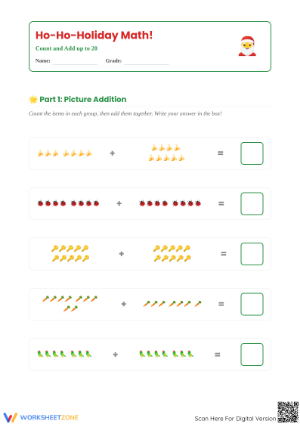
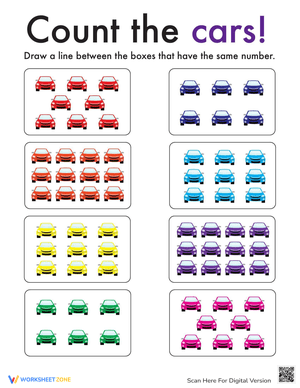
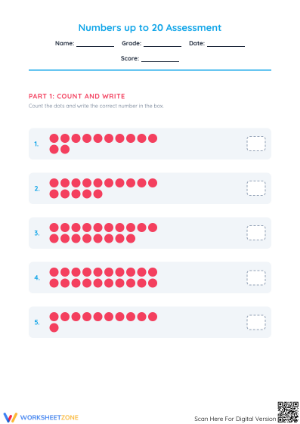
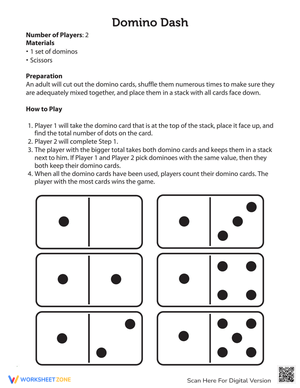
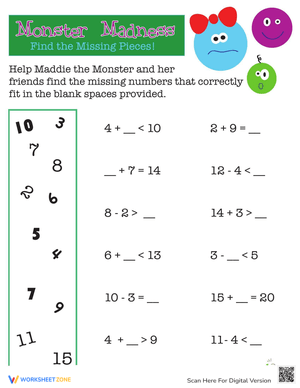
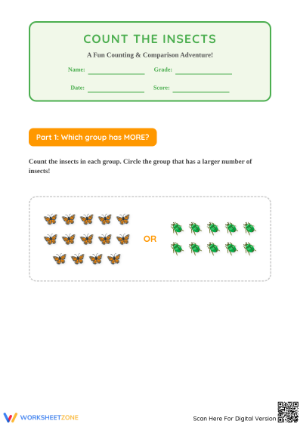
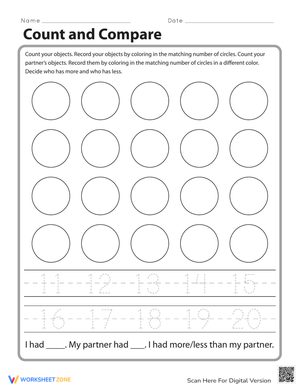
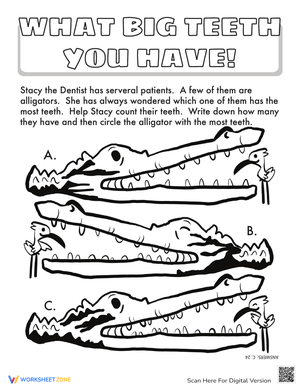
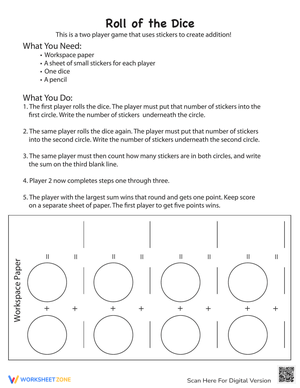
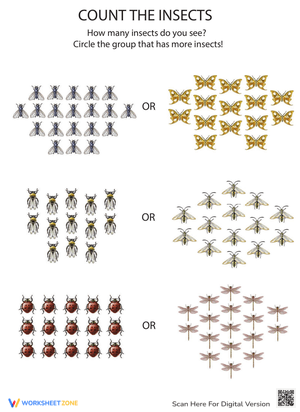
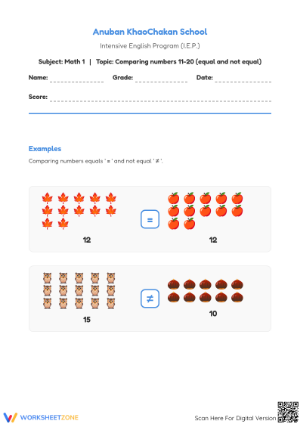
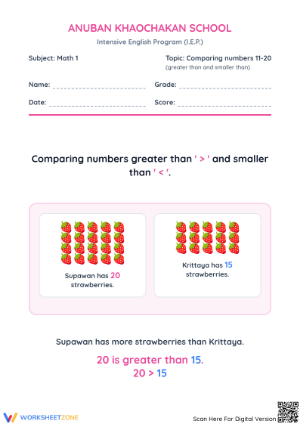
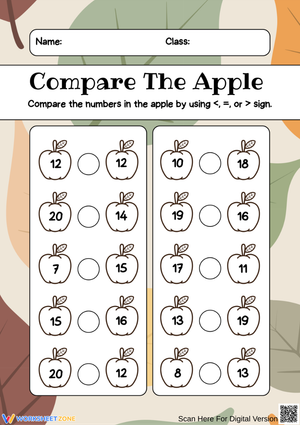
These comparing numbers 11–20 worksheets give kindergarten and first-grade teachers a structured set of practice activities targeting one of the most conceptually tricky ranges in early number sense. The teen numbers sit in an awkward linguistic space — "eleven" and "twelve" carry no audible trace of ten, and "thirteen" through "nineteen" lead with the ones unit before naming the ten — so students need more than exposure to numerals. They need repeated, structured encounters that connect spoken names, symbolic notation, and quantity. Each worksheet in this set builds that connection deliberately.
What Each Worksheet Targets
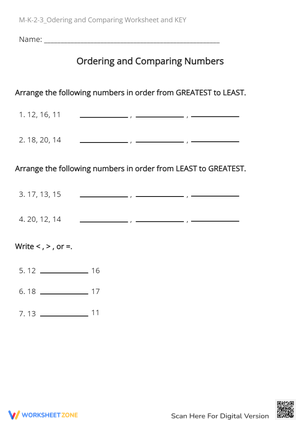
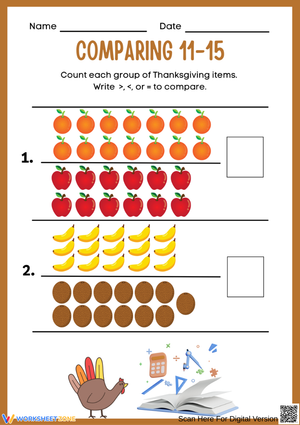
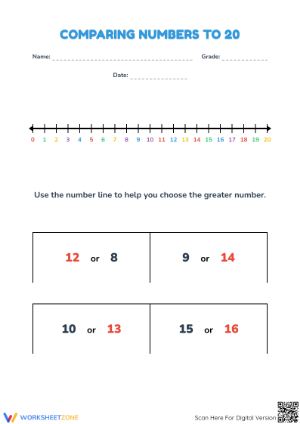
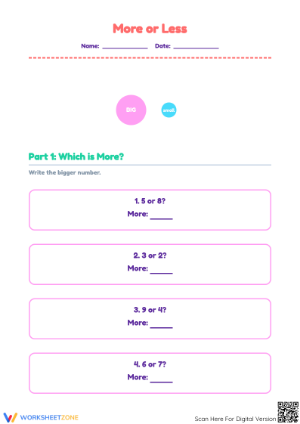
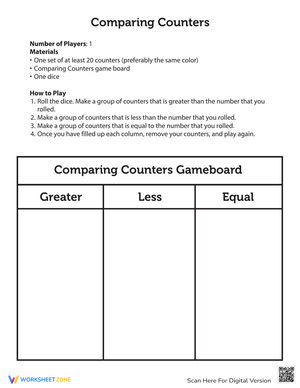
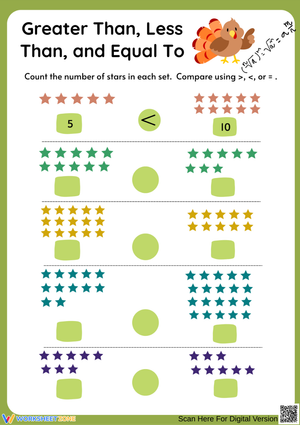
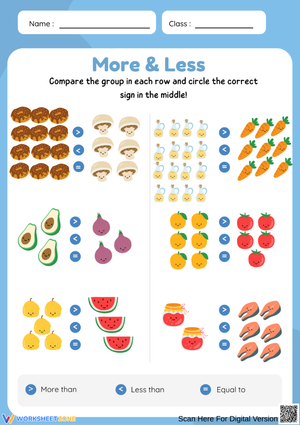
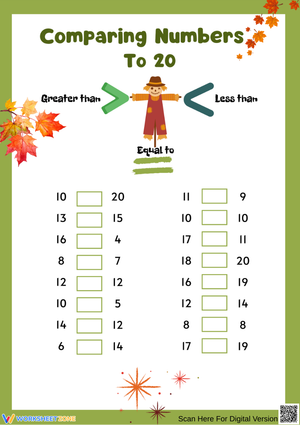
The set covers the comparison skills students need to move confidently through the 11–20 range. Students mark greater than, less than, and equal to relationships between pairs of teen numbers, order sequences of three or four numbers from least to greatest, and interpret ten-frame representations before recording a comparison symbol. Several worksheets ask students to complete a comparison sentence in words ("16 is greater than ____") rather than just placing a symbol, which surfaces whether understanding is procedural or conceptual. Cut-and-paste tasks appear across the set as well — students sort number cards or place comparison symbols — because the physical act of manipulating pieces before committing to an answer slows impulsive guessing in ways that circling or bubbling does not.
Standard Alignment
These worksheets align primarily to CCSS K.CC.C.7, which requires students to compare two numbers between 1 and 20 presented as written numerals. In instructional terms, this standard sits at the end of the kindergarten counting and cardinality progression — students should have worked through rote counting, one-to-one correspondence, and cardinality before comparison becomes meaningful. First-grade teachers use these worksheets as early-year consolidation before students move into CCSS 1.NBT.B.3, which extends comparison to two-digit numbers more broadly. The ten-frame tasks in this set also support K.NBT.A.1, the kindergarten standard requiring students to compose numbers 11–19 as ten ones and some further ones.
Why This Format Works for Teen Numbers Specifically
Teen numbers are the one place in early elementary math where the English number name actively works against place value understanding. Twenty-three at least sounds like "twenty and three"; seventeen tells a student nothing reliable about its structure. Research on cognitive load in early numeracy supports giving students a visual anchor — typically a ten-frame — while they are still encoding the base-ten concept, rather than asking them to hold the structure in working memory while also applying a comparison rule. These worksheets pair the ten-frame image directly beside the comparison task so students can track both numbers' ones simultaneously. Once that scaffolding is internalized, later worksheets in the set remove the frames and present numerals alone.
There is also a developmental reason this skill appears at this grade level rather than earlier: kindergarteners typically consolidate single-digit cardinality around mid-year, which means teen-number comparison belongs in late kindergarten and early first grade — not as review of counting, but as the first real encounter with multi-unit structure. Teachers who introduce these worksheets before students have solid one-to-one correspondence to 20 will see frustration rather than growth.
Frequent Student Errors Worth Watching For
The most persistent error is symbol reversal uncoupled from number confusion — meaning students correctly identify which number is larger but then draw or select the symbol pointing the wrong direction. A student who writes 14 > 17 often knows 17 is bigger; they have simply lost track of which end of the symbol represents "opens toward the greater number." This is a notation problem, not a number-sense problem, and conflating the two leads teachers to reteach quantity comparison when what the student actually needs is more practice with symbol orientation in isolation.
A second error pattern: students who are shown two ten-frame images will correctly count the filled cells in each frame but then compare the total counts as if they were single-digit numbers. A student looking at 13 and 18 may say "three is less than eight, so thirteen is less" — which arrives at the right answer — but will then apply the same logic to 13 and 9 and conclude that 9 is greater because "nine ones" feels like more than "three ones." Watching for this error across the set reveals which students have not yet internalized the teen numbers as "ten plus some ones" rather than as a two-digit string.
Fitting These Worksheets Into Your Lesson Plans
The most effective placement for most of these worksheets is the guided math block, not whole-group seat work. In a group of four to six students, a teacher can watch a student's pencil in real time — noticing whether they count up from one or subitize the ten-frame — and intervene before a wrong strategy calcifies into habit. That kind of diagnostic observation is impossible during independent work across 22 students.
For teachers running math rotations, the cut-and-paste comparison worksheets work well as a center task during the weeks immediately following direct instruction on greater than and less than symbols. The physical manipulation adds enough novelty to sustain engagement for 10–12 minutes without requiring teacher presence. Save the numeral-only comparison worksheets — those without ten-frame supports — for the Friday review block or Monday warm-up, when you want a quick formative check before moving forward. A single worksheet completed in the first eight minutes of math gives a clearer picture of retention than an exit ticket at the end of a lesson, when recency effects can inflate performance.
Frequently Asked Questions
What should students already know before using these worksheets?
Students need accurate rote counting to 20, reliable one-to-one correspondence when counting objects, and working recognition of the written numerals 0–20. They should also have some informal experience with "more" and "fewer" in single-digit contexts. Students who cannot yet identify the numeral 14 on sight will spend their cognitive effort on numeral recognition rather than comparison — at that point, numeral fluency practice is the more pressing priority.
How do I teach the greater than and less than symbols without the confusion sticking around for months?
The "alligator mouth" analogy is widely used and genuinely helpful as a first entry point — the open side faces the larger number because the alligator eats as much as it can. What the analogy doesn't fix on its own is symbol-drawing accuracy. A practical follow-up: have students place two dots next to the larger number and one dot next to the smaller, then connect them. The resulting lines form the correct symbol every time, and students who draw it themselves internalize the orientation faster than students who only select a pre-printed symbol on a worksheet. Use both approaches together.
Are these worksheets useful for intervention work with older students who have gaps?
Yes, with a framing adjustment. Second or third graders who are shaky on place value foundations often have their gaps traced back to unresolved confusion in the teen number range. These worksheets are appropriate intervention material for that population — the ten-frame visuals are functional at any age, even if the aesthetic feels young. If the visual design is a concern for older students' buy-in, use the numeral-only comparison worksheets from the set rather than the illustrated ones.













 Interactive Worksheet Maker
 Quiz Maker
 Word Search Maker
 Crossword Puzzle Maker
 Word Scramble Generator
 Sentence Scramble Generator
 Handwriting Worksheet Generator
 Name Tracing Generator
 Fill In The Blank Generator