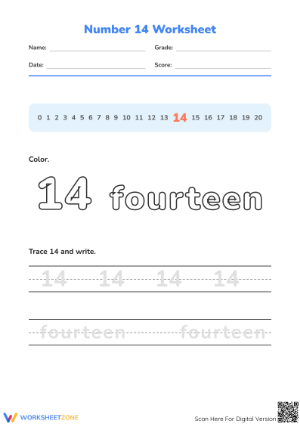
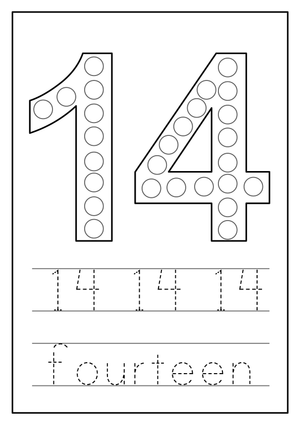
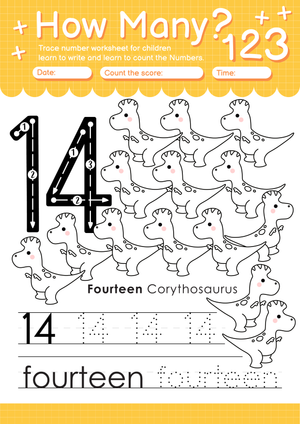
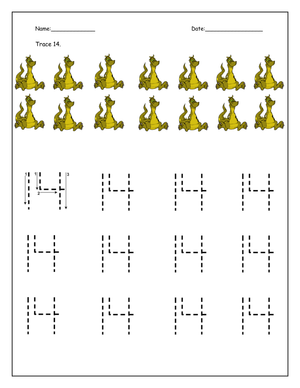
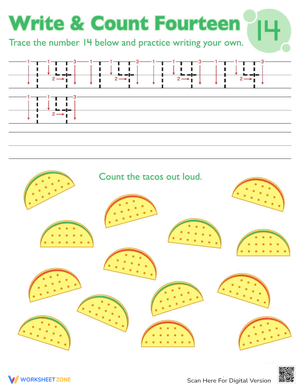
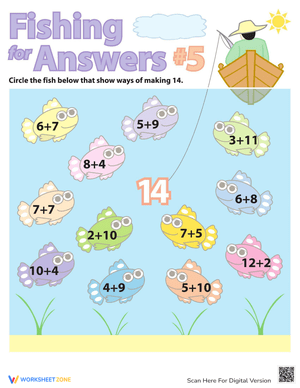
Once students move past counting 1 to 10, the teen numbers introduce a different kind of thinking. Number 14 worksheets are not just another rung on the counting ladder. They ask students to hold two ideas at once: that 14 is one more than 13, and that 14 is also 10 ones plus 4 more ones. For a five- or six-year-old, that second idea is genuinely new. A worksheet built around 14 gives you a repeatable, low-prep way to practice tracing, counting, and place-value reasoning in the same sitting, which matters when small-group time is short and every minute needs to count toward a specific skill.
Counting to 20 Still Matters
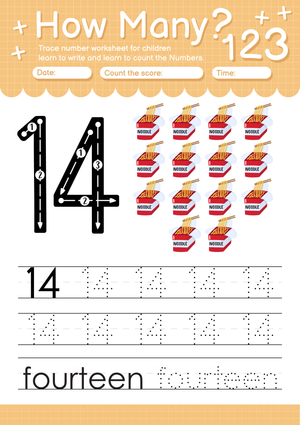
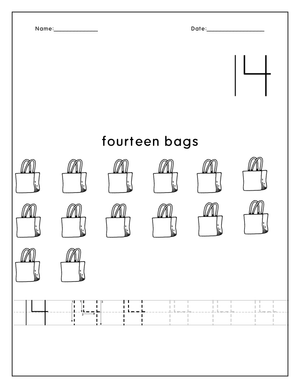
Kindergarten Counting and Cardinality expectations require students to count to answer how many for up to 20 objects, whether arranged in a line, a rectangular array, or a circle. Number 14 worksheets that mix up the arrangement of objects, rather than always lining them up neatly, do more to build true cardinality than worksheets that only ever show a tidy row. A student who can count 14 scattered items in a circle has a stronger grip on the concept than one who has only practiced counting a straight line. Look for worksheet sets that vary the layout from page to page so students are not just pattern-matching a familiar visual.
Formation and Writing Practice
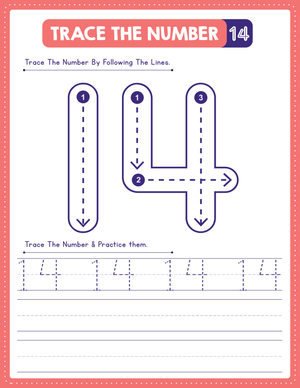
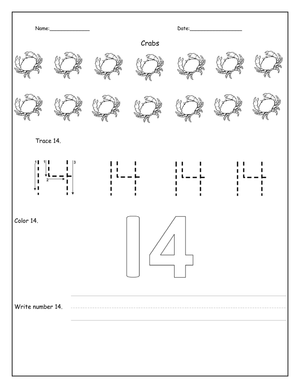
Students are expected to write numbers 0 to 20, and 14 is often where formation errors first show up, since it is the earliest two-digit number many students are asked to produce independently. Reversals of the 1 and 4, or writing them as separate, oddly spaced digits, are common at this stage. Worksheets with directional arrows, dotted-line tracing, and a few independent-write boxes let you catch these habits early, before they become harder to unlearn. A short daily formation routine using a number 14 worksheet, paired with verbal cues like start at the top, straight line down, works well as a warm-up before a math block.
Ten-Frames and Base-Ten Blocks as Companions
Common classroom methods for teaching teen numbers include ten-frames, base-ten blocks, and finger counting, all built around the same ten-plus-some-more structure. Pairing a number 14 worksheet with a physical ten-frame mat lets students build the number with counters before they ever touch a pencil. This sequence, concrete first, then pictorial on the worksheet, then abstract as they write the numeral, follows a well-known progression that keeps struggling students from guessing at answers they do not yet understand. If a student can fill a ten-frame and add four more counters but cannot yet write 14 independently, that is useful diagnostic information, not a failure.
Sequencing Number 14 After 1 to 10 Mastery
Teen numbers like 14 are best introduced only after solid mastery of counting 1 through 10, since teen numbers add place-value reasoning on top of basic counting fluency. If a student is still shaky counting to 10 with one-to-one correspondence, jumping straight to 14 worksheets is likely to frustrate rather than build confidence. A reasonable sequence is to confirm fluent counting and writing through 10, then introduce 11 through 15 as a cluster before moving into the higher teens. Number 14 sits comfortably in that first teen cluster, making it a good early checkpoint for whether a student is ready to progress.
Classroom Implementation
In a whole-group setting, open with a quick ten-frame build: show 10 dots already filled, then ask students how many more to make 14. This primes the ten-plus-four structure before students pick up a worksheet. During small-group or intervention blocks, use number 14 worksheets as a two-part station: one side for tracing and writing, one side for counting scattered objects and circling groups of ten. For formative assessment, a single number 14 worksheet completed independently can tell you whether a student has one-to-one correspondence, correct numeral formation, and an emerging sense of ten-plus-some-more, all from one page. Keep a few blank ten-frame templates on hand so students who struggle can rebuild the number physically before trying the worksheet again.
Frequently Asked Questions
1. What grade level are number 14 worksheets appropriate for
Number 14 worksheets are designed for kindergarten, where teen-number counting and place value are core standards, though they also work well for early first-grade review or targeted intervention for students still building teen-number fluency.
2. How do number 14 worksheets align with Common Core kindergarten math standards
They directly support the Number and Operations in Base Ten expectation that students compose and decompose numbers 11 to 19 into ten ones and further ones, using 14 as 10 plus 4, alongside the Counting and Cardinality expectation to count up to 20 objects accurately.
3. What classroom methods pair well with number 14 worksheets for teaching teen numbers
Ten-frames, base-ten blocks, and finger counting all reinforce the same ten-plus-some-more structure that number 14 worksheets are built around, and using them together before or alongside the worksheet helps students move from concrete to abstract understanding.
4. How can teachers use number 14 worksheets for intervention or review
In small-group settings, number 14 worksheets work well as a two-part task, tracing and formation on one side, counting and grouping on the other, giving teachers a quick way to check counting-to-20 and number-writing skills for students who need more repetition before moving to higher teen numbers.













 Interactive Worksheet Maker
 Quiz Maker
 Word Search Maker
 Crossword Puzzle Maker
 Word Scramble Generator
 Sentence Scramble Generator
 Handwriting Worksheet Generator
 Name Tracing Generator
 Fill In The Blank Generator