What Writing Linear Equations Worksheets Actually Assess
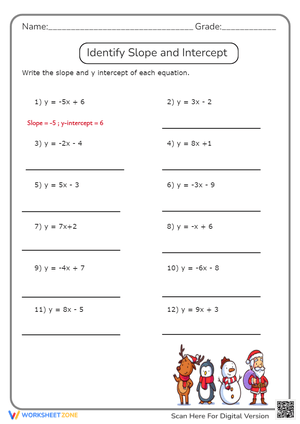
When you hand students a set of writing linear equations worksheets, you're really testing one skill: can they translate a relationship into the form y = mx + b? That relationship might arrive as a slope and a point, two points, a table of values, a graph, or a short word problem. The worksheet strips the task down to that single translation step, so you can quickly see who owns the procedure and who is still guessing. For grade 8 pre-algebra and Algebra 1 review, this is the pivot point where students stop merely reading equations and start producing them from scratch. That shift matters, because every later topic — systems, functions, and modeling — assumes students can write an equation before they analyze one.
The Four Input Types Students Practice
Most writing linear equations worksheets cycle through four input types, and each one demands a slightly different move from the student:
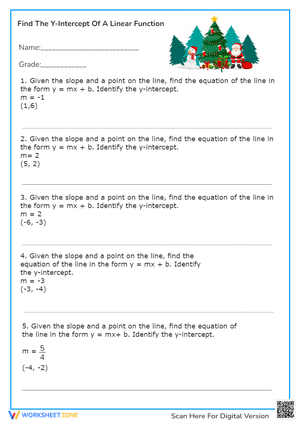
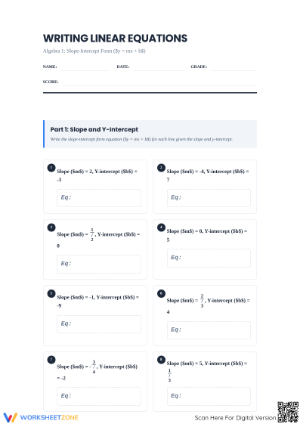
- Slope and a point: substitute the values into point-slope form, then rearrange to slope-intercept form.
- Two points: find the slope first with the rise-over-run calculation, then repeat the point-substitution step.
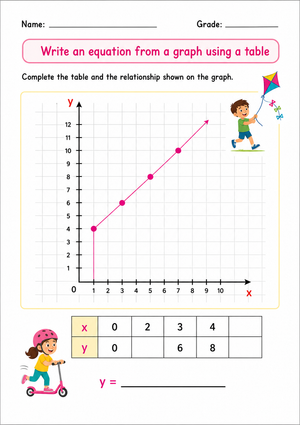
- A table of values: read the constant rate of change between rows, then work back to the y-value where x equals zero.
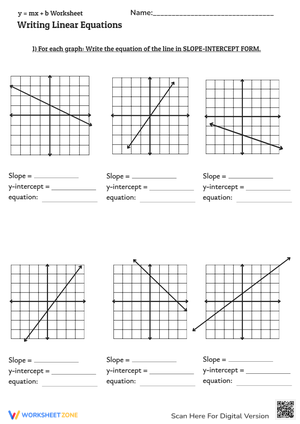
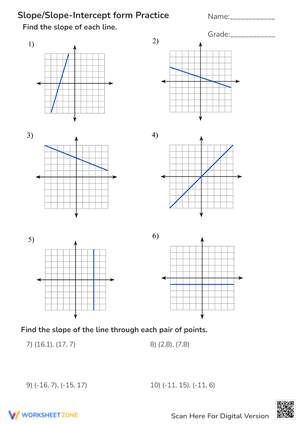
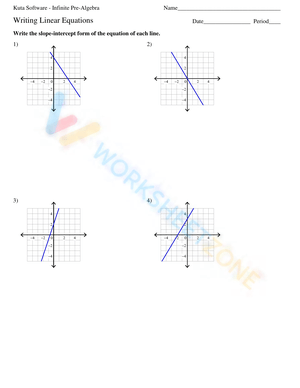
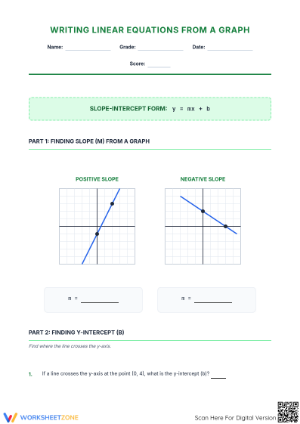
- A graph: count the slope directly off the grid and read the y-intercept where the line crosses the vertical axis.
Students who only ever see one input type tend to memorize a single recipe and freeze when the format changes. Rotating all four inside the same packet pushes them to generalize, so they recognize that every version is the same underlying relationship written from different starting information. That generalization is the difference between a student who passed a quiz and a student who actually understands linear relationships.
How These Worksheets Support the Grade 8 Standards
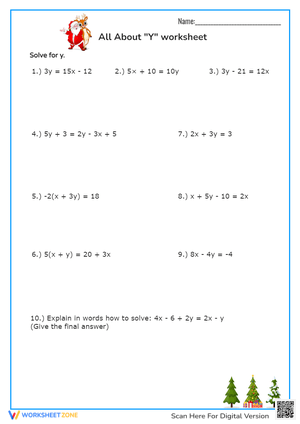
Writing linear equations sits at the center of the grade 8 Expressions and Equations cluster. Before students can write an equation, they need the slope reasoning described in 8.EE.B.6, and before they can isolate y in a messier problem, they need the solving fluency in 8.EE.C.7.b, which explicitly includes using the distributive property and combining like terms. A worksheet that asks students to write an equation is quietly rehearsing both standards at once.
According to the Common Core State Standards Initiative, standard 8.EE.B.6 asks students to derive the equation y = mx for a line through the origin and y = mx + b for a line intercepting the vertical axis at b, making slope-intercept fluency a defined grade 8 expectation rather than an optional extension reserved for advanced students only.
Bridging Grade 8 Practice Into High School Algebra
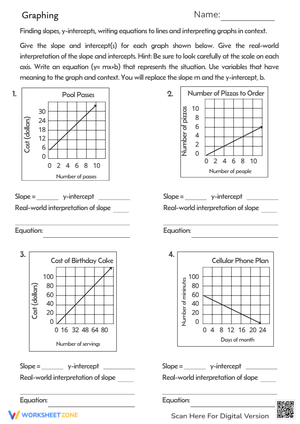
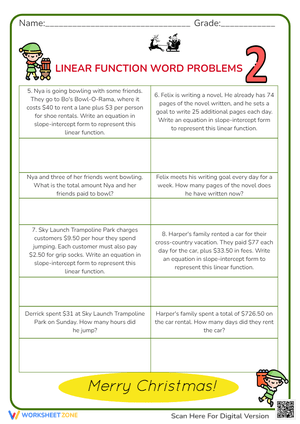
The skill doesn't end in eighth grade. High school standard HSA-CED.A.2 asks students to create equations in two or more variables to represent relationships between quantities and to graph them on labeled, scaled axes. Pairing a writing-equations worksheet with a real-world scenario — cost per ticket plus a flat booking fee, distance covered over time, or a weekly savings plan — makes that jump concrete for students. The equation they write stops being an abstract exercise and becomes a model they can graph, interpret, and use to predict. That is exactly the connection 8.EE.C.8.c and HSA-CED.A.2 are built around, and it's why the strongest worksheet sequences move students from bare numbers toward applied context over the course of a unit.
Classroom Implementation
Short, targeted sets tend to work better than long packets here. A ten-item worksheet that isolates one input type makes a clean exit ticket: if a student misses every two-point problem but nails the graph problems, you know exactly what to reteach tomorrow. Use that signal to sort your next day's small groups instead of guessing.
- Whole-class review: mix all four input types so the class practices choosing a method, not just executing one on autopilot.
- Small-group intervention: hand out single-input sets with the slope pre-calculated, so students can focus their attention on the y-intercept step alone.
- Enrichment: add word problems that require writing the equation first, then answering a follow-up question the equation predicts.
In practice, the input type that trips up the most students isn't two points or graphs — it's the table. A table hides the y-intercept whenever x = 0 isn't one of the listed rows, so students who learned to just read b off the chart stall out completely. Building at least one table per worksheet where the rows start at x = 2 or x = 3 forces students to work backward to x = 0, and it surfaces the exact misconception that a graph-only worksheet would never catch. It's a small design choice that turns a routine practice set into a diagnostic.
Common Student Errors to Watch For
A handful of mistakes show up again and again on these worksheets. Watching for them lets you give feedback that targets the underlying misconception instead of just marking the final answer wrong:
- Flipping the slope ratio, computing run over rise instead of rise over run.
- Dropping the negative sign when a line falls from left to right across the grid.
- Reading the y-intercept as the first y-value listed in a table instead of the value at x = 0.
- Forgetting to distribute after substituting into point-slope form, which is a direct 8.EE.C.7.b skill.
When several students miss the same step, that's your cue to pull a quick small-group lesson rather than reteaching the whole class something most of them already have.
Frequently Asked Questions
1. What grade level uses writing linear equations worksheets?
They fit grade 8 pre-algebra most directly, where 8.EE.B.6 introduces y = mx + b, and they carry into high school Algebra 1 as review or as a bridge toward HSA-CED.A.2 modeling work.
2. What should students know before starting?
Students need to calculate slope as rise over run and solve multi-step equations, including distributing and combining like terms as described in 8.EE.C.7.b. Without those prerequisites, the equation-writing step tends to collapse.
3. How do I use these for intervention versus whole-class work?
For intervention, isolate one input type and pre-calculate the slope so students rehearse a single move. For whole-class review, mix all four input types so students practice choosing the right method for each problem.
4. What errors should I watch for?
The most common are inverting the slope ratio, dropping negative signs, and misreading the y-intercept from a table when x = 0 isn't shown. Each mistake points to a specific step worth reteaching.
5. How do these worksheets connect to word problems and graphing?
Writing the equation is the modeling step. Once students produce y = mx + b from a scenario, they can graph it and answer questions the model predicts, which is the connection at the heart of 8.EE.C.8.c and HSA-CED.A.2.